

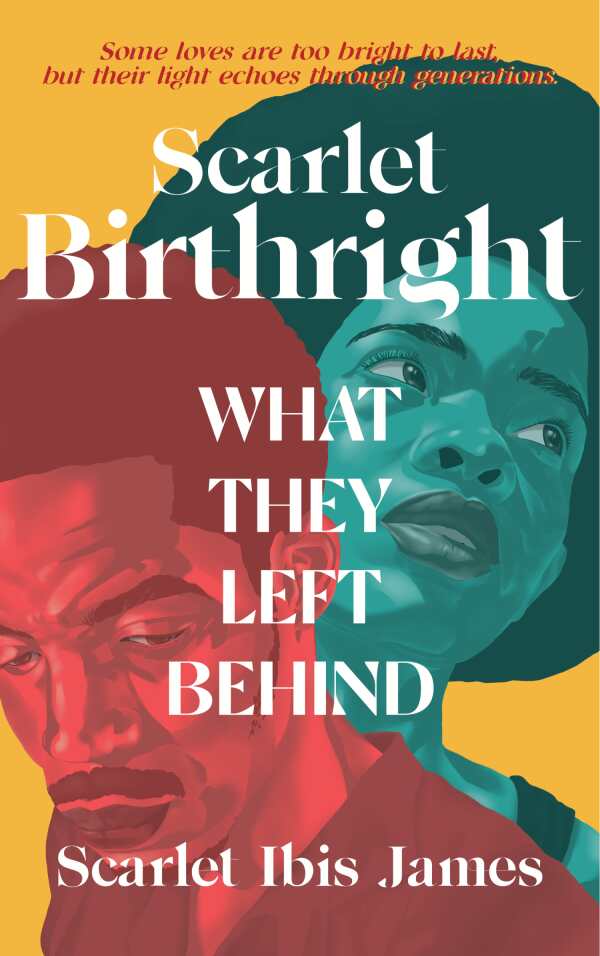
Scarlet Birthright
What They Left Behind
Across a span of decades, people either evade or take risks when it comes to the loves and lives they desire in the affecting novel Scarlet Birthright, about a determined family’s efforts to forgive.
Scarlet Ibis James’s haunting novel Scarlet Birthright is an intergenerational Trinidadian tale.
In 1969, nineteen-year-old Joromi freelances as a DJ in Port of Spain and has trysts with a carefree woman, despite the fact that his father thinks he should settle down. Then Joromi meets Margaret, who plans a mutual future in New York. Joromi goes along with Margaret’s plans even after his previous companion announces her pregnancy,
Across the following decades, the fallout of Joromi’s absentee fatherhood is explored through his family’s multiple perspectives. The chapters assume the forceful clarity and succinctness of a stage play, covering story highlights and using rich conversations to generate momentum. References to dry and rainy seasons are also used to mark the time, while the implied tumult of tropical weather comes to echo the characters’ passionate, fraught experiences. Poetic evocations of island life come via mentions of its scents, music, and rhythmic dialect.
The book’s narrative gaps are a point of distraction, including when it comes to Margaret’s characterization, which is minimized while the book rushes through accounts of Joromi’s flightiness and desire for respectability post-emigration. Indeed, the secondary cast is underdrawn on the whole; most are fleshed out in terms of how they react to Joromi, not on their own merit. His parents raise his daughter in Trinidad; Joromi’s mother considers him a coward but acts in accordance with her duty nonetheless. Joromi’s daughter, Trisha, is cast as bewildered. Further, people’s feelings are stated in quite plain terms, and their explanatory musings have an unnatural quality: Margaret asserts that she “couldn’t see that my fear of losing what I had was making me perpetuate a cycle that had devastated me,” while Joromi has uncharacteristic moments of clarity, such as “Sometimes, love means letting go.”
In the end, the novel’s most compelling elements are its subtle vignettes from Trisha’s point of view. Her childhood memories are poignant, including of her father’s fleeting phone calls. Less involving are a posthumous letter sent in the 1990s and forays into the afterlife, which are too-obtrusive expressions of the book’s intended themes.
A moving family saga, Scarlet Birthright is about fractured family relationships and the healing power of love.
Reviewed by
Karen Rigby
Disclosure: This article is not an endorsement, but a review. The publisher of this book provided free copies of the book and paid a small fee to have their book reviewed by a professional reviewer. Foreword Reviews and Clarion Reviews make no guarantee that the publisher will receive a positive review. Foreword Magazine, Inc. is disclosing this in accordance with the Federal Trade Commission’s 16 CFR, Part 255.


