

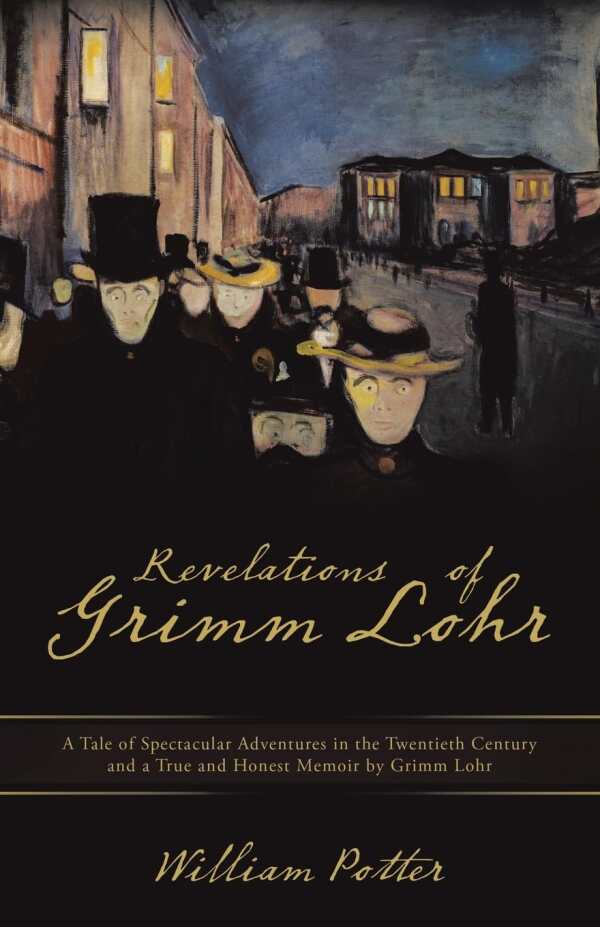
Revelations of Grimm Lohr
A Tale of Spectacular Adventures in the Twentieth Century and a True and Honest Memoir by Grimm Lohr
The witty bildungsroman Revelations of Grimm Lohr is equal parts comedy, horror, and hero’s journey.
A German American man recounts the people, places, and events of his unconventional life in William Potter’s absorbing novel Revelations of Grimm Lohr.
Against the backdrop of the twentieth century, Grimm looks back on his family’s eclectic history and his unusual childhood. His grandfather pioneered the study of human intestinal gases as a physician in World War I; his father, Irving, served as a top-ranking interpreter in the Nazi hierarchy. When Irving did not return from the Battle of Stalingrad, Grimm and his American nurse mother left their missionary work in the South Pacific to settle in Normal, Illinois.
As Grimm grew up, he discovered his love of acting. From there, he headed to Los Angeles to pursue various jobs in the entertainment industry, meeting a plethora of wild and eccentric people along the way. He also met the love of his life, Polly, who harbored a startling secret.
Covering sixty years of his life, Grimm’s bildungsroman is equal parts comedy, horror, and hero’s journey. It fuses double entendres with serious depictions of depravity, as where Grimm spotlights his father’s reluctant Nazi affiliation that put him in the circle of Adolf Hitler and his henchmen. Irving’s own writings portray the evil and debauchery of a typical night on the town with the Führer, where sex and diabolical medical experiments went hand in hand.
Scenes of a disturbing nature abound in Grimm’s father’s experiences. They also appear later in Grimm’s life as he witnesses fantastical technological innovations on the mysterious archipelago Morro Burra, where the ultrawealthy enjoy poolside amenities as they wait on their next bodies. In between the nightmare fuel scenarios are Grimm’s endless and entertaining run-ins with actors, directors, and a stalker with a literal taste for him.
While Grimm narrates with the goal of being as honest in his “replication of the facts” as he can be, this leads to some unevenness. There are lengthy conversations included, their subjects alternating between comedy and introspection, with philosophical, political, and literary disquisitions aplenty. Further, Grimm is an unreliable narrator who includes outrageous elements in his tales, like exploding children, walking heads, and devices that can turn flatulence into energy.
Further, the sheer number of characters is overwhelming, including because their individual histories weave into the tale. This leads to a sprawling novel in which Grimm’s unorthodox experiences are overindulged. He has smart but outlandish takes on American culture and society; he skewers art in the 1970s and 1980s as superficial and shallow. He also ranges beyond his personal catalog of achievements and failures to describe historical events at length, as when he states that the Vietnam War was one in which millions of people are “relieved of their lives.” A sense of a discernible plot dissipates as the book continues, meandering through Grimm’s farcical scenarios.
In the lengthy satirical novel Revelations of Grimm Lohr, the mundane and monstrous events of the twentieth century are filtered through the perspective of a German American man.
Reviewed by
Peggy Kurkowski
Disclosure: This article is not an endorsement, but a review. The publisher of this book provided free copies of the book and paid a small fee to have their book reviewed by a professional reviewer. Foreword Reviews and Clarion Reviews make no guarantee that the publisher will receive a positive review. Foreword Magazine, Inc. is disclosing this in accordance with the Federal Trade Commission’s 16 CFR, Part 255.


