
Jane Smith aka Thistle Fabuloso
An Up Story About Being Down
A misunderstood girl has a dream that guides her toward acceptance from her peers in the upbeat novel Jane Smith aka Thistle Fabuloso.
In Barra Grant’s whimsical novel Jane Smith aka Thistle Fabuloso, an intelligent nine-year-old emerges from a dream in which all her problems have been fixed and decides she can fix them in her waking life too.
When Jane’s parents get a divorce without consulting her, it is the ultimate embodiment of all that is wrong with her life: Her parents and classmates ignore and misunderstand her, the school counselor cries about her own problems during their sessions, she is the tallest child in her class, and she has untamable hair and gigantic feet that make her feel like she doesn’t belong. One night, she has a fantastical dream in which an earthquake tears apart her town, and in which she is impervious to its damage, adopting an alter ego, Thistle Fabuloso. In fact, the earthquake cures her ills, reuniting her parents and convincing her classmates to befriend her when she saves them from a sinkhole. Jane awakens from the dream determined to push her life in the trajectory of this fantasy.
After her dream, Jane articulates the concept of resilience by imagining bouncing a ball against a wall and catching it without looking. This parallels the trial-and-error work of her practicing confidence. When she throws the metaphorical ball when trying to connect with her clueless mother and it rolls back “bounceless,” her disappointment and determination are palpable.
Jane narrates; she is sage and clever, and the prose is sharp and witty because of her perspective. Her two pet fish, for instance, “swim around their bowl all day and never stop to give each other a single glance”; later, when her parents ask how she feels about the divorce, she wonders, “What am I going to tell them? They remind me of my fish?” She is self-deprecating and morose, yet her self-awareness and smart humor are spellbinding. When she tells her mother “The more I get to know you, the more I might find some clues that could help me figure out things like myself,” her wisdom soars. However, Jane, as Thistle, lists a series of rules for her classmates to follow before she rescues them in her dream; the revenge-fantasy elements of her heroic acts diminish their moral potency.
Slips between the past and present tenses, sometimes in single sentences, muddle the prose. The tense issues also lead to false implications, as with “I wish I could’ve spent more time with Bill,” a neighbor, which suggests that Bill has passed away when he has not. There are jarring transitions as well, as when Jane shifts from musing about Bill into a conversation with her mother about the meaning of life.
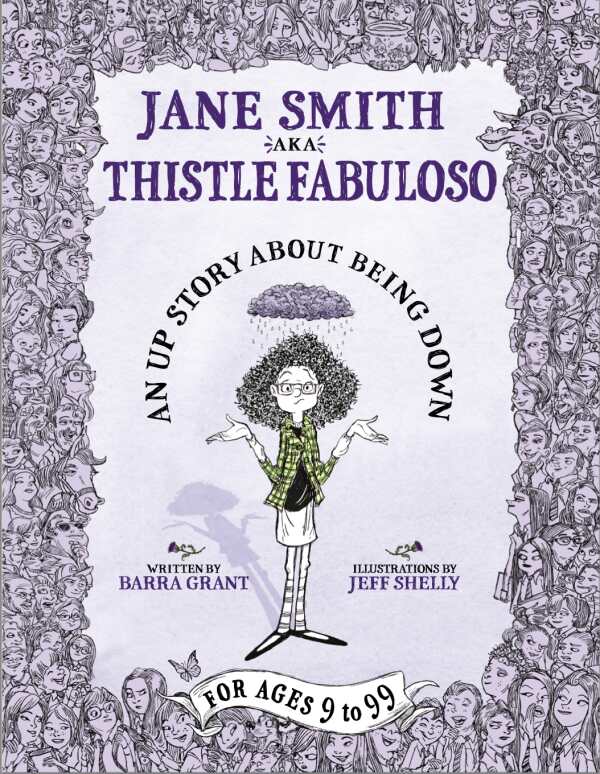
The illustrations render Jane gawky and show her companions in black and white and purple; their moody elements mirror Jane’s sadness. In contrast, the full-color dream illustrations are vibrant, dynamic, and joyful. In covering both waking and dream-state situations, the images are intricate, and their fantasy elements are whimsical and humorous: Jane dons armor while riding a steed and imagines the twenty-four-hour life cycle of the mayfly in terms of human milestones, complete with graduation caps, wedding gowns, and elderly stooped postures.
An imaginative children’s novel, Jane Smith aka Thistle Fabuloso is about resilience and self-confidence.
Reviewed by
Aimee Jodoin
Disclosure: This article is not an endorsement, but a review. The publisher of this book provided free copies of the book and paid a small fee to have their book reviewed by a professional reviewer. Foreword Reviews and Clarion Reviews make no guarantee that the publisher will receive a positive review. Foreword Magazine, Inc. is disclosing this in accordance with the Federal Trade Commission’s 16 CFR, Part 255.


