

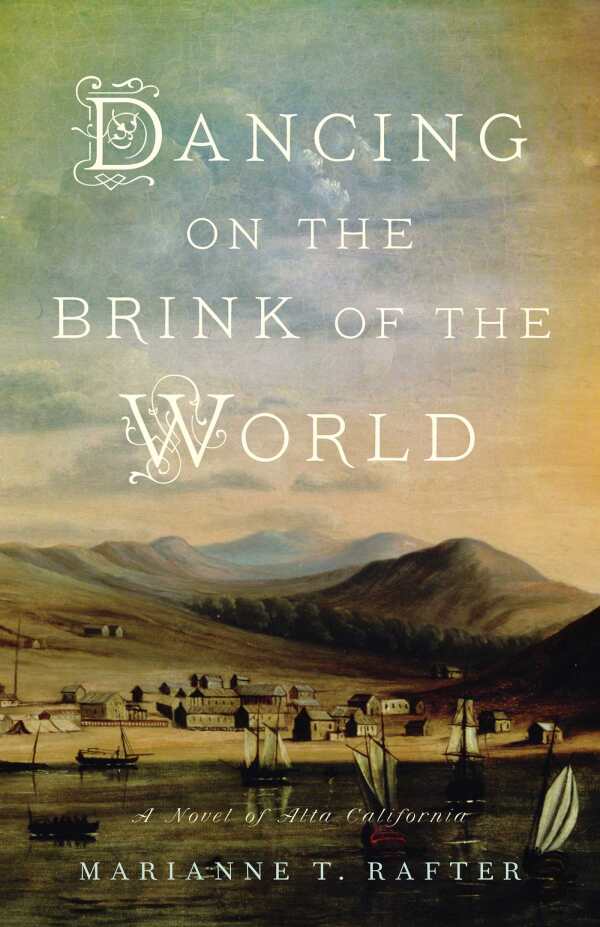
Dancing on the Brink of the World
A Novel of Alta California
In the vivid historical novel Dancing on the Brink of the World, a man comes into his own in a place teeming with frontier potential and multicultural influences.
In Marianne T. Rafter’s intriguing historical novel Dancing on the Brink of the World, a British seafarer starts a new life in Alta California.
This biographical novel about William A. Richardson, an Englishman whose entrepreneurial settlement is part of the San Francisco Bay Area’s history, begins with his arrival in 1822 aboard a whaler. Richardson learns about the Presidio, a Spanish fort that came under Mexican rule, when his ship captain sends him there to ask the Presidio’s commander, Martínez, for provisions. Invited to a dance, Richardson is beguiled by Martínez’s daughter María. When his delay in reporting back to his captain results in a fight, he loses his job—and an opportunity for adventure arises.
Richardson’s efforts to join the remote, bustling outpost are covered in vivid terms. A stranger in a new land, he notices illuminating details about Alta California and has edifying conversations with Californios (descendants of Mexican or Spanish settlers from before California was granted statehood) and Indigenous Ohlones and Miwoks that reveal additional information. However, some of his exchanges are too expository.
Short topic-driven chapters chronicle the stages of Richardson’s journey toward prosperity. But the narrative’s drive to encompass the highlights of Richardson’s life also makes its pace quite clipped at times, and leads to isolated sketches about community life (such as a bear versus bull fight) that don’t wend into his ultimate story well, though they do help to establish the habits of the people he meets. More central developments, such as Richardson’s work teaching carpentry and shipbuilding at Mission Dolores, are summarized in brisk terms.
Further, Richardson’s decision to court María is not explored beyond their chance first meeting. They have a few chaperoned encounters, but insights into who she is are sparse. Practical matters, including his Catholic conversion, are skimmed over, undercutting suggestions of his ambivalence. The couple’s marriage is rushed through, too, and María’s family members are supportive but not well fleshed out.
The setting is developed in evocative terms, though, through clear prose sprinkled with occasional Spanish words. There are details about ranchos, Russian hunters, and the region’s Mexican governance. As such, Alta California is vivified as a place teeming with frontier potential and multicultural influences. Peripheral darker moments, like friars’ punishments of Native Americans, are also mentioned, thus keeping Richardson’s view from becoming too wide-eyed.
Richardson begins the novel as an impetuous figure, but he matures as he explores the coast. Through cargo-related enterprises, his prospects improve, and his family with María grows. They establish themselves in Yerba Buena, facing some wilderness dangers along the way. Brushes with violence around California’s annexation to the United States round out the regional history, with the story culminating with cautious hope.
A forthright, revealing historical novel, Dancing on the Brink of the World evinces a man’s keen determination to make a life for himself in California.
Reviewed by
Karen Rigby
Disclosure: This article is not an endorsement, but a review. The publisher of this book provided free copies of the book and paid a small fee to have their book reviewed by a professional reviewer. Foreword Reviews and Clarion Reviews make no guarantee that the publisher will receive a positive review. Foreword Magazine, Inc. is disclosing this in accordance with the Federal Trade Commission’s 16 CFR, Part 255.


