

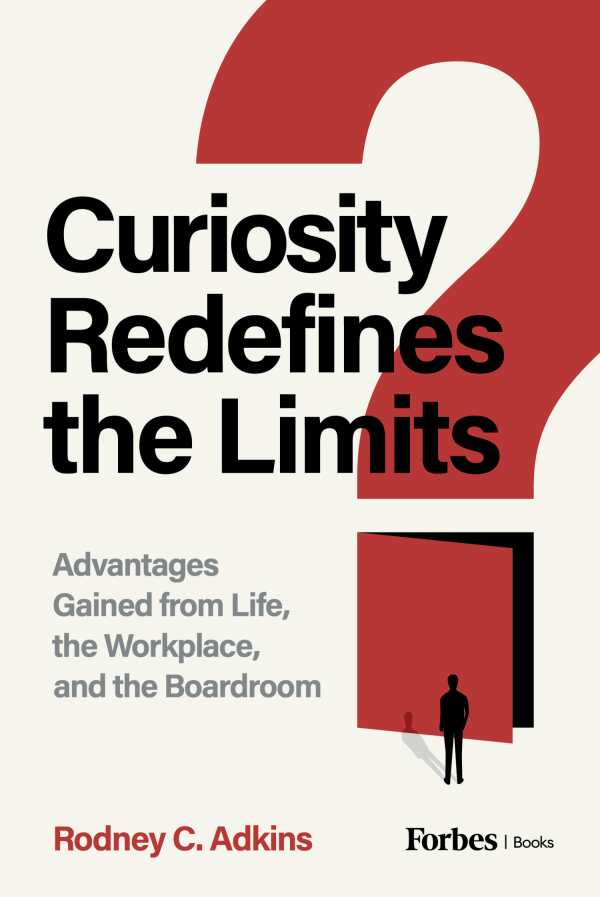
Curiosity Redefines the Limits
Advantages Gained from Life, the Workplace, and the Boardroom
An inspiring memoir that models intellectual curiosity, Curiosity Redefines the Limits celebrates individual achievements and community impacts.
Rodney C. Adkins’s memoir Curiosity Redefines the Limits chronicles four decades of technological leadership, arguing that intellectual curiosity provides a competitive advantage.
Born prematurely in the 195Os in Georgia, Adkins pursued martial arts training in Miami and two college degrees. For over three decades, he worked at IBM, his career spanning desktop computing and supercomputers; the book’s information related to that formative period, from the evolution of computing from the 1981 IBM PC launch through Watson’s 2011 Jeopardy victory, holds attention. After his retirement, he served on the boards of multiple Fortune 500 companies and engaged in philanthropy, endowing scholarships, funding a Rosa Parks sculpture, and supporting the Smithsonian’s African American History Museum.
Attributing his success in part to his constant curiosity, the book encourages seeking new ideas, adapting to the unknown, and challenging the status quo. Fifteen defining moments in Adkins’s life are held up as proof of “the curiosity advantage”—for example, he overcame his teachers’ limited expectations; he also navigated health scares. In addition, three operating principles are named: speed acting with balance, focus, and timing; addressing challenges with respect; and seeking wisdom through others. Indeed, the book takes frequent pauses for Adkins to credit his mentors, family, and colleagues.
While the book’s early episodes serve to ground its abstract business concepts in concrete experience, its shift from personal stories toward prescriptive career guidance is jarring. Indeed, it jumps from vibrant stories to analytical frameworks, as with the enumeration of nine career roles, habits like “lifting as you rise, not when you arrive,” and calculated risk-taking strategies. It encourages audiences to focus on adaptation strategies in the face of challenges rather than fostering grievances, too, modeling resilience well. Indeed, it does an able job of rendering complex technical and corporate concepts accessible, including RISC architecture, Moore’s Law, and semiconductor fabrication processes.
The book’s advice related to career development covers topics as ranging as positioning oneself for board seats and mastering situational leadership, all covered in conversational prose marked by direct, declarative sentences that prioritize communication over style. Details related to product code names, and with exact meeting dates and unnecessarily quantified achievements sometimes crowd it, but its metaphors are keen, as where it compares a role during IBM’s strategic shift toward software and services to playing left tackle in football, protecting the quarterback from the blind side. Its handling of issues related to race is also nuanced, as with its recollections of Adkins fielding microaggressions and experiencing isolation. And its quirkiness is engaging, as with Adkins’s account of his obsession with the number three and with the inclusion of silhouette sketches.
Half memoir, half career guide, Curiosity Redefines the Limits demonstrates how sustained intellectual curiosity drives achievement across the technical, leadership, and civic domains.
Reviewed by
John M. Murray
Disclosure: This article is not an endorsement, but a review. The publisher of this book provided free copies of the book and paid a small fee to have their book reviewed by a professional reviewer. Foreword Reviews and Clarion Reviews make no guarantee that the publisher will receive a positive review. Foreword Magazine, Inc. is disclosing this in accordance with the Federal Trade Commission’s 16 CFR, Part 255.


