

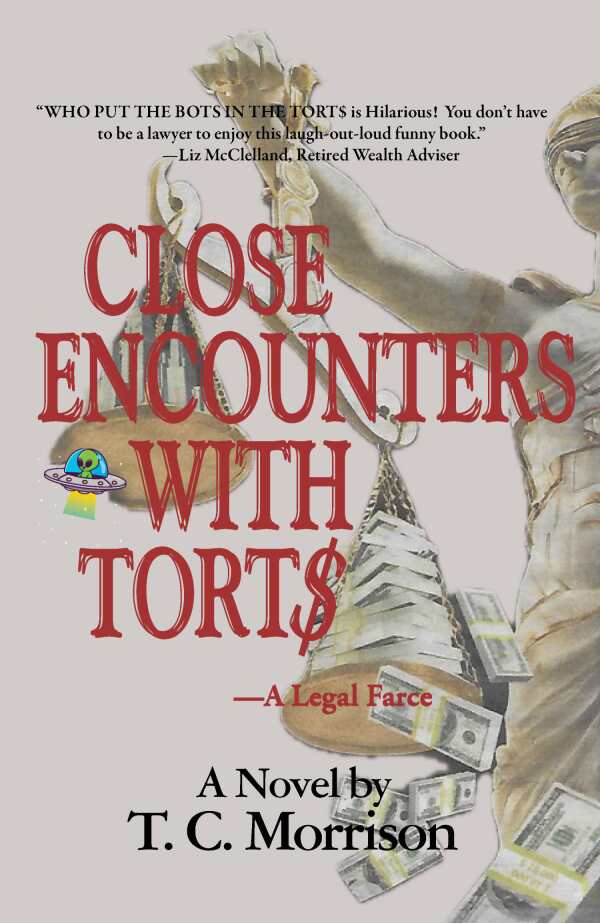
Close Encounters With Tort$
A Legal Farce
Theatrical lawyers navigate an elaborate government scheme in the jovial satirical novel Close Encounters with Tort$.
In T. C. Morrison’s energetic satirical novel Close Encounters with Tort$, courtroom absurdity and contemporary conspiracy theories are used to lampoon the American legal system.
The story follows twin lawyers Patrick and Prescott—known as Pap and Pup—as they navigate an elaborate government scheme. When their neighbor, Mona, is arrested by the FBI for her documentary about mysterious drone sightings over New Jersey, the CIA recruits the brothers to file a $400 billion lawsuit alleging that Russian spy drones compromised US military systems. However, the lawsuit is a smokescreen, buying time for the government to develop countermeasures without alerting Russia to the extent of the breach. Meanwhile, a disastrous remake of a classic children’s movie becomes entangled in the proceedings, leading to a massive class-action settlement.
The narrative careens among federal courtroom proceedings, Monday morning staff meetings filled with cultural commentary, and preposterous legal machinations. Its alternating storytelling methods result in intentional tonal whiplash. The extended courtroom transcripts are procedural; in office scenes, lawyers debate and bicker, critiquing pretentious art and space tourism. While amusing, these detours disrupt the narrative’s momentum. Further, the Russian spy drone case is interrupted by lengthy tangents on topics whose connections to the plotline are too loose.
The twins balance each other: Pap handles their theatrical courtroom performances while Pup manages their legal strategy. Their dynamic is consistent, and their interplay is comical. A former CIA operative–turned–judge adds additional opportunities for courtroom banter, while Mona’s outlandish documentary projects and conspiracy theories add texture. Still, Mona is not developed beyond her role as a wealthy neighbor who’s prone to wild theories.
The prose is brisk and utilitarian, leaning into conversations and action. Situating descriptions are few, devoted to cursory gestures to courtrooms and offices that are the mere backdrop for the characters’ verbal exchanges. Legal terminology wends in, though also in economical ways. More pronounced is the book’s humor, which builds on evocative juxtapositions and deadpan literalism. For instance, a man calculates that maintaining a banana artwork for a century would require 5,200 bananas, and there are references to President LeRumpe and billionaire Jared Zebos.
The case is resolved in a tidy manner because of a substantial settlement; the book’s geopolitical stakes remain opaque. Indeed, herein, theater matters more than clear outcomes, and the book’s final chapter even proposes yet another absurd venture: sending women clients and staff into space as “Astrohotties.” Closure is avoided; instead, the novel hints at legal adventures to come.
In the amusing legal thriller Close Encounters with Tort$, contemporary events are skewered through an extended courtroom farce.
Reviewed by
John M. Murray
Disclosure: This article is not an endorsement, but a review. The publisher of this book provided free copies of the book and paid a small fee to have their book reviewed by a professional reviewer. Foreword Reviews and Clarion Reviews make no guarantee that the publisher will receive a positive review. Foreword Magazine, Inc. is disclosing this in accordance with the Federal Trade Commission’s 16 CFR, Part 255.


