

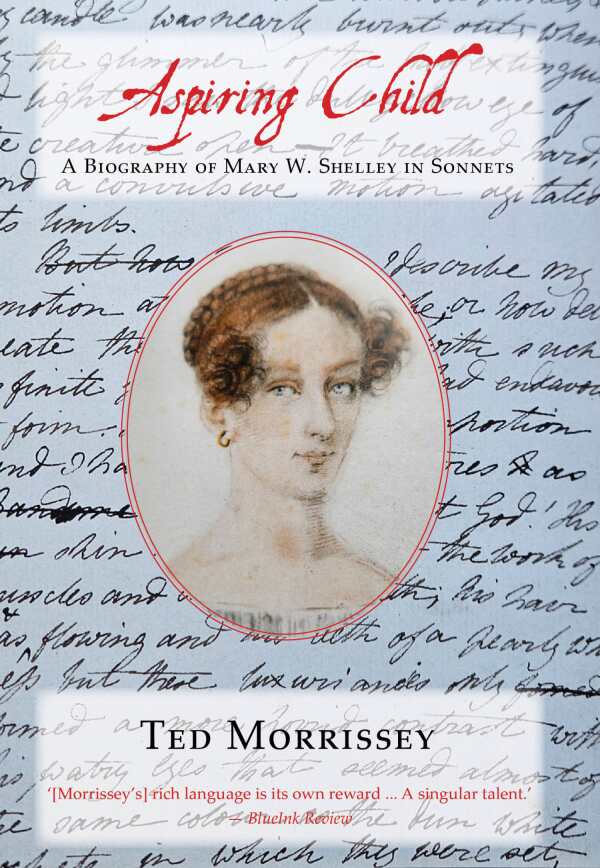
Aspiring Child
A Biography of Mary W. Shelley in Sonnets
An extended love letter to Mary Shelley, the poems and prose in Aspiring Child describe her complex life in depth, heartbreak by heartbreak.
The visceral poems collected in Ted Morrisey’s Aspiring Child are framed as personal letters to Mary Shelley.
The book suggests that Mary Shelley was made up of many layers, and each poem within it addresses her different facets and the events that marked her personal history. From her writing to her politics and the gothic tragedies that she endured, the book recalls the circumstances that shaped her life and legacy using a steady, even rhythm and subtle traces of witty, tongue-in-cheek turns of phrase.
The longer narrative guiding the book’s prose begins with the death of Shelley’s mother, which occurred days after Shelley was born. This is painted as a crucial turning point that marked the rest of her life. The book returns to this event on multiple occasions, both in specific references and by more vague means; its importance is stressed through earnest, sympathetic language. Indeed, the verses themselves tend to mimic Shelley’s signature style of writing: simple yet beautiful, pointed yet nuanced, and gentle enough to be recognized as the words of a proper lady.
In particular, the book narrows in on Shelley’s life as it was in 1823, around the time that her second novel, Valperga, was published. “Resurrection” suggests that the tumultuous and heart-wrenching themes of Frankenstein mimicked how Shelley may have seen herself, especially while it was first being circulated to the public. It also sheds light on how she was likely viewed then versus how contemporary resources depict her:
…Articulate, impassioned
yet rational, advocating for himself and all
the unfairly alienated. Even still, his story
is buried beneath Victor’s and Walton’s.
Was it your voice, at last, bursting forth?
Your eloquence unleashed? Yet entombed
in anonymity, and mistaken for Shelley’s.
It is significant—it is symbolic—that the
creature was quickly stripped of his voice
and his intelligence, 1823, and they have
remained well-kept secrets ever since.
An intimate tone dominates, implying a certain level of familiarity with Shelley’s work and biography. As such, the poems take on a conversational quality despite the fact that their intended recipient died 175 years before their publication. By reaching across time in this manner, the book gives credit to Shelley for what she was able to accomplish in her lifetime while also acknowledging what it cost her to do so and the burdens she hid even from those closest to her.
Poignant and passionate by turns, Aspiring Child is an extended poetic love letter to a celebrated author.
Reviewed by
Katelynn Watkins
Disclosure: This article is not an endorsement, but a review. The publisher of this book provided free copies of the book and paid a small fee to have their book reviewed by a professional reviewer. Foreword Reviews and Clarion Reviews make no guarantee that the publisher will receive a positive review. Foreword Magazine, Inc. is disclosing this in accordance with the Federal Trade Commission’s 16 CFR, Part 255.


