
EXITS — A Literary Phenomenon
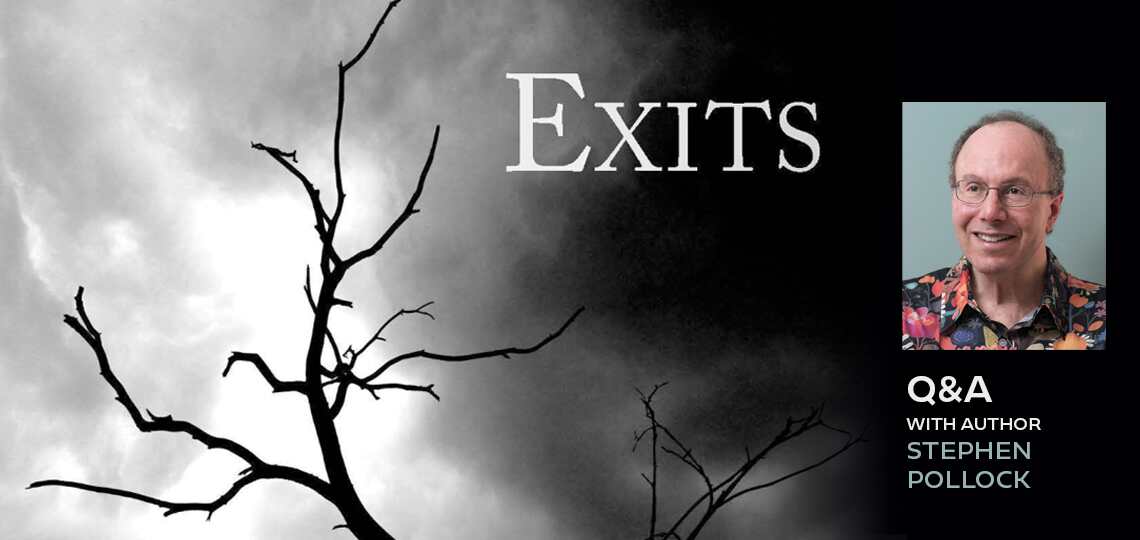
An Interview with Stephen C. Pollock, Author of Exits
For all the waxing and wonder about where poems come from, today’s guest prompts a different question: from where do poets come? Stephen C. Pollock provides us with an intriguing and unique answer. His polymath background — Physician, eye surgeon and neuro-ophthalmologist; Retired Associate Professor at Duke University; Author of numerous scientific papers and book chapters; Inventor and patent holder; and Co-founder and CEO of a nationwide insurance company — reveals an extraordinary mind, but one that gave little warning to the literary world that his debut poetry collection, Exits, would be the intellectual capstone of his multifaceted career.
Exits has been honored with an unprecedented 48 awards in national and international competitions since its publication in 2023, so we at Foreword Reviews are not alone in our admiration. We reached out with a few questions from Foreword’s Camille-Yvette Welsch, and Stephen was kind enough to respond.
What is the organizing principle of Exits?
The poems in Exits explore several closely related themes. These include the beauty and frailty of life, the cycles of nature, the transience of our biological selves, and the promise of renewal.
By definition, an exit is a departure, an act of leaving. But it can also refer to a portal through which humans and other living things pass from one place to another. This latter sense calls to mind the transformations that occur throughout the natural world. There are many such transformations in Exits. Indeed, the title of the book is plural because the poems address a wide range of endings and beginnings.
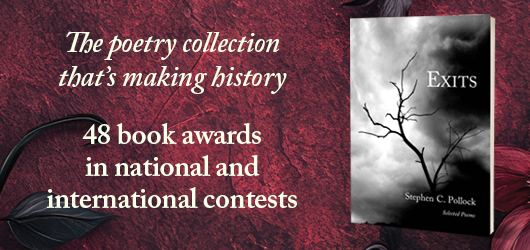
The cover photograph suggests, paradoxically, that death and dying are integral aspects of life. It also teases the reader with its ambiguity. Is the leafless tree dead or merely dormant? Do the ominous clouds portend a storm? And when the rain finally comes, will it precipitate the resurrection of a green canopy or leave the branches bare?
We live in a time of great uncertainty. War, contagion, famine, and climate change have led many to contemplate the prospect of death. Exits speaks to this anxiety and angst. It dovetails with the prevailing zeitgeist.
How do you think your opening poem, “Arachnidæa: Line Drawings,” introduces the primary themes of your collection, including the fleeting nature of life, the inevitability of death, and the balance in nature?
The impulse for me to write can originate from a variety of sources: from a dream; from a vague thought or idea that percolates to the surface from somewhere in the subconscious; or from a particularly compelling or disturbing personal experience. But my most common sources of inspiration are observations of natural phenomena that seem to possess metaphorical value. This was true of “Arachnidæa.”
One warm August night, a beige and brown orb weaver spider built a web across the window of my exercise room. The site was brilliant, both in terms of radiance and in light of the spider’s strategy. Winged insects seeking illumination encountered instead an invisible web and became entangled, inextricably, in its sticky silken threads. Each captive soon fell prey, and every night, death would choreograph a new ballet.
Despite initial reservations about my visitor’s predations, I became accustomed to her presence and even looked forward to her company, though as the days grew shorter and fall felt fit for a first freeze, I knew that she too, in due time, would die, and I pictured the abandoned web as a lace veil on a lightless sky.
The web in the window led me to dwell on the prospect of my own demise. But the impetus to write only materialized when I started to see, embedded in the web’s geometry, a raft of ways to cope with my own mortality. The uncanny aptness of web metaphors auditioning for parts inspired me to draft “Arachnidæa: Line Drawings.”
The first word of the title, Arachnidæa, doesn’t appear in any dictionary. It’s a made-up word, a neologism built on the Greek root arakhnē for spider and/or spider web. To my ear, Arachnidæa sounds like a compendium of sorts, an encyclopedia of things imbued with arachnid properties. The character æ, referred to as a ligature or ash, was incorporated to exploit its aura of antiquity.
The secondary title, Line Drawings, weaves together three strands of meaning: the lines of a web, lines of poetry, and renderings in pen and ink. The latter sense reflects the visual imagery that appears in each section of the poem.
Readers may be surprised to find that “Arachnidæa” contains no explicit references to spiders (apart from the title). Even so, the narrative voice frequently speaks in the second person, which seems to suggest an implicit presence. Could the “you” of the poem be a spider? Or is the speaker engaged in a soliloquy with his or her own psyche, channeling some vestigial link to a phylum far away on the evolutionary tree?
You have chosen to include drawings and photographs with the text. How do you think the use of images enhances the poems?
The decision to include visual art was an intuitive one. I sensed that many of the poems would resonate in interesting ways with visual images and that this would enhance the reader’s experience.
While a few of the images were selected solely for illustrative purposes (e.g., the image of a goldfinch and a coneflower accompanying “Seeds”), most were chosen because they offered alternative slants on the content of the poems. Though the poem “(eclipse)” drips with erotic innuendo, it’s paired with the image of a 1908 patent for an orrery, a mechanical device that replicates the motion of the Earth around the sun and the moon around the Earth. The sonnet “Nasal Biopsy” is ostensibly about a surgical procedure, but a photo of a cathedral door was chosen to accompany the poem because the speaker perceives gothic architecture in the anatomy of the nose and because the poem is ultimately concerned with questions of faith.
Your poems embrace a lot of sound work, particularly interior rhyme, assonance, and consonance. How does that speak to your overall aesthetic?
Form is as old as poetry itself. It’s part of the oral tradition. Formal elements related to sound and meter excite the human psyche across all ages and all cultures. Even young children respond to rhyme and repetitive rhythms with both joy and the impulse to move in concert with the tempo.
In poetry — to a much greater degree than in prose — sonic effects are inextricable from meaning. The close marriage of sound and sense obligates the poet to remain hypervigilant with respect to word choices. The substitution of one word by a so-called “synonym” having different consonants, different vowels, and a different accent structure can profoundly alter both the tone and the semantics of a line.
(As an aside, this author subscribes to the view that no two words share the exact same meaning, that the combination of different sounds and different etymologies imbue each word with a unique set of connotations and associations. Synonyms do not exist.)
The received form that most commonly appears in my work is the sonnet, probably because of its musicality and because it often surprises the reader with a change in perspective or an unexpected twist at the end. While some of my sonnets obey traditional conventions, others employ more challenging rhyme schemes and/or syllabics (i.e., a prescribed number of syllables per line, as in the sonnet “Seeds”). This raises the stakes, but it also increases the potential for enjoyment if the diction retains its natural inflections and fluidity, the syntax remains undistorted, and the formal elements seem to materialize as if by coincidence (what Frost famously described as “riding easy in harness”).
In most of my longer poems, formal elements coexist with free verse. The role of meter and rhyme in these “hybrid” works varies, but includes irony (when blended with darker content), humor, and maximizing the impact of a closing line.
I find form to be paradoxically liberating. Word choices and ideas that would never have bubbled up into consciousness are often suggested by the very constraints that define the form. Indeed, I find free verse much more difficult to write than formal verse, mainly because free verse requires that I create the desired tone, rhythms, and sonic effects organically and without a safety net.
Which poem do you think might serve as an ars poetica for you?
It can be challenging to judge one’s own work objectively. That said, with respect to Exits, “Syringe” may be the most original, multilayered, and technically accomplished poem in the collection. Composed over the decade from 2009 to 2018, it was shortlisted by guest judge Liz Berry in the Live Canon International Poetry Competition and was subsequently published in Live Canon Anthology. Though the poem doesn’t directly address the art of poetry or the nature of the art form — the widely accepted criterion for a bona fide “ars poetica” — it nevertheless exemplifies several of the qualities championed by authors of such works, from Horace (65 BC to 5 BC) to Archibald MacLeish (1892 to 1982).
First and foremost, “Syringe” was crafted as an independent work of art. It is, as the cliché goes, art for art’s sake. Neither the author’s background nor the author’s intent are germane to the reader’s experience (though both influenced the poem’s content). Similarly, the poem wasn’t created for public consumption, and it eschews contemporary trends in poetry. During the writing process, the intended audience was always me, or, to be more precise, the facsimile of me that constantly looks over my shoulder and critiques every word I draft. The word ecstasy comes to mind. It captures the elation I feel when a line finally comes together, but it derives from the Greek ek-stasis — to stand outside of oneself.
“Syringe” is divided into three parts. It draws on the Greek myth of Syrinx as recounted in Book One of Ovid’s Metamorphoses. It also delves into the experience and pathophysiology of multiple sclerosis (MS). Parts I and III feature a narrator (the “I” of the poem). Part I opens as the speaker is using a syringe to draw up medication:
“These marks, my metric
of defiance and decline,
gauge a meniscus as the lumen fills
with fresh platoons of synthetic drug,
game as ever to deploy.’’
Part III also describes the unsuccessful effort to conquer the disease:
“I return to burned-out husks
the columns collapsed
the cry of syllables huddled in shelters
each vowel a child dragging its feet.’’
The extended middle section, Part II, defies conventional interpretation. Is it a drug-induced hallucination? A dream? A temporal lobe seizure? Or some other dissociative state? Many of the lines are multilayered, addressing both of the main themes simultaneously. For example, at the end of the first stanza, the poem seems to be alluding to the transformation of Syrinx into hollow reeds near the edge of a pond:
“… by the water’s edge
a stand of reeds — horsetail, I surmise, cauda equina—
piercing the surface like needles.’’
However, a neurologist reading those lines would recognize that: a) “cauda equina” may refer to the bundle of nerve roots that emanate from the lower spinal cord; b) the “water” of the water’s edge may be the spinal fluid that surrounds those nerves; and c) the needles piercing the surface may represent a lumbar puncture, a procedure often performed to confirm a diagnosis of MS.
The final stanza of Part II — configured on the page as a feminine silhouette — is similarly ambiguous. It ostensibly describes a scene of seduction, yet the same lines accurately describe the process of nerve fiber demyelination.
Finally, I’d be remiss if I failed to point out that the metaphors of the poem often blend at their borders. Here, a partial image of a syringe — the plunger — is applied to an arcadian landscape:
“No plunger
drives the sun to its zenith,
retracts the shadows of trees,
pressures the breeze
to be wind’’
Your poems pull from myths like Narcissus and Syrinx as well as references to music and literature. This creates a compelling intertextuality. As a writer, how does this fuel your creative process?
My creative process — if one can call it that — is sporadic and undisciplined. In contrast to most other poets, I lack the ability to sit down daily at my desk and call forth ideas and/or personal experiences to serve as the basis for new poems. Nor have I ever relied on writing prompts or workshops to prime my poetry pump. The unpredictability of this approach means that I never know when the next poem will materialize.
Once I begin writing, however, I become intensely focused. I typically begin as I did in childhood, with pencil and paper. After sketching out a preliminary concept or drafting several pages of auspicious words, phrases, or stanzas, I transition to composing on a laptop. When fully engaged and maximally productive, my efforts typically yield four new lines of poetry per day (derived from perhaps a dozen pages of notes and drafts).
It’s true that mythology, medicine, music, and literature find their way into many of my poems. But as to whether these subjects inspire creativity, I’m ambivalent. It may be more accurate to say that these intellectual materials are selectively employed to achieve the overarching objective of my work, which is to leave behind a small oeuvre that touches on truth and beauty.
Camille-Yvette Welsch


