
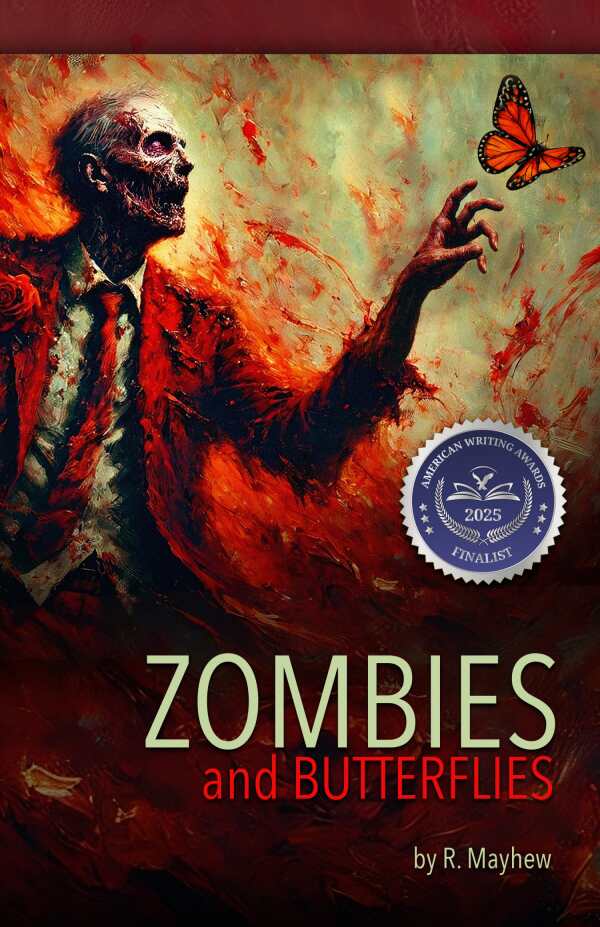
Zombies and Butterflies
Mysticism, spirituality, popular culture, and science coexist in the brief self-help text Zombies and Butterflies, which prizes notions of interconnectedness.
Robert Mayhew’s succinct spiritual self-help book Zombies and Butterflies combines science and faith into its novel recommendations for pursuing harmony.
This brief book urges contemplating the interconnectedness of people, the incredible power of kindness, and the ability to reconcile faith and doubt. It says that people and corporations should take radical responsibility for their actions and inactions, rewriting their narratives to become free instead of remaining in spiritual infancy:
With all that is within me - from my heart to yours- I want you to know you are unique the way you are. I want you to feel special, because you are. I want to make you feel worthy, because to me, you absolutely are! By all that governs the universe, and with a heart so kindred, I want you to know that I would no more hurt your heart than I would my own.
Despite its limited space, the book includes elements of fiction, creative nonfiction, self-help, spiritual writing, and poetry, defying genre expectations. Both scientific knowledge and spiritual beliefs are brought into play, with the chemical realities of ionic and covalent bonds explored alongside the intangible possibility of a creator. Mysticism, spirituality, popular culture, and science coexist herein.
Quotes from Marcus Aurelius, Jean-Jacques Rousseau, Theodore Roosevelt, and Victor Hugo also appear, diluting the book’s original work. It makes an effort to braid and blend a wide variety of philosophies together throughout its pages, drawing sometimes tenuous connections between them. This work is done in order to comment upon how all of the incorporated philosophies apply to the book’s vision of the inner world of the mind and the soul.
The prose is overly ornate early on, impeding engagement; it becomes clearer as the book progresses. In one early passage, for example, an imagined story likens trench warfare to the internal wars waged within each individual; this leads into the assertion “The largest battlefield on this earth is found inside each and every one of us, our hearts.” An overabundance of similes and mixed metaphors weakens the book on the whole, though: In a single sentence, men on the battlefield act “like gazelles with adrenaline-filled veins,” frightened by gunfire and moving “like the orchestra conductor waving his baton.”
The book further compromises its delivery by beginning with the author’s disclaimer: Audiences should “not … believe anything I’ve written, but rather … prove or disprove it for yourself.” This casts immediate doubt upon its ranging tapestry, which depicts life through myriad lenses to complement the central notion of interconnectedness. Indeed, in its quest to make meaning of it all, the book involves too many disparate disciplines, proposing but not sufficiently expanding upon supposed connections between science, culture, faith, and people.
Zombies and Butterflies is an encouraging but wide-ranging self-help book that proposes kindness, care, and self-compassion as the core guiding principles of a life well lived.
Reviewed by
Caitlin Cacciatore
Disclosure: This article is not an endorsement, but a review. The publisher of this book provided free copies of the book and paid a small fee to have their book reviewed by a professional reviewer. Foreword Reviews and Clarion Reviews make no guarantee that the publisher will receive a positive review. Foreword Magazine, Inc. is disclosing this in accordance with the Federal Trade Commission’s 16 CFR, Part 255.


