

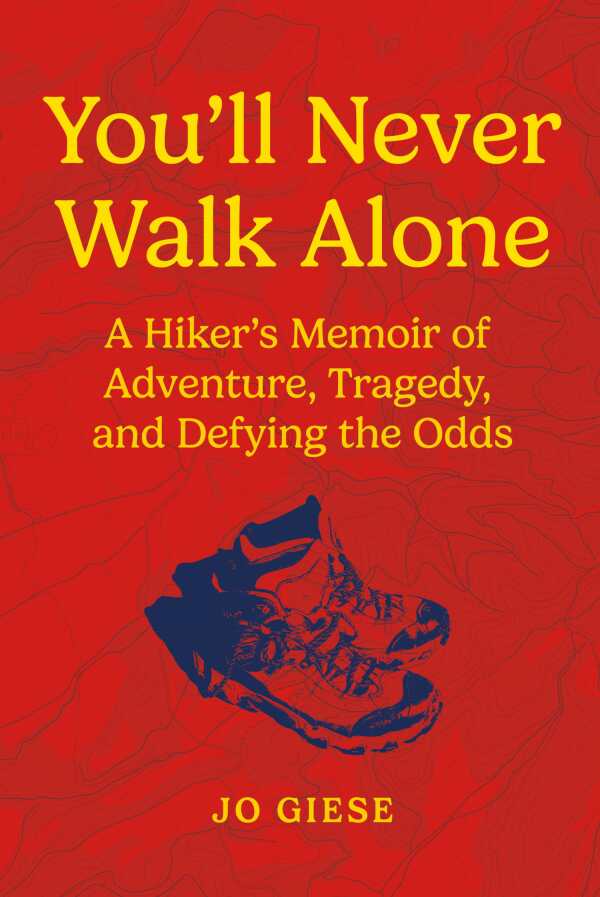
You'll Never Walk Alone
A Hiker's Memoir of Adventure, Tragedy, and Defying the Odds
You’ll Never Walk Alone is a surprising memoir about hiking, hurt, and healing.
Jo Giese’s conversational memoir You’ll Never Walk Alone is part travelogue, part recovery story, and all adventure.
Giese, an avid international hiker, records her experiences of hiking to waterfalls in places including Chilean Patagonia, Ousel Falls in Montana, and New Zealand. In the latter case, she went to locations accessible only by private helicopter. However, an injury to her Achilles tendon derailed her once-active lifestyle, and the botched procedure to repair it, which resulted in a tenacious infection and necrosis, diminished her hopes of returning to her past practices.
Moving between Giese’s accounts of her recovery and flashbacks to her preceding travel adventures, the book emphasizes how much Giese lost to her injury. Convinced that her healing would be enhanced by being in the presence of waterfalls—not only because of their super-oxygenated air and negative air ions—Giese mused on the general benefits of being in nature, which she was delighted to witness even at home:
A scattering of the tiniest bluebirds fluttered out of the little wooden bird houses attached to the fence [and] spiraled up into the sunlight, iridescent turquoise shimmering on the underside of their wings. This was a take-away-your-breath spectacle, and it was right on our driveway.
Indeed, there’s a testimonial quality to the book when it considers such themes, even in the face of Giese’s injury-imposed physical distance from waterfalls.
To flesh out Giese’s evolution, appeals are made to the work of other writers who themselves faced medical losses or became disabled in adulthood. This places Giese’s story within a varied lineage of personal challenges, resilience, triumph, and acceptance. The idea of “tragic optimism” is raised, with Giese and her husband’s initial, perhaps naïve hopes about her surgical treatment gestured toward.
There’s an aspirational quality to the underlying story despite the medical travails it records; Giese writes about traveling to exotic locations and obtaining extensive, sometimes experimental, medical care, for instance, and both reflect a degree of privilege. Further, the book’s prescriptive language around what people and medical providers should do in various circumstances is sometimes undersupported and unpersuasive, as with the notion that people should take a hike instead of reaching for an aspirin for a headache. Still, intrigue is generated around the question of whether Giese would ever hike again, propelling interest forward. Accounts of her recovery are amplified by anecdotes celebrating the importance of friendship, and the book’s celebratory descriptions of waterfalls, trails, and landscapes, which are complemented at times by photographs, are quite evocative.
You’ll Never Walk Alone is an outdoorswoman’s encouraging memoir about lifestyle and perspective shifts following a bad injury.
Reviewed by
Michele Sharpe
Disclosure: This article is not an endorsement, but a review. The publisher of this book provided free copies of the book and paid a small fee to have their book reviewed by a professional reviewer. Foreword Reviews and Clarion Reviews make no guarantee that the publisher will receive a positive review. Foreword Magazine, Inc. is disclosing this in accordance with the Federal Trade Commission’s 16 CFR, Part 255.


