

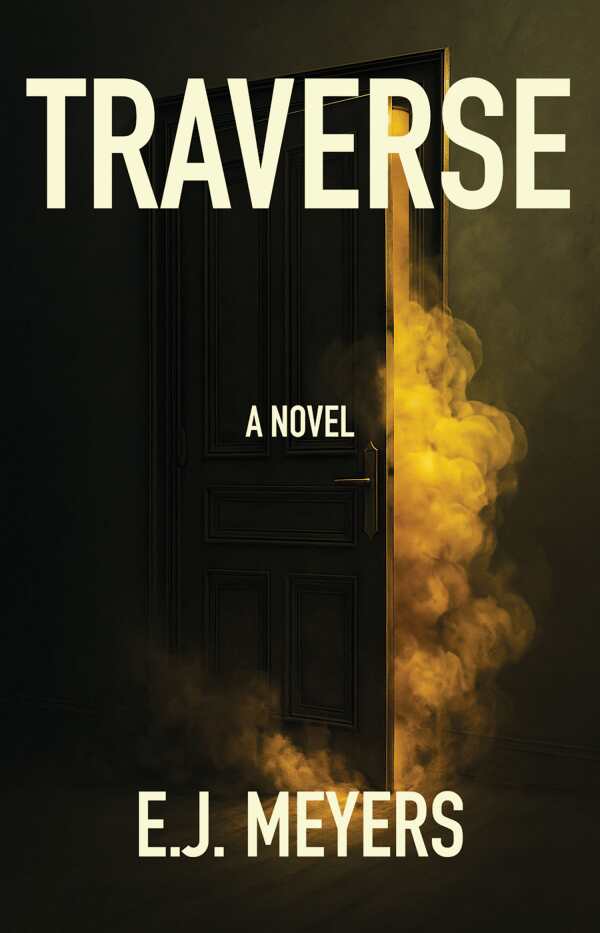
Traverse
A reeking yellow mist of unknown provenance haunts people across periods, assuming familiar, deadly patterns, in the foreboding literary novel Traverse.
The mysteries behind a pungent yellow fog and the unspeakable horrors left in its wake take on time-traveling significance in E. J. Meyers’s excellent thriller Traverse.
In the summer of 1896, Rhode Island police officers are dispatched to the Bellecliff Mansion, where a gory massacre has unfolded. The depth of the carnage and the lingering odor turn up only enigmas; authorities are forced to assign erroneous blame. From here, the book travels forward and backward in time to focus on various people whose experiences with the reeking yellow mist begin to fall into familiar, deadly patterns.
In 2018, a reported schizophrenic, Wilcox, is picked up by police, taken to a mental health facility, and put under the care of a host of postgraduate doctors. In another timeline, Linda is painstaking about her renovations of Bellecliff into a Gilded Age–inspired hotel; she is confronted by a powerful odor wafting through the halls with her grand opening on the horizon. Elsewhere, contemporary authorities and agents from the Department of Unexplained Occurrences levy years of research into the phenomenon, attempting to identify the possibly extraterrestrial source of the destructive fog.
Propulsive across its various periods, the novel does an able job of tackling tough subjects, including the rigors of mental health afflictions; the mysteries of the yellow fog and its viscous, slimy aftermath run parallel to the mental health facility’s primary directive of counseling and care for the mentally ill. Its inherent puzzle unfolds the way a diagnosis might, with small clues and observations across eras used to unpack the whole. Its work crosses genres, too, borrowing from horror novels, whodunits, and science fiction.
Vivid imagery amps up the book’s sense of disorientation, as with a reference to a rising “black sphere, hovering at the heart of the chaos. Above it, something shimmered—a rift, a perfect oval, splitting the sky. It wavered, glimmering like heat off pavement.” The prose also employs misdirection to great effect, alluding to otherworldly influences alongside subplots devoted to romance, hospital riots, and disappearing nurses. With the fate of the world hanging in the balance, the plot accelerates into overdrive as the novel turns toward its conclusion, unlocking and uniting the bevy of moving parts. The finale is both satisfying and nightmarish.
Traverse is a horror novel that taps into the fear of many unknowns, with satisfaction and slime featuring in equal measure.
Reviewed by
Ryan Prado
Disclosure: This article is not an endorsement, but a review. The publisher of this book provided free copies of the book and paid a small fee to have their book reviewed by a professional reviewer. Foreword Reviews and Clarion Reviews make no guarantee that the publisher will receive a positive review. Foreword Magazine, Inc. is disclosing this in accordance with the Federal Trade Commission’s 16 CFR, Part 255.


