

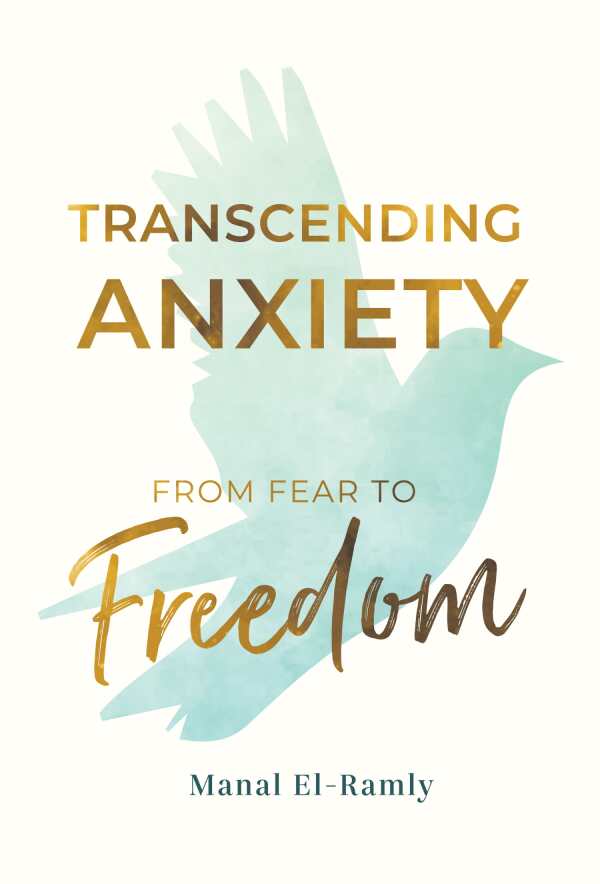
Transcending Anxiety
From Fear to Freedom
Merging introspection with practical application, the self-help book Transcending Anxiety combines the precision of a guidebook with the tone of spiritual counsel.
Manal El-Ramly’s sincere self-help book Transcending Anxiety examines the roots of inner unrest through a fusion of psychology, spirituality, and structured self-inquiry.
The work proposes that anxiety is not a flaw, but the “unacknowledged fear of the future.” From this premise arises a method that seeks alignment between what are termed the Four Bodies—the Physical, Emotional, Mental, and Egoic bodies. The book’s first part is devoted to defining how anxiety manifests through these dimensions, while the second part presents the Mattain Method, a five-step process of awareness, acknowledgment, appreciation, allowing, and surrender. The system moves from theory to practice through diagrams, reflection prompts called “Mattain Moments,” and several case studies in which people confront patterns of fear and resistance using the method.
The book’s organization is deliberate. Each chapter follows a progression of explanation, introspection, and integration, ending with a short exercise that mirrors a coaching approach. Still, the book’s first part, which establishes its foundation through conceptual repetition, slows its initial momentum. The division of the text to represent the four bodies is also quite rigid, limiting its flexibility of thought at points. Further, in describing “resistance” as any emotional, mental, or physical blockage to alignment, the book risks overgeneralizing complex psychological states. Still, the book’s steady structure underscores its emphasis on consistency and ritual as tools of transformation.
The prose is clean and precise, translating abstract concepts into tangible images. The description of the four bodies as “instruments in an orchestra” captures the interplay between emotion, thought, and physicality without sentimentality. And the case studies illustrate the book’s theories in comprehensible settings, as with a childhood memory of being left with a babysitter that becomes a recurring metaphor for how small events shape adult fear. But the book’s neologisms, including “The Unconditional Three” and “Mattain Speak,” combined with its overuse of capitalized concepts and terms, carry an off-putting self-promotional tone.
The integration of spiritual and psychological traditions deepens the work. References to the Upanishads, Buddhist Skandhas, and Western psychology are used to link ancient ideas to modern therapeutic language. The “It just is” principle, repeated through multiple chapters, also serves as both philosophical anchor and emotional refrain, promoting acceptance without resignation. This combination of spiritual surrender and analytical reasoning produces a framework that is both systematic and inwardly focused. However, the reliance on affirmation and repetition does not carry enough empirical support or varied stylistic range.
The later chapters reflect the best narrative flow. In them, humanizing examples replace conceptual exposition. The sections on surrender and alignment move with emotional resonance, showing the culmination of earlier lessons. The pacing improves as reflection gives way to action, and the text closes with a sense of measured completion. Despite its occasional excesses of explanation, the book achieves coherence between its method and message: Its gradual unfolding mirrors the gradual work of healing.
Transcending Anxiety is a structured self-help book that unites psychological insights with spiritual clarity to transform fear into a sustainable mindset.
Reviewed by
John M. Murray
Disclosure: This article is not an endorsement, but a review. The publisher of this book provided free copies of the book and paid a small fee to have their book reviewed by a professional reviewer. Foreword Reviews and Clarion Reviews make no guarantee that the publisher will receive a positive review. Foreword Magazine, Inc. is disclosing this in accordance with the Federal Trade Commission’s 16 CFR, Part 255.


