

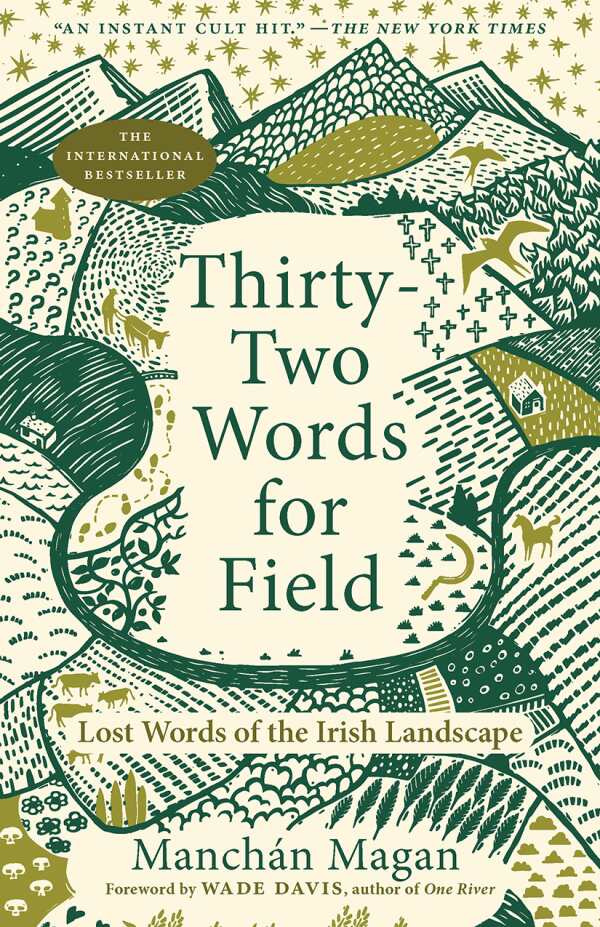
Thirty-Two Words for Field
Lost Words of the Irish Landscape
Manchán Magan’s profound yet playful book Thirty-Two Words for Field is part memoir, part history, and part ecology. Drawing on primary research, scholarly texts, and his family’s personal history, Magan documents the ongoing reclamation of Gaelic with deep appreciation for its astonishing depth and complexity, telling the timeless story of how language both creates and reflects culture as it makes and remakes itself.
The textured, multilayered chapters cover assorted word categories like “Dancing Words,” “Thresholds,” and “Contortions and Comets”; their underlying arguments in favor of Gaelic’s contemporary value unite the assortment. Each chapter amplifies the notion of language as a human communication system; Gaelic’s “ecology of perception” is said to encompass the land, plants, animals, and the uncanny. Magan insists that intuition and imagination must be valued, and that every facet of human perception is needed to meet contemporary challenges.
Somber considerations of the British suppression of Gaelic share the page with exuberant wonder at Gaelic’s intimacy with island ecology. Both coexist in the book’s precise, sometimes humorous, curiosity about connotations and etymology. In Gaelic, the book notes, action, matter, and spirit can be combined in a single word, while a word like field can be split into thirty-two others to account for layers of history, myth, and ecologies of place.
Thirty-Two Words for Field is a luminous linguistic guide, addressing Old Irish and the magic of island culture and ecology.
Reviewed by
Michele Sharpe
Disclosure: This article is not an endorsement, but a review. The publisher of this book provided free copies of the book to have their book reviewed by a professional reviewer. No fee was paid by the publisher for this review. Foreword Reviews only recommends books that we love. Foreword Magazine, Inc. is disclosing this in accordance with the Federal Trade Commission’s 16 CFR, Part 255.


