
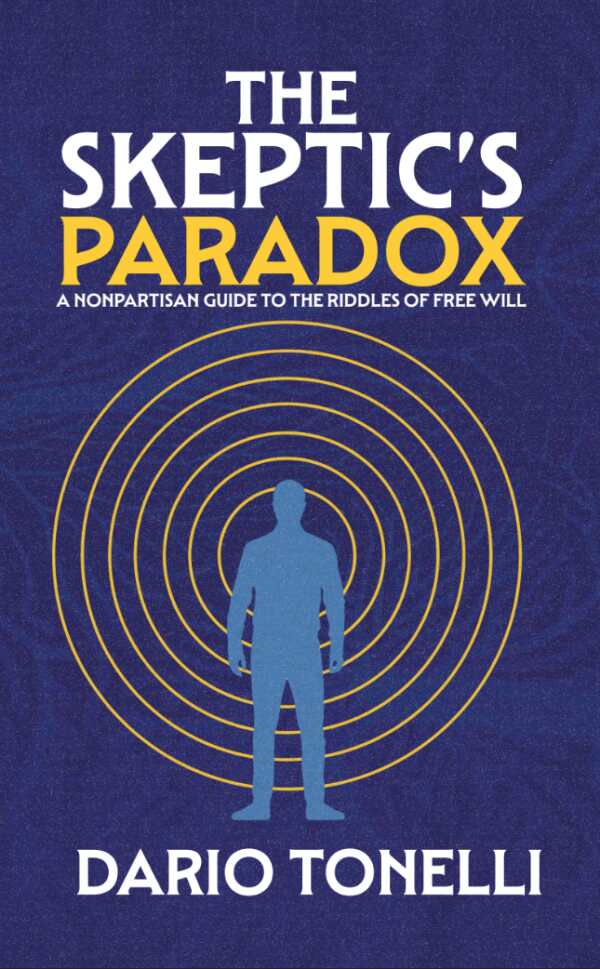
The Skeptic's Paradox
A Nonpartisan Guide to the Riddles of Free Will
Considering a litany of cerebral problems having to do with ongoing debates about the existence of free will, The Skeptic’s Paradox is a probing philosophical exercise.
Dario Tonelli’s novel treatise The Skeptic’s Paradox suggests new means of understanding free will.
Exploring the philosophical pitfalls of paradoxes related to the concept of free will, the book parses out variations of free will thought in an attempt to clarify the parameters of how to think about the engagement and deployment of related arguments. Its framework guidelines for free will include categories like intentional free will, or doing what one wants to do; libertarian free will, or complete leeway to act as one pleases; and stochastic free will, or second chance outcomes driven by random events. The book then subdivides to consider a litany of cerebral problems having to do with ongoing debates about free will’s existence.
Concepts of what “we” or “I” means in the context of decision-making, responsibility, and accountability permeate the prose. Deep questions regarding the self, the influence of external sources as instigators in decision-making, and the tangled diction used to attempt to define free will coalesce as the book reaches for clarity. However, in the end, its pages include as many questions and qualifications as they do outright declarations of definitive theory.
Though the book is quite concise given the enormity of its inquiry, it does an able job of balancing its purpose as a guide for navigating discussions of free will with healthy skepticism. It broaches popular theories around mental computation speeds and a probable lag in the firing mechanism between when the brain has made a decision and the moment the decision occurs to a person, though not all such topics are treated in full. Indeed, the book’s attention to reasonable variations in understanding and the subjective experience of drilling down on free will’s omnipresence is limited. While it asserts that people should take ownership over their actions, it also notes that derivative sources influence illusions of free will to occasion questions of who people are, and what they want, at micro and macro levels.
Still, considering the heady nature of the subject matter, the book establishes an even playing field for understanding. It quotes popular lyrics and makes references to culture at the start of each chapter to allude to personal choice, making its cumbersome study feel more accessible. Throughout its pages, it also prompts audiences to clarify their own views about looming philosophical questions, suggesting open critical inroads for deep inquiries.
Exploratory and curious, the philosophical treatise The Skeptic’s Paradox relates free will to human metrics for accountability.
Reviewed by
Ryan Prado
Disclosure: This article is not an endorsement, but a review. The publisher of this book provided free copies of the book and paid a small fee to have their book reviewed by a professional reviewer. Foreword Reviews and Clarion Reviews make no guarantee that the publisher will receive a positive review. Foreword Magazine, Inc. is disclosing this in accordance with the Federal Trade Commission’s 16 CFR, Part 255.


