

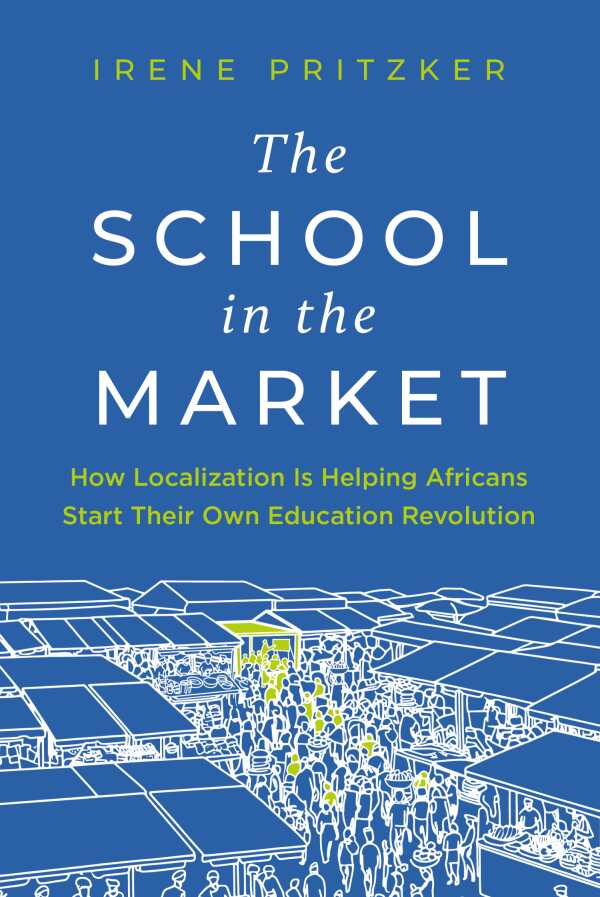
The School in the Market
How Localization Is Helping Africans Start Their Own Education Revolution
The philanthropic business guide The School in the Market models innovative approaches to sustainable organizational endeavors in developing markets.
Philanthropist Irene Pritzker’s business guide The School in the Market showcases private school education structures in Ghana as a blueprint for similar endeavors.
Across the developing world, public schools are unable to meet the pedagogical demands of local youth, the book asserts, resulting in a rise in low-fee private schools. In 2008, this climate served as founding inspiration for Pritzker’s IDP Foundation to support education for marginalized youth in Ghana. The book details the flagship Rising Schools Program, an innovative effort for financial literacy training, as well as corresponding loans for proprietors of low-fee private schools. It also elucidates what building blocks are necessary to achieve sustainability. Local partnerships in Ghana, global advocacy, and private school success stories are featured throughout, alongside business insights for outsiders to emulate.
Organized in three parts to address the multifaceted scope of groundbreaking philanthropy in a new market, the comprehensive text succeeds in showcasing the IDP Foundation’s growth and program challenges over sixteen years, as with initial interviews of local school proprietors, collaboration with Ghanaian banks and government officials, and commitment to the United Nations’ Sustainable Development Goals. A how-to guide on increasing support to low-fee private schools while accounting for skepticism, such as donors’ or financial institutions’ reluctance to provide microfinancing to school proprietors, it delivers a persuasive argument for replicating its model in other marginalized communities. Larger advocacy challenges, including financial market fluctuations and pandemic-related ones, are also addressed.
Pritzker draws upon her experience as the foundation’s sole director to share her unconventional business tactics. These are supported by heartfelt anecdotes from local personalities and influential business contacts. The prose is accessible and transparent, as with descriptions of Ghanaian locales: The Agbogbloshie Market in Accra is fleshed out in terms of “exposed electrical cables” that serve as “trip hazards,” and where women balance “large baskets of yams on their heads” with “babies strapped to their backs.” Still, the text’s credibility rests in Pritzker’s own expertise: Its tips for the effective management of a small foundation are all based on her own experiences, including her advice to have no or a small board of directors, conduct 360 reviews, and plan for one’s leadership succession.
Four distinctive and successful school case studies, as of Magdalene Sackey’s Phiga School and Paa Willie International School, further augment the narrative in sidebar text boxes. However, the book’s wide-ranging scope results in some superfluous details being included. The background is drawn out in narrative detours, as with an early explanation of low-fee private schools that disrupts the text’s flow on the subject of how the foundation’s initial efforts started. Further, the appendix that addresses artificial intelligence in education comes across as mismatched with its core message. Still, the book’s insights on philanthropic endeavors are keen throughout.
Leading by example, the business guide The School in the Market details a remarkable philanthropic model for other nonprofit endeavors to mimic.
Reviewed by
Katy Keffer
Disclosure: This article is not an endorsement, but a review. The publisher of this book provided free copies of the book and paid a small fee to have their book reviewed by a professional reviewer. Foreword Reviews and Clarion Reviews make no guarantee that the publisher will receive a positive review. Foreword Magazine, Inc. is disclosing this in accordance with the Federal Trade Commission’s 16 CFR, Part 255.


