

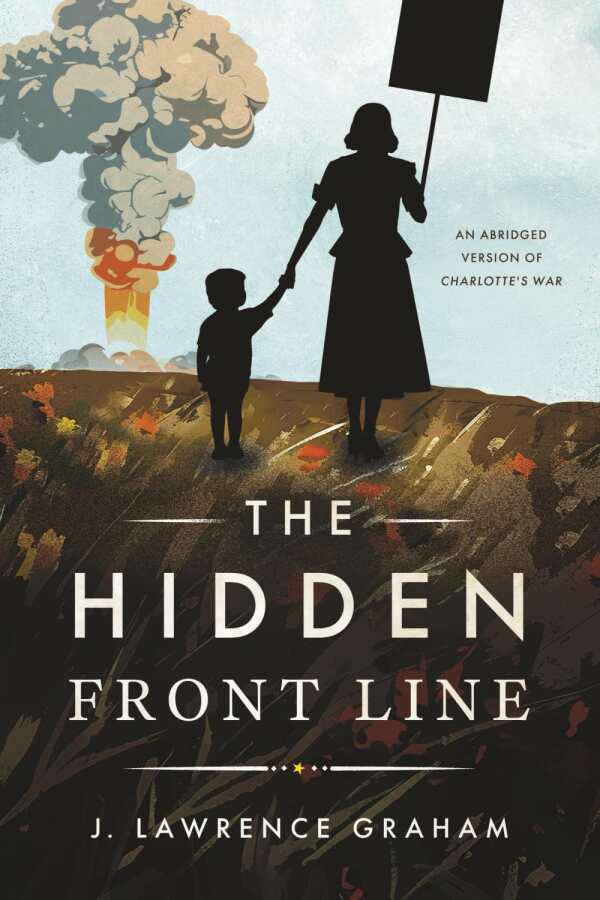
The Hidden Front Line
An Abridged Version of Charlotte's War
A woman with deep family ties to the American war machine navigates changing political landscapes with aplomb in the historical novel The Hidden Front Line.
An American wife and mother witnesses the impacts of war on the men in her life in J. Lawrence Graham’s devastating historical novel The Hidden Front Line.
Charlotte, the child of missionaries, grows up and moves toward academia, marriage, and motherhood in 1960s California, continuing her graduate work in anthropology even after her marriage. Her entire life is touched by war: Her brother Christian returns from World War II with life-altering scars, and her husband, John, is sent off to fly dangerous missions in the Korean War. To her dismay, even Jack, her oldest son, goes to war in Vietnam.
In her quest to address the feckless American officials who create chaos, Charlotte interacts with some of the leading political and literary figures of the 1960s and 1970s, including John F. Kennedy, Henry Kissinger, and Ho Chi Minh. These interactions sometimes strain credulity, though the conversations they occasion proffer sharp insights into the antiwar positions of their eras, as when Charlotte says to Kissinger “The brilliance of your initiative on all this is that a Democrat could never have done it. The Right, especially Nixon’s cronies, would have gone nuts. Good move.” Indeed, here and elsewhere, Charlotte proves to be an engaging, unorthodox heroine who evinces keen intelligence. Prone to expletives, she also speaks fluent Cantonese.
Though Charlotte is focal and absorbing, featuring academic and romantic adventures, the book segues halfway through to follow Jack’s Navy SEAL training, marked by “hurry-up-and-wait tedium and [other] annoyances,” and Vietnam battle experiences. Hereafter, its pace changes, and its narration becomes more distant; Charlotte recedes, and Jack emerges into manhood, ignoring his mother’s warnings about the potential for death or disfigurement. His experiences in boot camp and first assignments are narrated with an eye toward sharing information; running commentary on the Vietnam crisis fills in the book’s background.
Further, while Charlotte’s and Jack’s stories are thematic complements, the inclusion of standalone chapters devoted to Henry Kissinger’s academic career and love life is distracting, compromising the novel’s sense of focus. Charlotte and Jack are sidelined in service of these discursions. In addition, the book’s lapsing into editorial commentary about politics and war is stultifying. And while the book’s ending is moving, its tardy twist and lack of closure is disappointing.
A coruscating woman is a centering force for men concerned with war in the historical novel The Hidden Front Line, about a courageous personal fight against fighting.
Reviewed by
Peggy Kurkowski
Disclosure: This article is not an endorsement, but a review. The publisher of this book provided free copies of the book and paid a small fee to have their book reviewed by a professional reviewer. Foreword Reviews and Clarion Reviews make no guarantee that the publisher will receive a positive review. Foreword Magazine, Inc. is disclosing this in accordance with the Federal Trade Commission’s 16 CFR, Part 255.


