

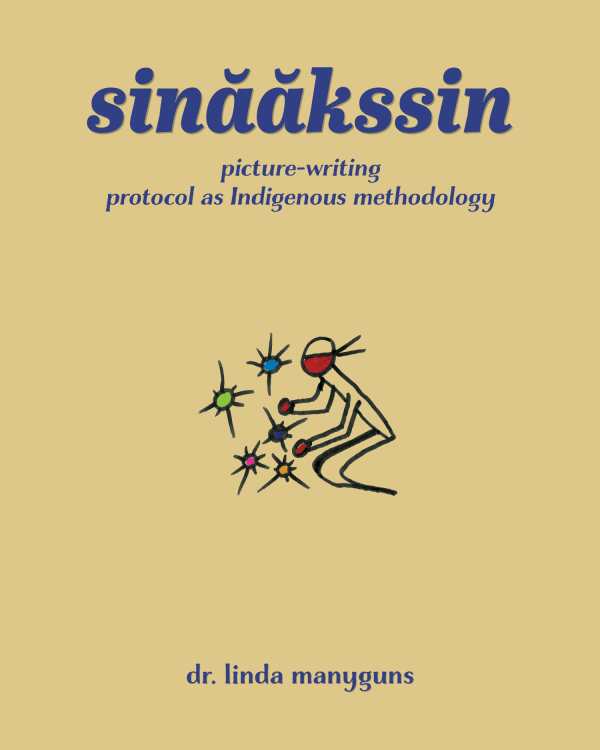
Sinaakssin
Picture-Writing Protocol as Indigenous Methodology
An inventive intersectional text, sinăăkssin recounts an illuminating bricolage social science study that incorporated Indigenous housing solutions.
Linda Manyguns’s social science study sinăăkssin introduces a novel visual narrative process, used to investigate the intersection of western policies with Indigenous epistemology.
The text centers on a research project designed to address the conflict between Canada Mortgage and Housing Corporation policies and Indigenous family values. Instead of standard interviews, the study employs a painted storyboard depicting a fictional housing crisis in the village of Akiskis. Four traditional thinkers, or Okaki otapi’ksi, from Alberta and the Northwest Territories are invited to solve the fictional board’s dilemma. Their responses generate four distinct housing models that prioritize cultural continuity, treaty rights, and survival skills over bureaucratic compliance. The work details the rigorous protocols required to access this knowledge, including the use of messengers and community consensus.
The structural backbone involves a creative deviation from traditional academic norms. The storyboard functions as a safe place for cultural interactions, allowing the participants to critique systemic issues without engaging in direct confrontation or gossip. This method, described as bricolage, zippers together conceptual inquiries with Indigenous storytelling traditions. Its pacing mirrors the slow, deliberate nature of the “collective community subjectivity” protocol, wherein decisions rest on community consensus rather than artificial academic timelines. This approach honors the nature of Indigenous research, showing how traditional knowledge is an active force for reshaping contemporary institutions.
Articulating three distinct knowledge paradigms—Traditional, Community, and Indigenous Knowledge—with clarity, the book does an able job of moving beyond rigid views of Indigenous wisdom to categorize its sources with precision. Traditional knowledge is presented as lived and transferred from nonhuman sources, while community knowledge arises from human experiences and history. This framework provides a clear focal point for analyzing the solutions proposed by the contributors. One model relies on treaty rights found in the community paradigm, while another draws on listening through the tipi liners, a concept from the traditional paradigm that limits the influence of outsiders. The visual symbols heading each section serve as functional tools for knowledge retention too.
The prose balances academic rigor with the oral cadences of the participants, whose voices are preserved with fidelity, capturing the specific speech patterns and survivalist teachings of the elders. Terms from the Blackfoot language, including iiyikssko (urge and to conduct actions in a way considered right or proper) and ikaitapiitsiniki (the place to tell old stories from our forefathers), are integrated into the chapter headings alongside their definitions and symbology. One Okaki otapi’ksi, Daniel Sonfrere, notes that “real teachings have to be told as teachings.” The clarity of such messages ensures that the dense theoretical framework remains connected to the practical realities of the housing crisis.
A pragmatic proof of concept for Indigenous research methodologies, the book moves beyond its theoretical critiques to offer concrete, workable models for social service delivery. By honoring the capacity of traditional thinkers to act as social architects, it offers a blueprint for Indigenous institutional policies. The resolution of the fictional Akiskis crisis demonstrates that cultural values like sharing and extended family support are not incompatible with contemporary governance, but are, in fact, essential to sustainable community health.
sinăăkssin is a groundbreaking social science text that uses visual storytelling to dismantle Western bureaucratic methods, suggesting a vital, innovative framework for Indigenous research in the process.
Reviewed by
John M. Murray
Disclosure: This article is not an endorsement, but a review. The publisher of this book provided free copies of the book and paid a small fee to have their book reviewed by a professional reviewer. Foreword Reviews and Clarion Reviews make no guarantee that the publisher will receive a positive review. Foreword Magazine, Inc. is disclosing this in accordance with the Federal Trade Commission’s 16 CFR, Part 255.


