

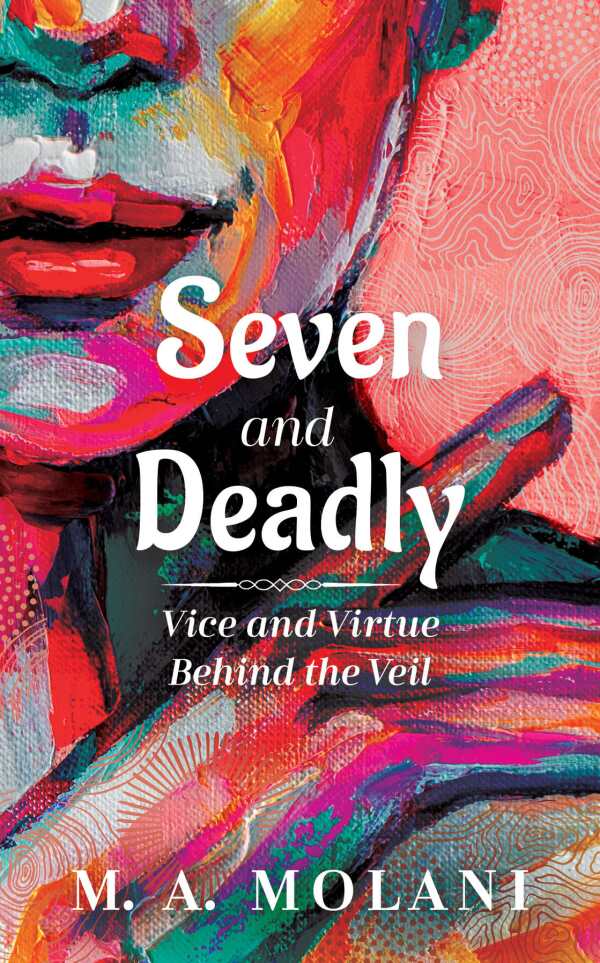
Seven and Deadly
Vice and Virtue Behind the Veil
The experiences of professional women and women of color are highlighted in this searing kaleidoscopic poetry collection.
Its sections inspired by the seven deadly sins, M. A. Molani’s striking poetry collection Seven and Deadly celebrates science and feminism.
These poems challenge assumptions about women’s lives, declaring new truths and questioning old ones. Here, the wrath of a woman scorned is nothing compared to that of a man who fears women, and it’s valid to question why anyone should keep taking the high road if the climb can kill them. The experiences of professional women and women of color are highlighted in poems making strong cases for a kaleidoscopic range of beliefs as they uncover the complexity of the concept of sin. They position opposite ways of thinking and ask questions such as whether successful women inspire others with their confidence or if theirs is a delusional pride, encouraged by systems that sabotage their success. It’s not gluttony to eat the chocolate cake when no one gets out of here alive, the book suggests.
The poems invert standard formatting; their titles appear in italics at the ends of poems so that their verses can be experienced without overt direction. Further, the titles often serve as epiphanic moments, jolting and illuminating. Verses about a sought-after woman’s desire to sit alone are titled supply and demand, and a poem asking “At which end of the leash is the beast?” is titled trauma-bond.
Iconoclastic, musical, and ranging, the poems apply formal poetic elements in both subtle and aggressive ways. Precise diction intersects with sonic elements, each strategy enhancing the other. Images of “a field of keloids” and lines like “How rabid he is / … / He comes with oblations / Of lotus, of silver, of cedar” stand out. Elsewhere, moments of humor play to human delights, providing light relief against the book’s centralized, gobsmacking insights and revelations.
Brevity is also employed to dramatic effect. Some poems are aphoristic, as with “You told me it was a ring / I didn’t realize it went around my neck / –collared.” A dance between variety and consistency dominates: Most of the poems employ a first-person speaker, and these speakers come from multiple perspectives, including a greedy magpie wearing “crumbles of starshine” and a woman whose skin “ignites” race hatred, who wears her partner “like a shield / all white skin and phallus.”
Some speakers use their imaginations to personify a sin: “Envy is conniving / He arrived quietly.” Other voices include that of a physician whose oath to do no harm in a cruel world may be the heartbreak she doesn’t recover from. Versions of speakers positioned as subordinate to white androcracy upend and undercut power through small yet significant changes in familiar phrases, including “in all my gory.” Elsewhere, playing with astrology, one speaker says, “This angst is unbearable / I should have loved to be a Libra / —crabby.”
Seven and Deadly brings a masterful command of musicality to its poems’ original perspectives.
Reviewed by
Michele Sharpe
Disclosure: This article is not an endorsement, but a review. The publisher of this book provided free copies of the book and paid a small fee to have their book reviewed by a professional reviewer. Foreword Reviews and Clarion Reviews make no guarantee that the publisher will receive a positive review. Foreword Magazine, Inc. is disclosing this in accordance with the Federal Trade Commission’s 16 CFR, Part 255.


