

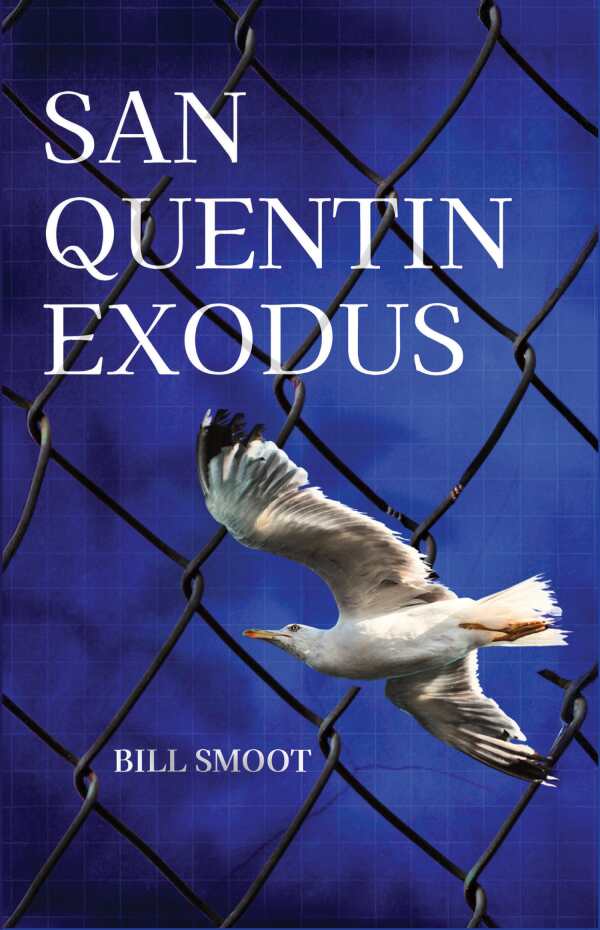
San Quentin Exodus
Substantial planning and extensive moralizing goes into a jailbreak in the musing novel San Quentin Exodus.
In Bill Smoot’s hopeful novel San Quentin Exodus, an idealistic volunteer, viewing it as her moral obligation, attempts to facilitate a prison escape.
James has been incarcerated for decades for the commission of a violent crime in his youth. Allison, a math teacher, volunteers as a tutor at his prison. They form an alliance with one another, sharing their memories. James also tells her about the institutional routines he’s subject to. In time, they plan James’s escape.
Herein, prison is a site for study, reflection, and endurance. Brief, discrete scenes move the book forward at a steady pace, if with limited momentum. The accumulated episodes make the James and Allison’s intentions clear; still, the excitement of a jailbreak is subdued as the story approaches its central action. The escape plan involves substantial research and extensive conversations, and some repetition is involved, further diminishing the book’s excitement; indeed, the duo often revisits the same points.
James’s and Allison’s childhood memories and James’s incarceration are covered in an even manner. Indeed, their characterizations are thoughtful if constrained. James is rendered as introspective, intellectual, and serious about his ethics; his inner life is shaped by study and reflection. But this also means that he responds to moments of conflict and challenges with a sense of calm understanding; his internal pressures are minimized in the process. Allison, too, is defined by her precision and persistence as a dedicated problem-solver. Her actions are logical and controlled throughout. She is also not often challenged, though, despite the high-stakes nature of her plans, and her growth is limited. And the book’s secondary characters appear in brief and exit without leaving a lasting impression.
Still, the book’s transitions are fluid, and its prose is measured, though too dominated by procedural considerations and the duo’s observations. Details about San Quentin’s gates, ledgers, classrooms, and routines are shared to the point of redundancy, and sparse images, as of birds flying over the prison walls, add insufficient color. Emotional moments are handled with the same restraint, to distancing effect. Further, the story proceeds to the jailbreak itself without alterations in its tonal register, rendering even these exciting actions muted. Consequences are acknowledged but unfold with a whisper; little narrative pressure is applied in the book’s final sections.
In the thoughtful novel San Quentin Exodus, a long-incarcerated man and a determined tutor plan his escape with care.
Reviewed by
John M. Murray
Disclosure: This article is not an endorsement, but a review. The publisher of this book provided free copies of the book and paid a small fee to have their book reviewed by a professional reviewer. Foreword Reviews and Clarion Reviews make no guarantee that the publisher will receive a positive review. Foreword Magazine, Inc. is disclosing this in accordance with the Federal Trade Commission’s 16 CFR, Part 255.


