

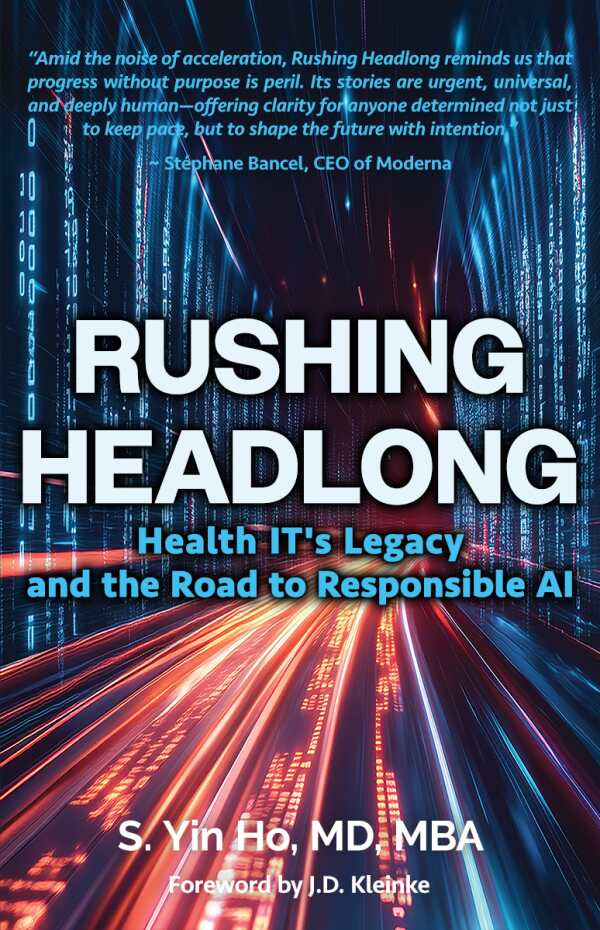
Rushing Headlong
Health IT's Legacy and the Road to Responsible AI
Rushing Headlong is an informed healthcare information technology manifesto that argues in favor of AI-led system improvements.
S. Yin Ho’s savvy business history book Rushing Headlong concerns information technology in the healthcare industry and argues that artificial intelligence is poised to transform the field.
Health information technology, the book argues, evolved in a patchwork, disconnected fashion for billing and other economic purposes, focusing on facilitating transactions while being bound by privacy laws and other regulations that have unintended consequences. Its topical chapters review how patients were left on the sidelines as health information technology emerged, the cost of outsourcing clinical trials, and how AI can change how people think. Indeed, the book asserts that AI could be used to shift the industry in a patient-centered, holistic direction, improving access to patient records and bridging the gap between patient care and clinical research. Such theorizing consumes a considerable portion of its space, as where it illustrates the value of data to patients, physicians, and researchers before weighing the “generational opportunity” of harnessing AI for disruption.
Personal stories from within the healthcare industry are included. These relate to the structure of the industry, the incentives at play within it, and how the industry was hemmed in by established practices. Insights into how electronic health record certifications sparked a gold-rush mentality in the industry, how data entry contributed to doctor burnout, and how government incentives created an oligopoly of large electronic health record vendors appear. The book’s points are undergirded by credible citations of academic studies, the US Department of Health and Human Services, and national newspapers.
The book’s approach is comprehensive, as where it catalogs medical record ownership by state, payment models, and interoperability standards. It explains basic concepts, like the differences between open and closed claims, at length, and it drives home key points with multiple examples, as with those related to how system design shapes behavior. Still, its prose is accessible, making technical concepts comprehensible, including how software standardized clinical workflows and hurt physicians’ independence and how AI can automate workflows, removing human decision-making at certain levels and changing the ways people think.
The book’s occasional analogies are clarifying, as where it compares tokens to video game player IDs, though its abundance of acronyms is distracting. Nonetheless, its arguments related to how new technology could be used to reform the system, increase access to data, and improve patient care are compelling. Its conclusion is spirited, encouraging people to take advantage of the explosion of generative AI in a responsible fashion.
An astute, historically attuned industry survey, Rushing Headlong analyzes healthcare information technologies and imagines how AI might be used to make the system more effective.
Reviewed by
Joseph S. Pete
Disclosure: This article is not an endorsement, but a review. The publisher of this book provided free copies of the book and paid a small fee to have their book reviewed by a professional reviewer. Foreword Reviews and Clarion Reviews make no guarantee that the publisher will receive a positive review. Foreword Magazine, Inc. is disclosing this in accordance with the Federal Trade Commission’s 16 CFR, Part 255.


