

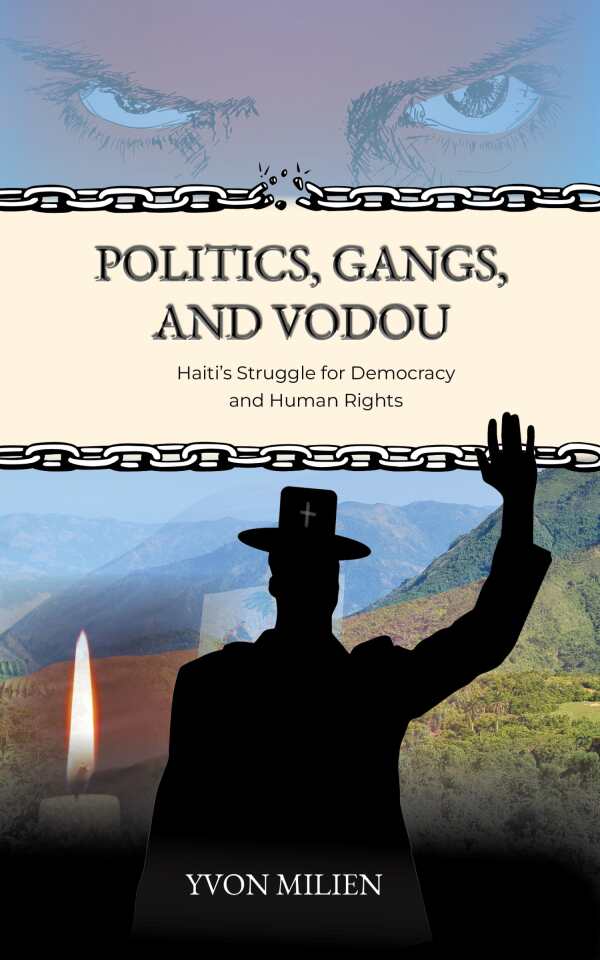
Politics, Gangs, and Vodou
Haiti’s Struggle for Democracy and Human Rights
Politics, Gangs, and Vodou is a philosophical political science study about how Haiti’s origins in a mass rebellion impact the nation in the present.
Yvon Milien’s political science study Politics, Gangs, and Vodou investigates the systemic structure of Haiti and suggests a moral and philosophical approach to the nation’s issues of oppression and crime.
The book notes that after enslaved Africans led a rebellion, Haiti became the first Black republic in the modern world in 1804. The effort also allowed the Caribbean country to break away from France’s hold, it says. However, the ramifications of the revolt spurred generations of systemic issues, including reparations being paid to France for its loss of property, stunting the growth of the new republic. Social hierarchies developed between Black and biracial citizens as political progress stalled, and religion—though instrumental in cultural identity and pride—was used by leaders as a manipulation tactic to keep Haitians misinformed, it asserts. Dictatorships and crime rings developed as a result:
Haiti’s society was shaped not only by the colonial system it overthrew but also by the social hierarchies and political habits it inherited and re-created… . From 1804 onward, the island was a nation of winners who were not equally rewarded.
Though the book works to note discrepancies within Haiti’s social fabric, it is too short on supporting details. Its evidence of economic and intellectual gaps between different classes is also quite sparse. Further, there are generalizations in the place of statistics and data, and a dearth of tangible context to flesh out the claims regarding how a lack of resources affected Haiti’s more vulnerable communities. Historical accounts are broached on a surface level, and the timeline and inner workings of the trajectory of Haiti’s social and political history is just sketched in. Further, much responsibility for Haiti’s proposed democratic change is placed on media platforms rather than political, gang, or spiritual leaders.
There are also instances of repetition in the book, whose structure is too loose on the whole. Chapters with similar themes exist at a distance from one another, and too many chapters are short and choppy. Further, the chapters are divided into parts sans a clear sense of themes. Circular and long-winded arguments also lead to a text that feels stretched in places. Indeed, despite the book’s opening explanations regarding the lack of chronological ordering and claims of topical fluidity, its repeating content proves to be an impediment to its ultimate persuasiveness and cohesion.
A philosophical political science study about how Haiti’s origins in a mass rebellion impact it in the present, Politics, Gangs, and Vodou explores means of honoring the country’s potential as a leader of democracy.
Reviewed by
Brooke Leigh Howard
Disclosure: This article is not an endorsement, but a review. The publisher of this book provided free copies of the book and paid a small fee to have their book reviewed by a professional reviewer. Foreword Reviews and Clarion Reviews make no guarantee that the publisher will receive a positive review. Foreword Magazine, Inc. is disclosing this in accordance with the Federal Trade Commission’s 16 CFR, Part 255.


