

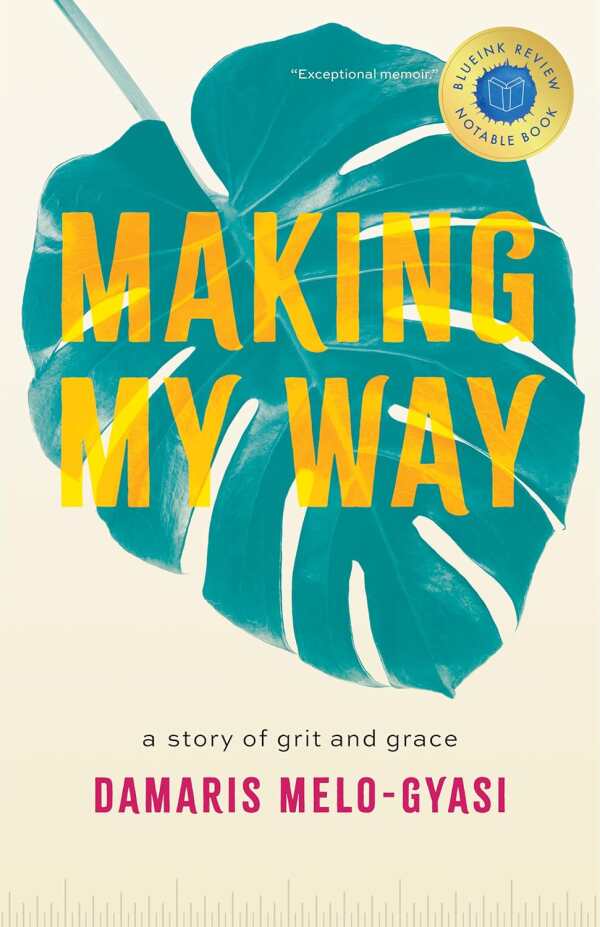
Making My Way
A Story of Grit and Grace
A story about maintaining personal integrity in strange and hostile surroundings in order to succeed, Making My Way is a compelling memoir.
In Damaris Melo-Gyasi’s powerful memoir Making My Way is about how her girlhood dream of becoming an architect came true.
This story of determination begins in São Paulo, Brazil. When she was seven years old, Melo-Gyasi observed a confident woman architect and felt a calling to become an architect herself. She recognized it as a sacred calling because her family was devoted to their Seventh-day Adventist Church, where direct contact with God’s callings was proclaimed. Her parents didn’t encourage her dream, however—in part because they could not afford to send her to university.
Still, Melo-Gyasi pursued her dream. She excelled in public school, attended university, and, as an exchange student on a nine-month visit to the United States, visited major cities to learn different styles of architecture. She also observed people inside buildings, taking note of their differences and similarities across cultures. Her focus on the human element of architecture became central to her success as an architect.
While conflicts between Melo-Gyasi’s religious culture and her career are alluded to, they are not fleshed out much. Instead, the book analyzes the ironic connection between Seventh-day Adventist religious practices, like the laying of hands and speaking in tongues, and Melo-Gyasi’s convictions about her calling. Indeed, the prose is message-conscious, persuasive, and exquisite. Sentence fragments and alternative spacing are used for emphasis, and Portuguese terms wend in to expansive effect, as when discussing her embromation (pretending to speak a foreign language by imitating its sounds and rhythm) as a student and exploring cross-cultural communication. Phrases like “Poverty had smelted my parents’ childhoods” also communicate much; Melo-Gyasi recalls “taking too many breaks in a hammock fastened to anger and exhaustion” in her frustrated teenage years.
Indeed, the book is well grounded in the experiences, history, and culture of Melo-Gyasi’s Portuguese-speaking Afro-Brazilian family, bridging cultural gaps with keen linguistic flourishes and ably transitioning between perspectives. São Paulo is fleshed out in terms of its “purple jacarandas and golden firetrees [that] plumed the sky”—images that complement the deep, internal reflections that run throughout and that make the book immersive.
Melo-Gyasi’s evangelical faith permeates the book, as does her desire to believe that she was good enough to meet her growing expectations. The challenges she encountered, including a sexual assault in her childhood, language acquisition to succeed academically, and prejudice against immigrants in the United States, are recounted with clarity. Notes about maintaining personal integrity in strange and hostile surroundings also appear, leading the book to a triumphant close.
Its prose gorgeous, Making My Way is the evocative memoir of an Afro-Brazilian architect who succeeded because of her faith and perseverance.
Reviewed by
Michele Sharpe
Disclosure: This article is not an endorsement, but a review. The publisher of this book provided free copies of the book and paid a small fee to have their book reviewed by a professional reviewer. Foreword Reviews and Clarion Reviews make no guarantee that the publisher will receive a positive review. Foreword Magazine, Inc. is disclosing this in accordance with the Federal Trade Commission’s 16 CFR, Part 255.


