

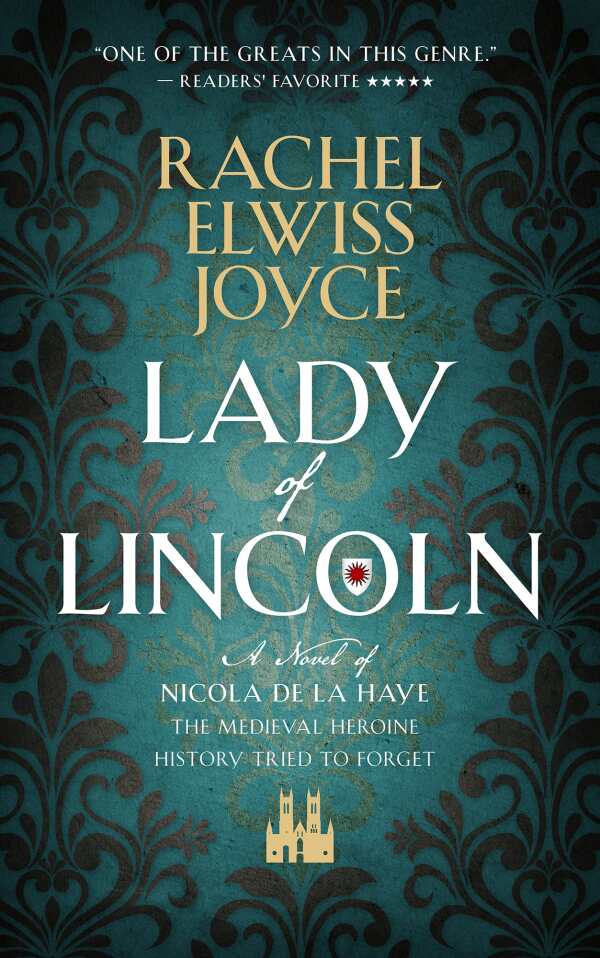
Lady of Lincoln
A Novel of Nicola de la Haye, the Medieval Heroine History Tried to Forget
Romantic subplots are used to explore feminine power in Lady of Lincoln, a heady historical novel involving high-stakes political maneuvering.
In Rachel Elwiss Joyce’s engaging historical novel Lady of Lincoln, a spirited adolescent in the twelfth century grows up to be the defender of Lincoln Castle.
Nicola de la Haye, a constable’s daughter, prefers horses, weaponry, and falconry over more “feminine” pursuits. Without brothers, she is expected to inherit her father’s land and position. She accepts an arranged marriage and, in time, becomes the sheriff of Lincolnshire.
Nicola is a shrewd narrator who’s pulled between her feelings of duty and desire. Her castle is both a home and “starting to feel like a gaol.” She manages daily tasks and tends to the rugged landscape, foreshadowing her future managerial work in precise terms. She also contends with threats against her Jewish neighbors and comes to realize how her role extends beyond matters of family pride. Her interventions on behalf of her family’s tenants distinguish her as quick-thinking and compassionate, earning their loyalty.
Other people, with their shadowed motivations, lend the novel its suspense. A roguish, debt-ridden suitor, Fitz, strategizes to elevate himself by winning Nicola’s hand; Gerard, a respected nobleman and Fitz’s chivalrous rival, strives to earn her genuine affection. All parties involved hope to turn their circumstances toward their favor. Indeed, Nicola’s romances are bound by the expectations of feudal marriage throughout.
The plot progresses through Nicola’s life, covering her impetuous choice of which man to wed, the challenges she faces after her father’s death, and her establishment as a strong Lady of Lincoln. Within the castle garrison, which is dominated by men, she earns respect by proving her hunting skills. In time, the intrigue around King Henry’s court and his son Prince Harry’s rebellion intensifies Nicola’s need to prove her resourcefulness. This historical context is well fleshed out, if from secondary viewpoints: Interspersed among Nicola’s perspective are the insights of other nobles, used to cover historical factors like King Henry’s problems with France and tensions involving Archbishop Becket in brief.
The book’s later chapters focus on the interplay between matters of royal import and Nicola’s leadership roles, which converge in consequential ways through her husband’s ambitions. Brutal battle scenes appear as well. However, Nicola’s second marriage is covered in too-feverish terms and involves a somewhat fanciful rescue from a siege.
In the exciting series-opening historical novel Lady of Lincoln, an inimitable noblewoman comes into her own.
Reviewed by
Karen Rigby
Disclosure: This article is not an endorsement, but a review. The publisher of this book provided free copies of the book and paid a small fee to have their book reviewed by a professional reviewer. Foreword Reviews and Clarion Reviews make no guarantee that the publisher will receive a positive review. Foreword Magazine, Inc. is disclosing this in accordance with the Federal Trade Commission’s 16 CFR, Part 255.


