
Konnect Better
Unlocking the Power of Your Relationships (Volume One: Committed Connections)
The ranging self-help book Konnect Better is concerned with improving one’s relationships based on awareness, action, and alignment.
Wealth advisors Mo Lidsky and Bob Gould’s self-help survey Konnect Better is concerned with prioritizing one’s inner circle as an invaluable asset.
Arguing that those who have it all best show what is still lacking once wealth goals are achieved, the book is split into three parts focused on awareness, action, and alignment, beginning with recommendations for improving one’s relationships. It uses the example of a family business’s disintegration in the wake of its patriarch’s passing as a throughline, suggesting best practices for achieving personal success based on their experiences. One sister’s turnaround is used to illustrate intrarelational and interrelational concerns, for example; and, when the book discusses the characteristics of a healthy relationship in its last section, the example of another sister’s transformation proves central.
Ultimately, though, the book’s central conceit is limiting. Its treatment of awareness is too focused on its negative example of flawed business and family leadership practices, which it uses as a cautionary tale; its goal-setting techniques and assessment tools are undermined by this connection. And though the need to improve relational health is well emphasized by the patriarch’s regrets on his deathbed, this is a limited lens, and one that is fast countered by the positivity of the following sections.
Action is encouraged by the book’s activities, which include questions to answer, statements to rate, and charts to fill in. All are designed to foster discipline when it comes to attending to one’s relationships. This emphasis on what to do, though, is undermined by the dearth of explanations as to why these actions should be taken, beyond the family’s illustrations of what might happen otherwise.
Some touchpoints beyond the family’s story appear, broadening the book’s reach, as with the chapter-beginning quotes, suggestions for reading, and citations of scientists and clinicians on the topic of strong relationships. Related personal vignettes and piquing hypothetical scenarios are included, too, alongside adages about actions shaping mindsets and environments determining prosocial behavior. However, these generalities are not always made to apply to the book’s specific guidance. Indeed, the book often feels like an incomplete introduction to its subject.
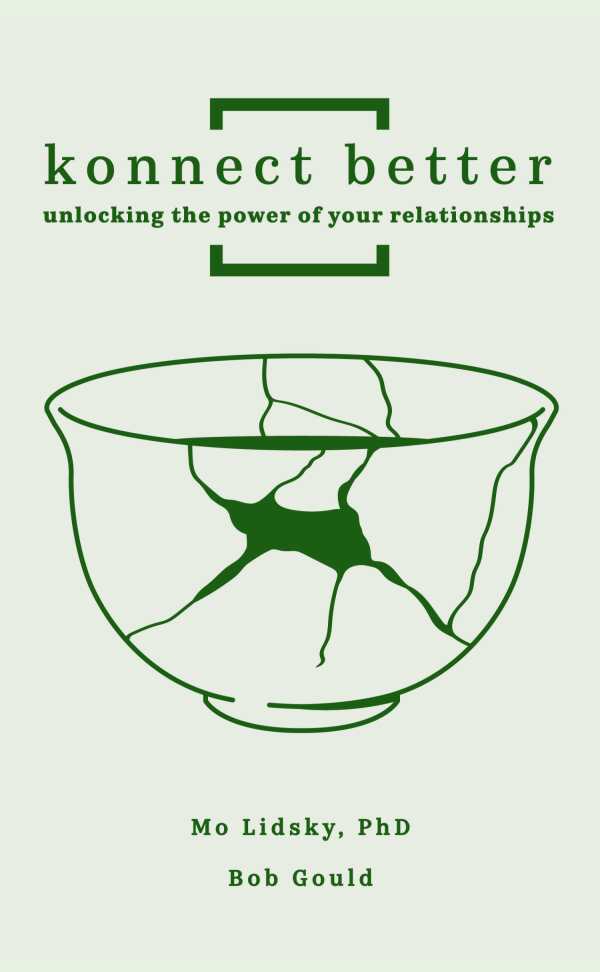
The book’s graphics have a superfluous quality, as with a bagel image to demonstrate flexible and inflexible ways of making interpersonal requests. Their green coloration has a random quality too. Further, the decision to spell “konnect” with a k and the book’s emphatic guarantee that its recommendations will work, land as unconvincing gimmicks. Also underwhelming are the book’s final summaries of studies on topics including trust, quality time, and decision ownership.
Distilling a wealth of self-help techniques and resources into one handbook, Konnect Better is an ambitious but diffuse self-help book concerned with improving one’s relationships.
Reviewed by
Mari Carlson
Disclosure: This article is not an endorsement, but a review. The publisher of this book provided free copies of the book and paid a small fee to have their book reviewed by a professional reviewer. Foreword Reviews and Clarion Reviews make no guarantee that the publisher will receive a positive review. Foreword Magazine, Inc. is disclosing this in accordance with the Federal Trade Commission’s 16 CFR, Part 255.


