

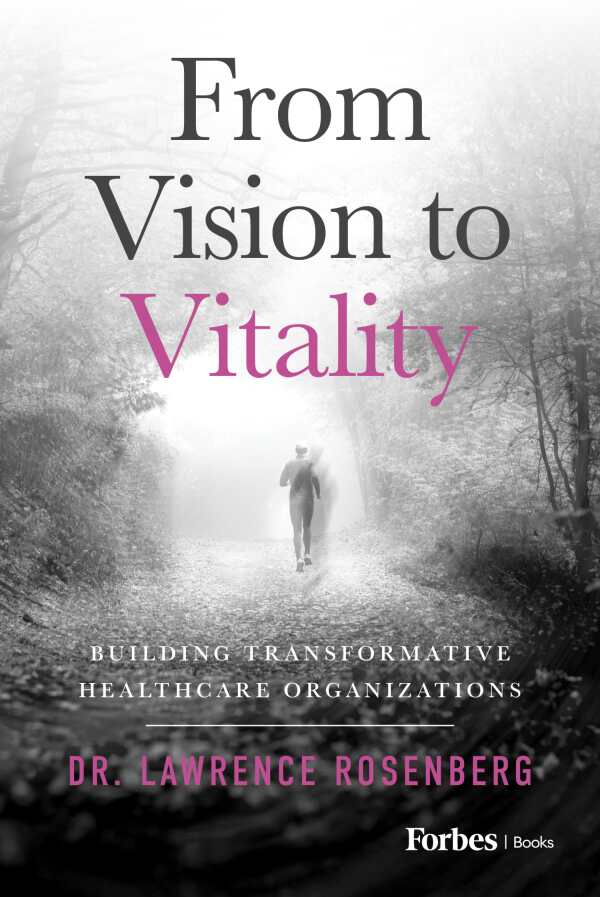
From Vision to Vitality
Building Transformative Healthcare Organizations
From Vision to Vitality is an illuminating industry leadership guide that draws on experiences within Canadian healthcare systems.
Physician and hospital CEO Lawrence Rosenberg’s healthcare industry leadership guide From Vision to Vitality concerns excellent patient care.
Arguing that healthcare systems should prioritize patient outcomes to achieve excellence, the book diagnoses bureaucratic impediments alongside stories of effective hospital leadership. Its ultimate vision for healthcare is grounded in relationships and values, with advice on inspiring workers, breaking down silos, and building integrated networks to address complex challenges.
The thematic chapters cover subjects including leadership, curiosity, and failure. They are somewhat self-contained, though. Further, some of their examples are quite personal, as with Rosenberg’s dramatic opening story about being fired due to an administrative policy change, which is juxtaposed with his successes at uniting various hospitals, healthcare institutions, and community clinics into an integrated system.
Still, from Rosenberg’s experiences, and those of others, come clear leadership tips, applicable across industries: A surgeon who ended up in management is held up as a positive example; tales about navigating relations between clinicians, patients, and other stakeholders in a way that protected operative excellence are also shared. The book also muses through which challenges can be addressed through expertise alone and which require behavioral shifts and adaptability.
Herein, complex topics are handled in an approachable manner. For example, theoretical physicist Per Bak’s sandpile model is used to explain how a system can hover on the edge of disaster. Such analogies are illuminating, as are examples as of orchids in the process of renewal, though they appear barren at the time, to explain natural life cycles; elsewhere, the nuances of healthcare management are compared to a game of sudoku. Business jargon and technical language are distracting, though, as with the inscrutable observation that AI can “enhance system flexibility by enabling rapid reconfiguration in response to changing conditions through dynamic care coordination algorithms.”
The book’s ultimate vision for transformative leadership rests on compelling corollaries, though. For instance, it notes that railroads were supplanted by airplanes in the 1920s in part because railroads forgot that they were in the transportation business and failed to adapt. In contrast to such past errors, it suggests a multifaceted approach to leadership that involves embracing innovation, preventing crises, and assembling strong teams. The works of respected medical and scientific authorities are cited for support, and references to specialized concepts, as of Nassim Nicholas Taleb’s notions of antifragility, are enlivening.
Drawing on experiences within Canada’s healthcare industry, the leadership guide From Vision to Vitality asserts that effective systems must focus on patient needs.
Reviewed by
Joseph S. Pete
Disclosure: This article is not an endorsement, but a review. The publisher of this book provided free copies of the book and paid a small fee to have their book reviewed by a professional reviewer. Foreword Reviews and Clarion Reviews make no guarantee that the publisher will receive a positive review. Foreword Magazine, Inc. is disclosing this in accordance with the Federal Trade Commission’s 16 CFR, Part 255.


