

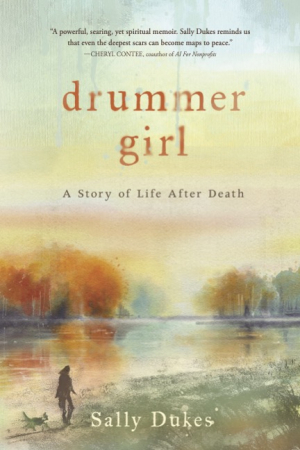
Drummer Girl
A Story of Life After Death
Drummer Girl is a thoughtful memoir about unwinding inner turmoil and uncovering “answers to the numinous” through meditation.
Sally Dukes’s mystical memoir Drummer Girl interrogates the fallout of the open-heart surgery she underwent in her childhood.
In the 1950s, when cardiac surgery was in its infancy, Dukes was a toddler with a congenital heart defect. She experienced preverbal trauma on the operating table, initiating lifelong efforts to find the words to articulate her pain and the persistent echoes of her near-death experience. Alongside that work, the book touches on historical developments in life-saving cardiac surgery for children and the role of mindfulness meditation in self-healing.
Haunted by her trauma and the memory of “the clear light at the end of the dark tunnel,” Dukes undertook international explorations of death and consciousness. As the owner of a Nantucket café, she worked hard during the summers and was free to travel in the offseason. She went to Varanasi, India, along the banks of the Ganges, observing funeral rites and cremations out in the open, where death seemed to be treated as “a welcome relief from the physical body.” This was the first of many international destinations intended to unwind her inner turmoil and uncover “answers to the numinous” through meditation.
But this is not a travel memoir; its descriptions of places and people are secondary to its descriptions of what Dukes took from each experience. After more than a decade of searching, she determined that her childhood out-of-body experience could not be made tangible for others. She then turned to a more conventional, in-the-body solution to her perennial discontent.
A powerful aural image of the sounds made by Dukes’s struggling heart—“beat, swish, gurgle, gush”—is an early example of the book’s rhythmic prose, which adapts throughout the book to match the pace of events. Short sentences give a sense of urgency to passages about life-threatening occasions, while longer sentences are used in paragraphs drawing on medical research and those concerning meditation, tilting toward a contemplative mood.
The book’s structure is formal, with COVID-19–related grief functioning as bookends for a series of flashbacks and scenes that take place over a period of almost seventy years. There’s a similar bookending in the narrative strategy, which assumes a double perspective, shifting between Dukes as an adult and the viewpoint of “drummer girl,” her inner child. This strategy is effective at separating her childhood consciousness from her adult awareness; however, when the two perspectives are included in close proximity to one another, sometimes even in the same sentence, the artifice is apparent.
The book’s final vignettes before the second COVID-19 bookend are observations of people dying. Witnessed as external evidence of an afterlife, these offered Dukes a sort of comfort, helping to define and validate her childhood out-of-body experience. They are a soothing conclusion to a book that also includes a frenetic personal search for clarity.
An introspective memoir, Drummer Girl draws on a childhood experience of open-heart surgery to make larger spiritual connections.
Reviewed by
Michele Sharpe
Disclosure: This article is not an endorsement, but a review. The publisher of this book provided free copies of the book and paid a small fee to have their book reviewed by a professional reviewer. Foreword Reviews and Clarion Reviews make no guarantee that the publisher will receive a positive review. Foreword Magazine, Inc. is disclosing this in accordance with the Federal Trade Commission’s 16 CFR, Part 255.


