

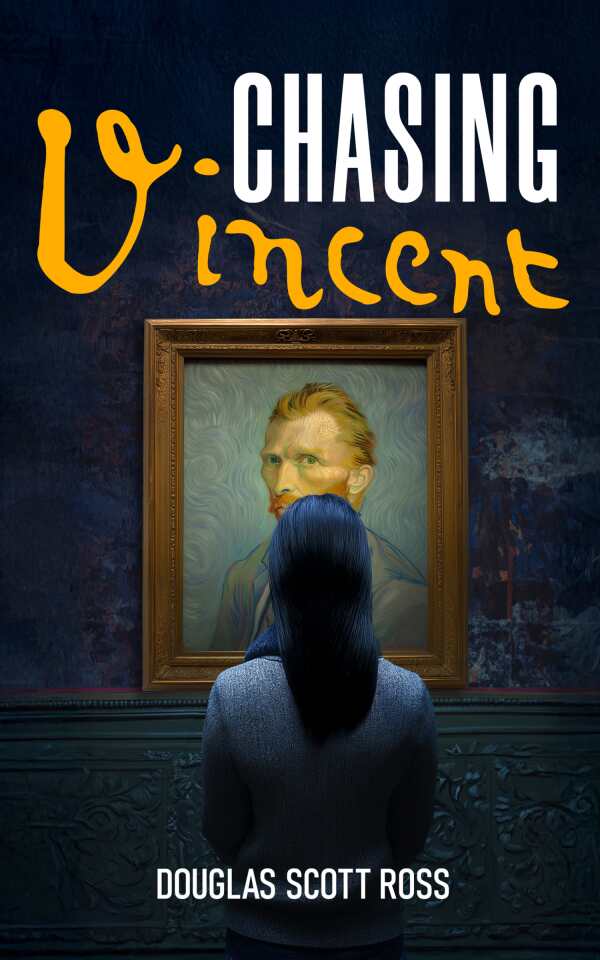
Chasing Vincent
A woman backpacking across Europe to reconnect with her family’s Jewish roots is put in danger because of a stolen painting in the suspenseful thriller Chasing Vincent.
A bereaved woman traces her family history in Douglas Scott Ross’s exciting thriller Chasing Vincent, about art theft and the bravery of Holocaust survivors.
In Nazi-occupied France, a Vincent van Gogh portrait of a beautiful teenager, Marie, is stolen on behalf of Hermann Göring. In 2002, Julie, Marie’s great-granddaughter, is a medical-school graduate who plans to scatter her father Jacob’s ashes in the Swiss Alps and to reconnect with her family’s Jewish roots. But as people scheme to claim the painting, she is put in jeopardy.
From inherited jewels to the excitement of chases, intrigue surrounds Julie’s heritage. Her travels in Europe are fleshed out via details of the scenery—a mix of her admiring observations of lavender fields and museums with insights into harsh conditions on the continent. She witnesses unfair conditions during a Swiss border stop at a refugee camp, for example, and is subjected to doubt after her passport and other documents are stolen—a microcosmic tie to what her ancestors endured.
Told across a multiperspective dual timeline, the novel trades between the sentient painting of Marie, who refers to herself as Moi, and Julie. Moi recounts how Jacob was separated from his family when the Vichy police arrived; she also discusses her own creation, opining on other artists and delighting to find herself among the stolen paintings of other artistic masters. Julie’s sections focus on her solo backpacking adventure and the serendipitous twists that lead to the painting. She matures through the trials she faces, proving resilient. A few letters by Van Gogh, an interlude covering Jacob’s childhood, and the stories of Julie’s adversaries are additional points of focus.
The prose is straightforward and action focused. Its transitions between locales are rushed and there are some gaps in the timeline, though. Secondary characters are introduced in abrupt succession and are ill–fleshed out: A man is charmed by Julie’s resemblance to Marie; a banking family and a henchman play into the story; a colleague of Julie’s father turns up to explain his art-related mission, his presence short lived.
Portions of Moi’s story strain credulity too much, however, proving distracting. She hears and spies more than her vantage as a canvas could allow. Her thought patterns are also exclamatory. Indeed, the light, magical quality around her existence is at odds with the gravity of the tragedies described. Further, shortcuts in the plot prevent some of its elements from being explored in full: People are murdered with minimal reactions from others, off-page moments are alluded to, and a major turn is disclosed via a newspaper headline. The foreboding finale makes room for further developments later.
Concerned, in part, with restitution for Jewish families impacted by the Holocaust, the cinematic thriller Chasing Vincent is about a woman’s imperiled family legacy.
Reviewed by
Karen Rigby
Disclosure: This article is not an endorsement, but a review. The publisher of this book provided free copies of the book and paid a small fee to have their book reviewed by a professional reviewer. Foreword Reviews and Clarion Reviews make no guarantee that the publisher will receive a positive review. Foreword Magazine, Inc. is disclosing this in accordance with the Federal Trade Commission’s 16 CFR, Part 255.


