

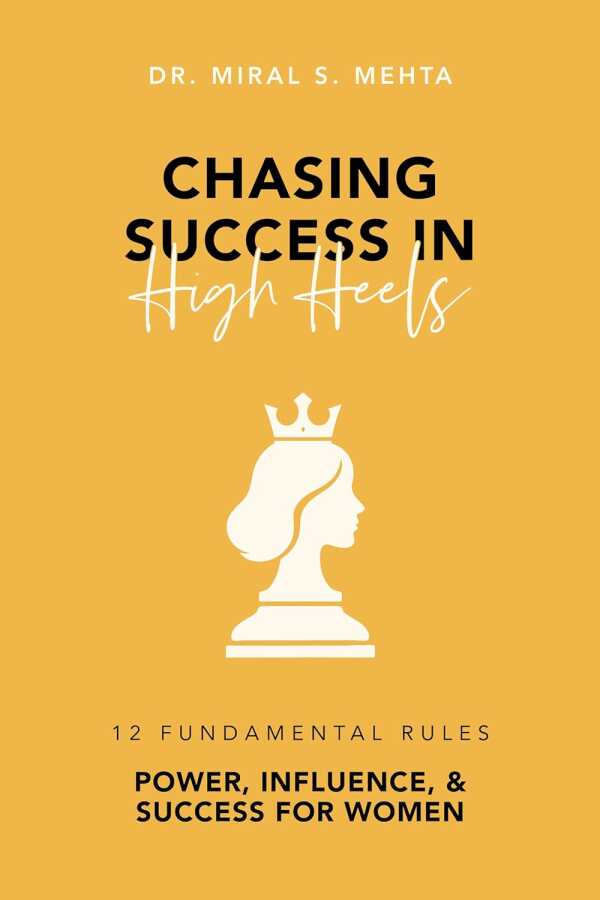
Chasing Success in High Heels
12 Fundamental Rules Power, Influence, & Success for Women
Chasing Success in High Heels is a supportive career guide for women.
Miral S. Mehta’s career guide for women, Chasing Success in High Heels, draws on the life stories of influential women throughout history to posit tips for professional success.
The book introduces twelve rules for fostering strength, courage, and resiliency in workspaces that are dominated by men. They include manifestation techniques, meditation sequences, and goal-making strategies for achieving women-centered success. A wide scope of topics is included, from picking one’s battles to remaining authentic.
Despite the central framing of twelve rules, the book has a disorganized quality. Subsections beneath particular rules are often ill-defined; for instance, a heading related to better opportunities after rejected battles is instead followed by multiple paragraphs about fighting inner battles. Furthermore, multiple chapters are without clear throughlines, and several rules are in discordance with each other (one rule encourages women to accept and reflect on all of their emotions; another suggests that they “eliminate” emotions like guilt, frustration, and anxiety).
The prose oscillates in quality, sometimes given to excesses of description and at other times proving quite vague. Indeed, some ideas are overexplained, as with the rule related to intuition, wherein three famous women’s lives are held up as proof of intuition alongside dozens of paragraphs repeating ideas about what intuition is, why it exists, and how to nurture it. At the opposite end, other rules are shared without a direct sense of how they might be applied in one’s personal life, as with the concept of “aligned perfection,” which is described in relation to Mehta’s personal experiences of perfectionism, but without a clear indication of what “aligned perfection” is or how to take action within it.
The book’s persuasiveness rests in its bold approach, though ultimately, too few of its points are well supported. It argues, for instance, that 90 percent of those who hear hypothetical boardroom scenarios involving two people will imagine that the inferior employee is a woman—a striking claim shared sans corroborating evidence. Also limiting is the book’s narrow view of women: The majority of the hypothetical situations that it posits are in relation to women having children, a spouse, and having to decide between work and home. Elsewhere, attributions of courage amid adversity to an amorphous “something inside a woman’s heart” prove too lofty to be compelling.
A supportive career guide for women, Chasing Success in High Heels outlines methods for succeeding in business and in life.
Reviewed by
Jennifer Maveety
Disclosure: This article is not an endorsement, but a review. The publisher of this book provided free copies of the book and paid a small fee to have their book reviewed by a professional reviewer. Foreword Reviews and Clarion Reviews make no guarantee that the publisher will receive a positive review. Foreword Magazine, Inc. is disclosing this in accordance with the Federal Trade Commission’s 16 CFR, Part 255.


