

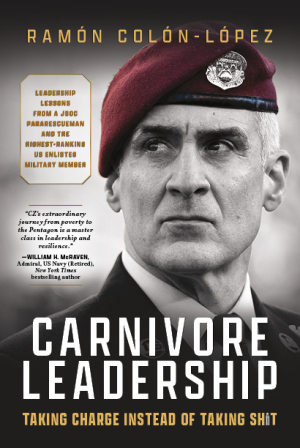
Carnivore Leadership
Taking Charge Instead of Taking Shit
The firm leadership guide Carnivore Leadership argues that being a strong leader requires ingraining disciplined risk-taking habits into one’s psyche.
Ramón Colón-López’s leadership guide Carnivore Leadership explores what success requires, both in the military and in general life.
Drawing on Colón-López’s careers in the United States Air Force and the Department of Defense—indeed, the book includes comprehensive, involving coverage of Colón-López’s thirty-plus-year military career—the book’s concept of success is based on a dichotomy between carnivores (disciplined and loyal risk-takers) and herbivores (lazy and unreliable defeatists). Interweaving personal anecdotes with actionable suggestions, it argues that being a strong leader requires ingraining carnivore habits into one’s psyche. Herein, striving for perfection and uniting opposing forces are keys to success.
In outlining its notions of carnivore versus herbivore leadership, the book’s organization proves to be tidy and direct. Its prose is accessible and descriptive, if also rather rigid in its reliance on the overarching military conceit. Every acronym is well-defined; central principles, as with “Loyalty is not mindless obedience” and “Never ask anyone to do anything that you are not willing to do yourself,” are held up as “silver bullets”; and the analogy of a bolt-action hunting rifle is used to argue that patience and listening are important.
But repetition also occurs, as with the many phrases that echo the idea of working for an organization that has passion and purpose. Elsewhere, the phrase “commitment, patience, and discipline” is used multiple times in the same paragraph, and accountability is brought up and defined in multiple silver bullets. The principles connected to the silver bullet about staying in shape are repeated in the silver bullet about lasting impressions, with little noticeable deviation between the two presentations.
Further, the integration of the book’s personal stories into its leadership principles is not always smooth. For example, in the discussion of a silver bullet about leading with dignity and respect, Colón-López launches into a lengthy description of the downfalls of social media and the importance of marriage, followed by discussions of the necessity of personal accountability, without clearly tying these ideas back to the concepts of dignity and respect. Elsewhere, a discussion of loyalty is delayed by several paragraphs on Colón-López’s views on polarization in US politics.
In the memoir–cum–leadership guide Carnivore Leadership, military recollections wind into a guide about developing the character attributes it proclaims essential to separating strong leaders from weak ones.
Reviewed by
Jennifer Maveety
Disclosure: This article is not an endorsement, but a review. The publisher of this book provided free copies of the book and paid a small fee to have their book reviewed by a professional reviewer. Foreword Reviews and Clarion Reviews make no guarantee that the publisher will receive a positive review. Foreword Magazine, Inc. is disclosing this in accordance with the Federal Trade Commission’s 16 CFR, Part 255.


