

Bloodletting a Butterfly
Poems
Bloodletting a Butterfly is an intricate narrative poetry collection that speaks to the trauma of witnessing human pain.
Alec B. Hood’s gothic poetry collection Bloodletting a Butterfly probes experiences of trauma.
In striking language and imagery, these untitled poems carve out scenes in which street-level emergency care is given to people with fatal, often gory injuries. The cumulative effects of witnessing the deaths of innocents and absorbing others’ pain leave permanent marks on the speaker’s psyche. As the book progresses, the capacity to identify with others extends to a wider range of suffering, bringing his empathy at last to bear upon himself.
The book begins with an interrogative exchange between a surgeon and Subject 06, who is the speaker in the poems. Their conversation concerns whether Subject 06 is eligible for a mysterious procedure. The poems that follow alternate with four subsequent exchanges, or Intermissions, that introduce different triggers of vicarious trauma, including direct witnessing, collective witnessing, political witnessing, and empathizing. The interrogations serve as points of suspense about the nature of the surgeon’s procedure and whether Subject 06 will be found eligible for it.
Unified yet complex, the poems are sometimes narrated with all-seeing confidence; at other times, the speaker doubts his purpose and efficacy. In a moment of political despair, he tells a tyrant’s tarantula “he can keep using my severed tongue as a toothbrush / because it’s probably for the best / that i just never speak again.” There’s significant literary irony in such lines, which undercut the speaker’s authority even as the memorable images insist on that very authority.
Depictions of up-close carnage evoke empathy for victims and medical personnel alike: “it’s the cpr that circulated blood / right out the bullet holes in his back.” Alliteration and repetition amplify some scenes, as with that of a mother listening to her premature infant’s heart through the speaker’s stethoscope, which ends with “as the silence sunk in / she sunk with it.” Indeed, the sense of trauma multiplies because of such constructions, mimicking how the repetitive exposure to trauma can have a hardening effect, as with “a cop crouching over a kid’s corpse / declaring their life a cautionary tale.”
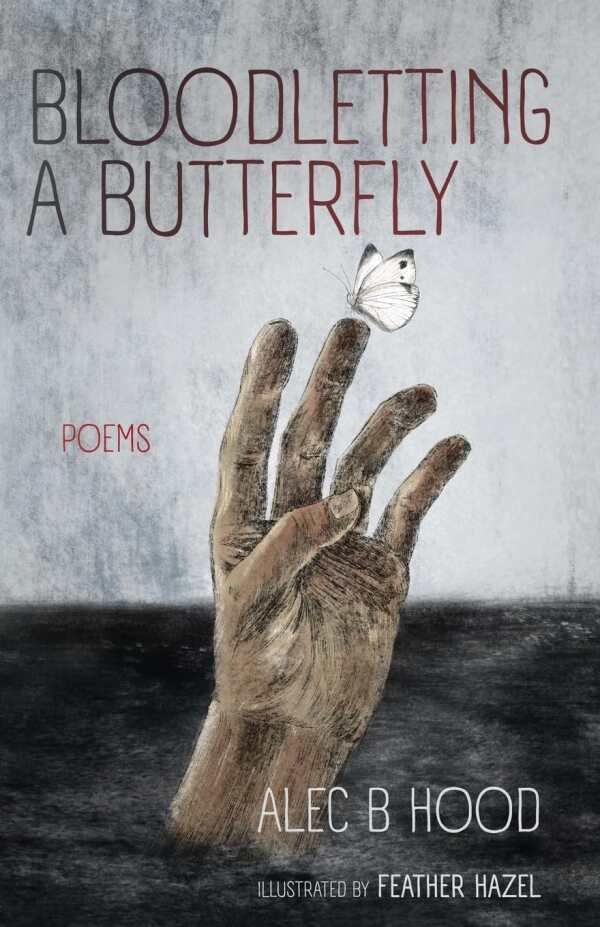
The scenes blur together on occasion, though, and alliteration is sometimes used to excess, with meanings buried under the weight of single sounds piling atop themselves. Malapropisms also arise to distracting effect, as with “These are supposed to illicit emotional reactions.” But the illustrations accompanying most of the poems are complementary. In their symmetry and beauty, these are sources of visual relief from the poems’ relentless psychological chaos, even when they illustrate horrors.
The multifaceted narrative poetry in Bloodletting a Butterfly explores vicarious trauma, devoting keen attention to its inner reality.
Reviewed by
Michele Sharpe
Disclosure: This article is not an endorsement, but a review. The publisher of this book provided free copies of the book and paid a small fee to have their book reviewed by a professional reviewer. Foreword Reviews and Clarion Reviews make no guarantee that the publisher will receive a positive review. Foreword Magazine, Inc. is disclosing this in accordance with the Federal Trade Commission’s 16 CFR, Part 255.


