

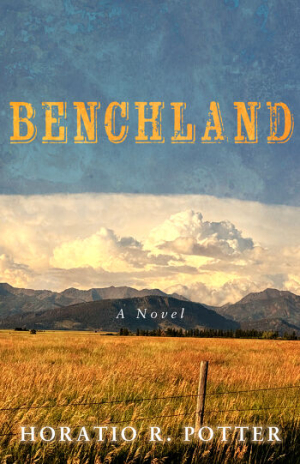
Benchland
Concerned with the transformation of rural communities under the pressures of regeneration, Benchland is a revealing and atmospheric novel.
Horatio R. Potter’s compelling novel Benchland depicts life in rural Montana.
Abe is a miner returning from Nevada to Montana. His identity is inseparable from his passion for his work. Still, he is conflicted, caught between his “craving” for mining and his fragile domestic life with his girlfriend, Lucy, who has a traumatic past. Abe’s sense of displacement is compounded by his family’s East Coast roots, which mark him as an outsider in a landscape that he wishes to claim as his own: “Compared to her, he was incomplete … only a transplant, a newcomer, a derelict from the east.” Parallel to Abe’s story are the stories of McCafferty and his daughter, Beth. Their struggling ranch embodies the broader economic and cultural shifts reshaping Montana: “Unimaginable wealth was pricing out families who had called Montana home for generations.”
The prose is poetic—attentive both to the vastness of Montana’s landscape and the fragile private lives of the characters. Indeed, the novel excels in its characterizations, with its central characters rendered in nuanced detail. Through their layered backstories and their strong perspectives, Abe and McCafferty take shape as complex and developed people. In a similar manner, Beth is a complex heroine. With a strong political consciousness, she proves resolute and refuses to accept the inherited logic of ranching. She represents a departure and reinvention of the self, including when she considers leaving Montana.
But some of the secondary characters, including Nicole, Beth’s lover, are underdeveloped. Nicole is present more to support Beth’s trajectory than she is on her own merit. Moreover, the novel’s inconsistencies in character names are distracting, as with the case of Lucy, Abe’s girlfriend, whose name and nickname are used in an interchangeable manner.
Through its interconnected storylines, the book explores what it means to inherit a place, and what happens when that inheritance is challenged or denied. People’s habits, trauma, and expectations prove to be intergenerational. Considerations of labor and the transformation of rural communities under the pressures of regeneration are portrayed well, against the paradoxical reality that those who built the land can no longer afford to remain on it.
The parallel storylines seem separate when the book begins, as though it is concentrated on disparate individuals whose fates are tied to the land and labor. However, as the book continues, these storylines build toward a cumulative reckoning, tying personal conflicts to larger structural themes.
Benchland is a thoughtful novel about family life set against the backdrop of changing rural landscapes.
Reviewed by
Defne Tekin
Disclosure: This article is not an endorsement, but a review. The publisher of this book provided free copies of the book and paid a small fee to have their book reviewed by a professional reviewer. Foreword Reviews and Clarion Reviews make no guarantee that the publisher will receive a positive review. Foreword Magazine, Inc. is disclosing this in accordance with the Federal Trade Commission’s 16 CFR, Part 255.


