

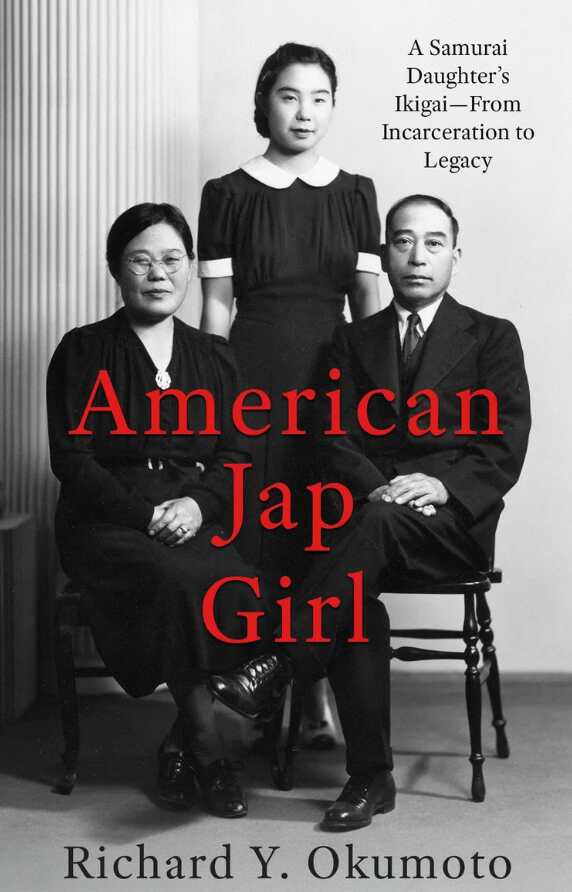
American Jap Girl
A Samurai Daughter's Ikigai---From Incarceration to Legacy
Newsworthy happenings are given new, intimate dimensions in the inventive historical biography American Jap Girl.
Researcher Richard Y. Okumoto draws on documents, memory, and imagination to reconstruct his mother’s life, from her perspective, in the innovative biography American Jap Girl.
Having grown up in the United States, Tome considered herself an all-American girl. However, her stepfather was a descendant of the samurai class, and he delivered lessons corresponding to Japanese ideals throughout her childhood. Thus she learned about ikigai (life purpose) and gambari (tenacity)––values that were sources of strength for her and her son during difficult times.
Incidents in Tome’s life collided with major events in American history, including the polio epidemic, the incarceration of Japanese Americans under Executive Order 9066, the atomic bombings of Hiroshima and Nagasaki, and the assassinations of President John F. Kennedy, Martin Luther King Jr., and Robert F. Kennedy (the latter’s killer attended the same high school as Tome’s son). Through her story, such newsworthy happenings are given new, intimate dimensions.
Tome left behind a cache of letters, journals, and photographs that feed into the book, which is written from her point of view until her death. Here and elsewhere, the book’s narrative approach is inventive. Indeed, it even includes a scene depicting Tome’s thoughts at her death.
The prose is eloquent, resulting in vivid scene setting, descriptive passages of qualities like “the smell of fresh wildflowers in [the] fields, and quiet nights occasionally interrupted by an old owl or the cry of coyotes or injured animals in the distance.” However, its recreated conversations are somewhat stilted, with their participants seeming to recite, rather than live, their lines. Further, Okumoto’s three siblings are all but excluded from the tale, which concentrates on Tome’s bond with the author—her youngest, “mystical child,” who intercepted her attempted suicide.
The book is also structured in accordance with academic conventions: A brief section describes its methodology, and short passages describe the content to be introduced in the ensuing chapters. The principles of narrative inquiry, life history, and cultural phenomenology are also used throughout to explore issues of identity, survival, and maternal love. Original field data, including a letter from President George H. W. Bush, and Tome’s handwritten notes are included in an appendix at the end of the book.
A revealing hybrid memoir, American Jap Girl memorializes a resilient woman who faced many hardships in the course of her life.
Reviewed by
Suzanne Kamata
Disclosure: This article is not an endorsement, but a review. The publisher of this book provided free copies of the book and paid a small fee to have their book reviewed by a professional reviewer. Foreword Reviews and Clarion Reviews make no guarantee that the publisher will receive a positive review. Foreword Magazine, Inc. is disclosing this in accordance with the Federal Trade Commission’s 16 CFR, Part 255.


