
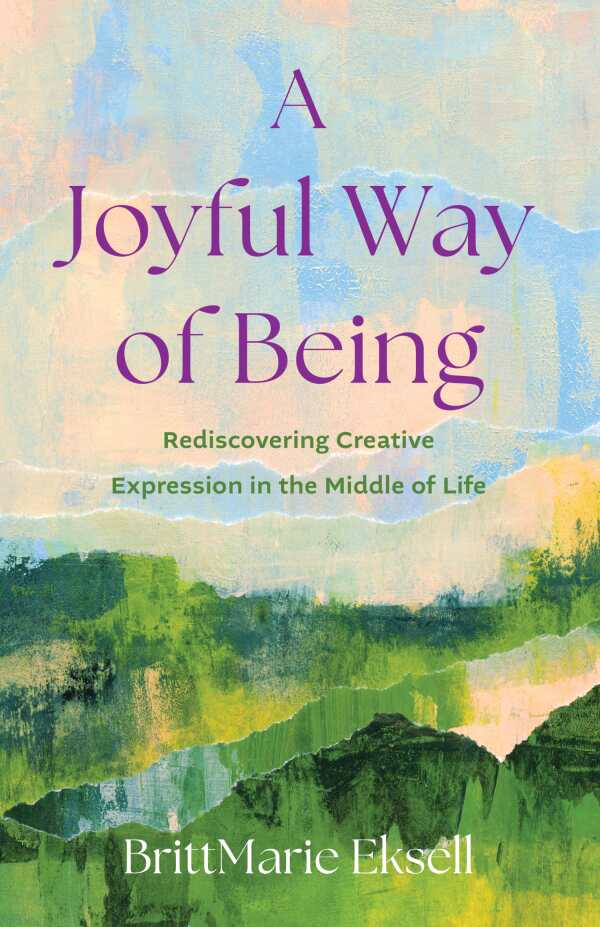
A Joyful Way of Being
Rediscovering Creative Expression in the Middle of Life
An encouraging self-help text for older audiences, A Joyful Way of Being suggests that making and enjoying art is key to finding and unlocking joy.
In BrittMarie Eksell’s guided workbook A Joyful Way of Being, creativity is proposed as a tool for navigating later life with wonder.
Drawing on the stories of Eksell’s therapy clients, personal anecdotes, and influential texts, this book depicts post-midlife as an opportunity to reignite one’s creative passions, which are sometimes lost during earlier adult stages. It asserts that the first step is shedding layers of criticism and doubt acquired since childhood, when self-expression is easy. Writing, photography, and art exercises with other household mediums are recommended to start the process of rediscovering one’s dormant impulses to create and express.
Guided by the sense that making and enjoying art is key to finding and unlocking joy, the book’s beginning chapters focus on reviving avenues to personal expression; they emphasize the necessity of regaining one’s intuitions too. Discussions follow of how symbols and myths enable emerging artists to work, succeeded by chapters on nature, loss, and resiliency (as an example, Eksell notes that regular “dates” with art and nature awakened her senses to connect to beauty) that synthesize art and psychology. The chapters end with prompts for artistic exercises; these vary in their sense of structure.
Most points are supported by appeals to Eksell’s clients’ experiences, ranging from explanations of why they sought out her methods in the first place to endorsements after the fact, pronouncing how they change as a result of her guidance. The visual examples are comparatively sparse, though, made up of Eksell’s own photographs and the work of two of her students, with other clients’ artworks described but not pictured. This leads to some gaps when artworks’ colors and textures are analyzed for what they convey about their makers’ emotions, when the small, black-and-white works featured lack these qualities.
Still, this is a supportive text, person-centered and action-oriented. Hero stories and narratives about fear and burnout are set in contrast to the recommended exercises for addressing the difficulties that older people confront. People are urged to take notice of beauty, create, and contemplate, exemplifying lived positivist philosophies. The closing exercise also encourages ongoing growth via individuated projects—a cozy and inviting conclusion to a nurturing work.
Approaching self-improvement through artistic exercises and commentary on the healing, A Joyful Way of Being is an affirming self-help text for those in life’s later stages.
Reviewed by
Mari Carlson
Disclosure: This article is not an endorsement, but a review. The publisher of this book provided free copies of the book and paid a small fee to have their book reviewed by a professional reviewer. Foreword Reviews and Clarion Reviews make no guarantee that the publisher will receive a positive review. Foreword Magazine, Inc. is disclosing this in accordance with the Federal Trade Commission’s 16 CFR, Part 255.


