
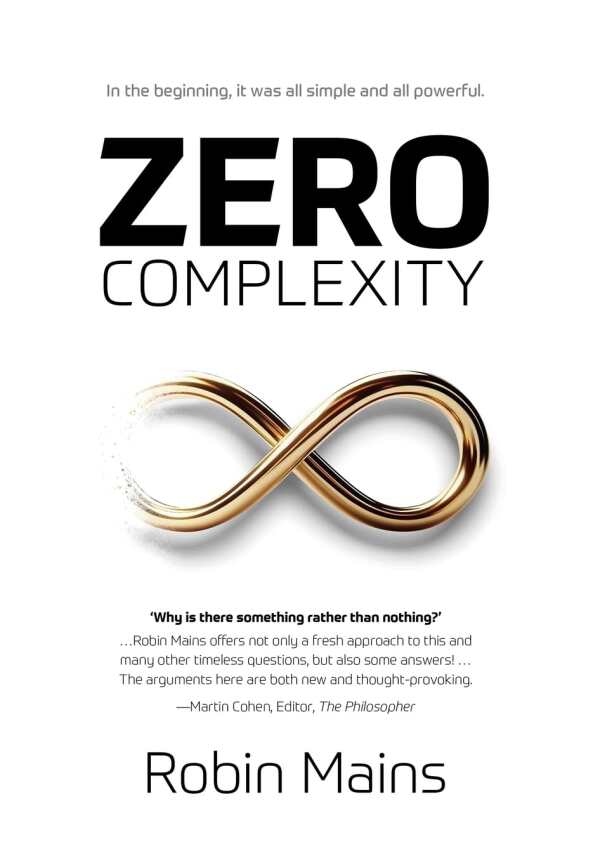
Zero Complexity
Zero Complexity is a compelling philosophical treatise that issues a sustained challenge to traditional religious and philosophical assumptions.
Robin Mains’s sweeping metaphysical text Zero Complexity argues for replacing traditional religious frameworks with new logical systems positioned as pathways toward morality, meaning, and peace.
Humanistic in orientation, the book grounds its claims in atheism and “emotional logic,” a conceptual structure meant to reconcile rational thought with the motivating forces of emotion. Through this framework, it suggests an alternative to religious absolutism. It also proposes reframing the fundamental questions of existence, purpose, and reality through a nontheistic lens.
At the center of the text stands the “Argument from Diversity,” which introduces and connects the book’s larger philosophical propositions. This argument critiques religious worldviews as sources of division and asserts that a unified worldview—rooted in shared logical principles, emotional resonance, and mutual understanding—is the most reliable route to peace. Through repeated reference to this core claim, Zero Complexity engages in metaphysical analyses intended to show that the concept of a creator deity is “logically indefensible” and that “creation itself is a contradiction.” From this premise, it constructs a moral system that shifts ethical authority from the divine to the human, suggesting that emotional logic can serve as a universal moral guide.
The structure of the Argument from Diversity rests on five interconnected claims that shape the book’s broader worldview. Although the prose is plainspoken, the rhetorical movement carries a sense of acceleration—an accumulation of interdependent ideas in which each assertion pushes the next. Much of this force comes from the text’s urgent tone rather than the strength of its abstract claims. Zero Complexity often redefines established concepts to support its own architecture, introducing new interpretations of common terms without acknowledging the speculative nature of these shifts. A representative passage appears early in the book:
The term equality can be defined as ‘without diversity’, although this usage is unconventional. A reality of equality, therefore, describes one devoid of any type of difference. Within such an existence, there cannot be two atoms, two stars, two elements, or two individuals. Given its ultimate simplicity, we can also refer to it as a state of zero complexity.
Passages like this reveal both the book’s instructional style and its philosophical limits. Its definitions often collapse distinctions in service of predetermined conclusions—a reductionist impulse that is central to the project. Indeed, Zero Complexity attempts to build an entirely new ontological vocabulary, and its illustrations and diagrams serve as tools for moving through the text’s conceptual reconstruction.
Still, the book’s sustained challenge to traditional religious and philosophical assumptions is compelling. By proposing a unified worldview grounded in logic and emotional resonance, it recasts the nature of being as a set of limits, identities, and structural relationships. Its metaphors and redefinitions aim to render complex abstractions accessible, even when its arguments rest on speculative premises.
A creative philosophical treatise, Zero Complexity introduces a provocative framework for understanding divinity, reality, and the moral capacities of the human experience.
Reviewed by
Xenia Dunford
Disclosure: This article is not an endorsement, but a review. The publisher of this book provided free copies of the book and paid a small fee to have their book reviewed by a professional reviewer. Foreword Reviews and Clarion Reviews make no guarantee that the publisher will receive a positive review. Foreword Magazine, Inc. is disclosing this in accordance with the Federal Trade Commission’s 16 CFR, Part 255.


