

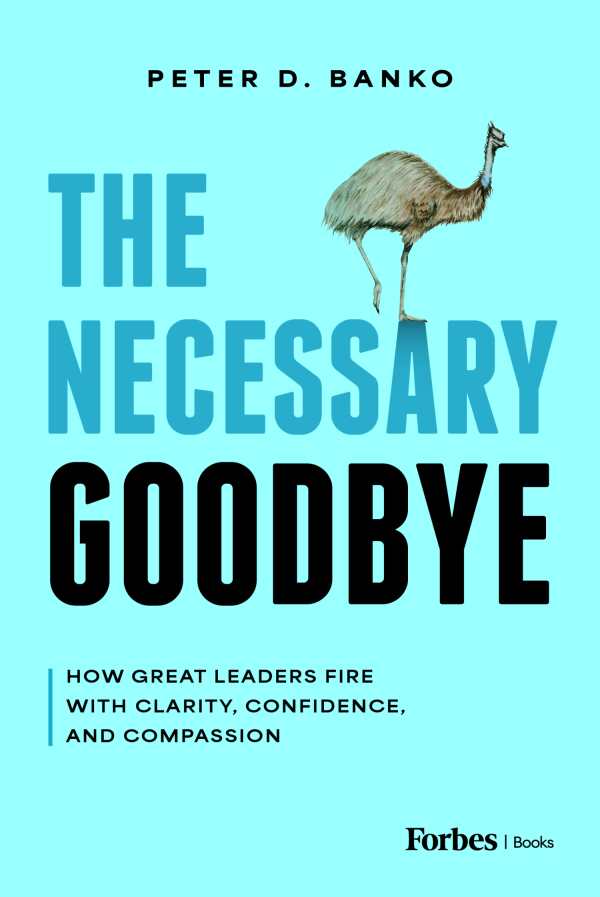
The Necessary Goodbye
How Great Leaders Fire with Clarity, Confidence, and Compassion
The Necessary Goodbye is an astute leadership guide that provides executives with a lexicon to understand the emotional dynamics of employee termination beyond nominal performance metrics.
Health executive Peter D. Banko’s edifying leadership guide The Necessary Goodbye covers the process of terminating nonperforming employees with clarity, confidence, and compassion.
Drawing on Carl Jung’s archetypes as guidelines for human characterization, this book aims to reframe employee termination as a standard leadership function that is essential for sustaining organizational longevity. It proposes twelve “firing” archetypes, including the Lover, Caregiver, Jester, and Sage, as a conceptual framework to gain insights into the human psyche and better understand oneself and others. By recategorizing termination scenarios this way, the book provides executives with a lexicon to understand the emotional dynamics of employee termination beyond nominal performance metrics.
The “firing” archetypes are engaging, yet the connection between certain archetypes, and the reasons for firing employees, is distant. For example, the book presents the reasons for firing “the Innocent” archetype as being structural as opposed to employee behavior or performance. This weakens the clarity of the “firing” archetypes, as structural layoffs are not driven by the archetype framework; they reflect organizational restructuring or cutting costs rather than individual performance.
In terms of originality, the book does an able job of treating the termination of employees as a necessary act of organizational stewardship. To support this perspective, it uses a hybrid method of evidence that blends secondary data from sources including the Harvard Business Review and the Gallup workplace report with intuitive personal anecdotes drawn from Banko’s two decades as a healthcare chief operating officer. While the anecdotal evidence is compelling, it is more oriented toward healthcare and large corporate structures rather than small business owners.
Structurally, the book unfolds in a clear, logical manner, beginning by establishing why terminating employees is necessary, transitioning into identifying employee types through the firing archetypes, and culminating with guidance on executing employee departure and managing the aftermath. Almost every chapter concludes with practical takeaways and advice for what comes next—sections that prove imperative for both skimming and implementation.
Still, the book’s organization stumbles under the weight of its own structure. The middle section of the book, which is dedicated to detailing the twelve firing archetypes, is quite exhaustive, and the twelve archetypes are handled in too similar a manner throughout: Each is defined, with this groundwork followed by anecdotal evidence and a pronounced firing strategy. Each instance of recurrence diminishes the impact of the book’s otherwise valuable insights.
The prose is conversational and direct, with a touch of informality that is designed to persuade audiences rather than overwhelm them with data. As a result, the book reads less like a manual than it does a high-stakes mentorship session. It persuades by normalizing the discomfort of firing, using metaphors like “Emu Power” to illustrate how leaders must move forward decisively and without retreat. Such recurring motifs anchor the book’s philosophy on forward leadership momentum well.
A pragmatic leadership and management guide, The Necessary Goodbye treats the termination of employees as an essential stewardship role that is crucial for organizational health.
Reviewed by
Taona Ian Chirumarara
Disclosure: This article is not an endorsement, but a review. The publisher of this book provided free copies of the book and paid a small fee to have their book reviewed by a professional reviewer. Foreword Reviews and Clarion Reviews make no guarantee that the publisher will receive a positive review. Foreword Magazine, Inc. is disclosing this in accordance with the Federal Trade Commission’s 16 CFR, Part 255.


