

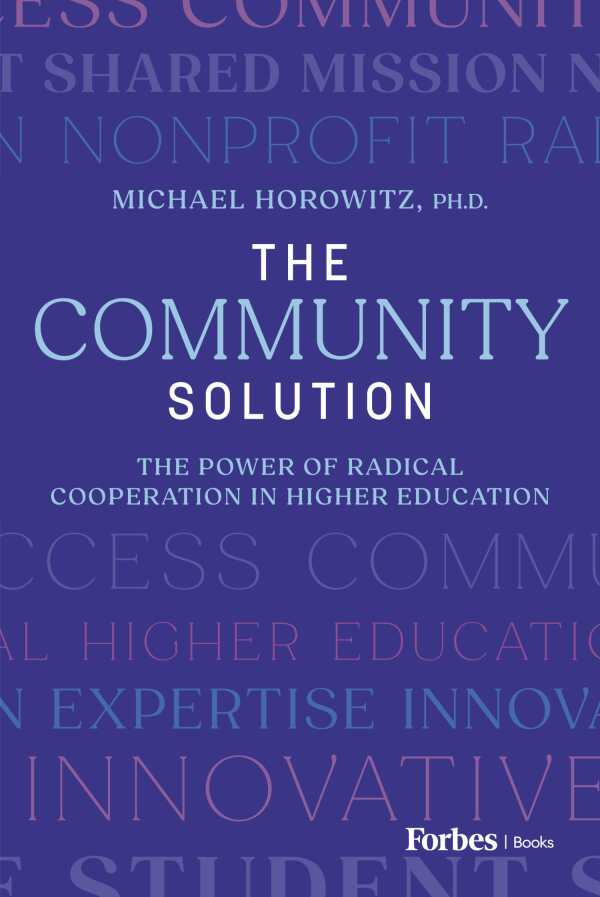
The Community Solution
The Power of Radical Cooperation in Higher Education
Encouraging the industry-wide embrace of collaboration, The Community Solution is an illustrative higher-education guide.
Leading by example, Michael Horowitz’s educator’s guide The Community Solution analyzes a strategic collaboration between six institutions of higher education.
Directed toward small colleges and universities facing falling enrollment and rising administrative costs, this book introduces an intentional model based on the philosophy of “radical cooperation.” It was implemented among six diverse colleges and universities at which Horowitz served as chancellor. The participating institutions sharpened their programming niches and relationships with students and relied upon other system participants to help them consolidate expertise in crucial operational domains like information technology and human resources.
Targeted at administrators, trustees, and consultants, the book is organized well, based on chronological patterns. The first part follows Horowitz’s development and success in higher education and analyzes the decline of small, private institutions beginning with the 2008 recession. Buzzwords, including “silos” and “redundancies,” are used to describe programs that struggle because they shut themselves off from external help or spend too many resources on tasks and durables that might have been shared.
Once these problems are illustrated, a solution based on “radical cooperation” is proposed, and that solution is framed in the chronology of the central model’s development and ultimate success, charted in the book’s second part. The third part expands upon and further explains elements of radical cooperation, including two-way learning and continuous urgency. It uses narratives to illustrate these elements.
The prose throughout is confident, inclusive, and patient, reflecting the radical collaboration model’s prioritization of “collective success over individual gains.” Jargon specific to the academic world is well defined and illustrated. However, the book’s argumentation style varies in its ability to compel outside audiences. Some of its claims are too reliant on anecdotal evidence, while others seem common sense. For instance, the book asserts that colleges can pool their administrative resources to save money, as well as that experts should collaborate on problem-solving, as two heads are always better than one. Further, too few of the book’s conclusions are supported by peer-reviewed studies or outside data, such as the claim “Our focus on conducting much of our education in the field keeps our programs fresh and our graduates workforce-ready.”
A passionate guidebook to reforming higher education, The Community Solution builds its proposed model on a personal story of being in community with other professionals in order to level up one’s own organization.
Reviewed by
Michele Sharpe
Disclosure: This article is not an endorsement, but a review. The publisher of this book provided free copies of the book and paid a small fee to have their book reviewed by a professional reviewer. Foreword Reviews and Clarion Reviews make no guarantee that the publisher will receive a positive review. Foreword Magazine, Inc. is disclosing this in accordance with the Federal Trade Commission’s 16 CFR, Part 255.


