

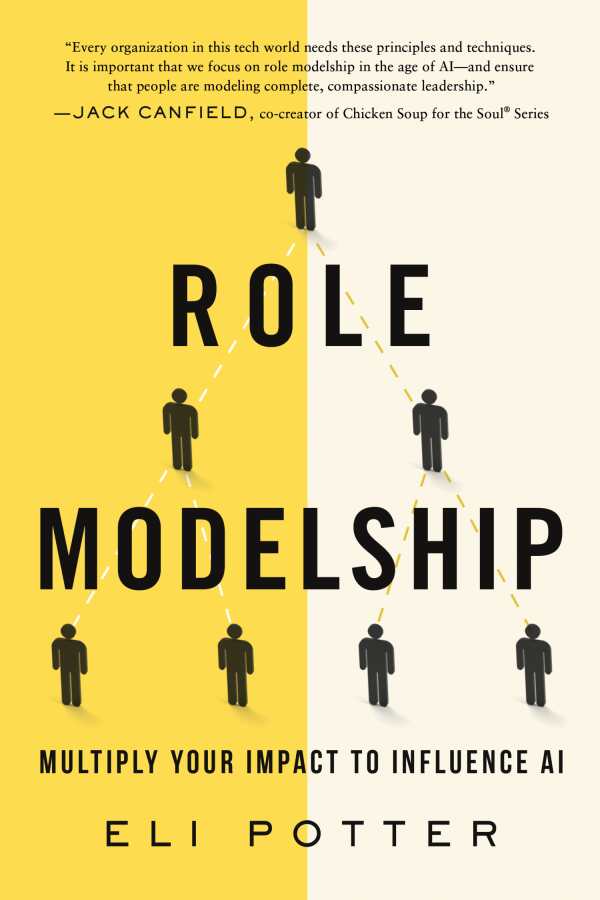
Role Modelship
Multiply Your Impact to Influence AI
Arguing that values-driven leadership multiplies a business’s impact and successes, Role Modelship is a compelling leadership guide.
Eli Potter’s ethics-driven leadership guide Role Modelship is about drawing on one’s personal values to effect organizational transformation.
Arguing that intentionality represents the critical counterweight to artificial intelligence, this book introduces a unified practice that encompasses five disciplines: stewardship, fellowship, mentorship, leadership, and sponsorship. It contends that as AI systems learn from human behavior, the quality of role models shapes machine intelligence too. And it asserts that values-driven leadership multiplies a business’s impact and success. Interviews with executives, educators, and entrepreneurs whose careers illustrate ethical principles are used to support its points.
The book’s organizational structure mirrors its central premise that transformation occurs through systematic, compounding habits. The BRAVER change-management framework—Baseline, Research, Adapt, Voice, Exemplify, Reward—for individual and organizational development adds in additional tools, including Harvey ball visualizations for assessing maturity, two-by-two matrices for identifying windows to social change, and sprint calendars for implementing twenty-one-day habit cycles. This scaffolding transforms abstract leadership philosophies into actionable methodologies. The Crawl-Walk-Run maturity framework also appears for assessment of progress across different contexts, from individual career development to product design to corporate culture. Each framework reinforces the others, creating an ecosystem of complementarity.
The book’s examples are encouraging, as with its profiles of figures ranging from Jeff Brzycki, the former Autodesk CIO who transformed IT culture through agile adoption, to Dominique Shelton Leipzig, a privacy CEO who has trained thousands of people in AI governance. Jamie Butler, a high school choir director raising scholarship funds while teaching social justice through music, is also highlighted. These subjects are shown to have demonstrated the Role Modelship methodology across different contexts, suggesting that the five disciplines function as universal principles. The book also notes that even exemplary role models practice imperfectly, with growth emerging from repeated attempts rather than flawless execution.
The prose is clear and direct, its metaphors drawn from the fields of technology, space exploration, and architecture. The book incorporates Bulgarian proverbs, Beatles lyrics, and references to Dune and The Matrix, humanizing its work. Its short paragraphs and frequent subheadings maintain momentum through its dense conceptual terrain. And Potter’s anecdotes as an immigrant who arrived in the US with two suitcases, learned English from song lyrics, and ascended through Silicon Valley’s ranks are encouraging. Less involving, but ultimately persuasive, are the book’s economic arguments, used to calculate the network effects of the system and to demonstrate how values-driven organizations achieve higher revenue multiples. Indeed, these points connect intangible cultural qualities to concrete financial outcomes well. And a discussion of organizational memory as an antidote to fragility, coupled with an analysis of how promotion processes reveal cultural health, is also compelling.
An eye-opening leadership guide, Role Modelship positions human values as both a competitive advantage and an existential necessity in an AI-saturated world.
Reviewed by
John M. Murray
Disclosure: This article is not an endorsement, but a review. The publisher of this book provided free copies of the book and paid a small fee to have their book reviewed by a professional reviewer. Foreword Reviews and Clarion Reviews make no guarantee that the publisher will receive a positive review. Foreword Magazine, Inc. is disclosing this in accordance with the Federal Trade Commission’s 16 CFR, Part 255.


