

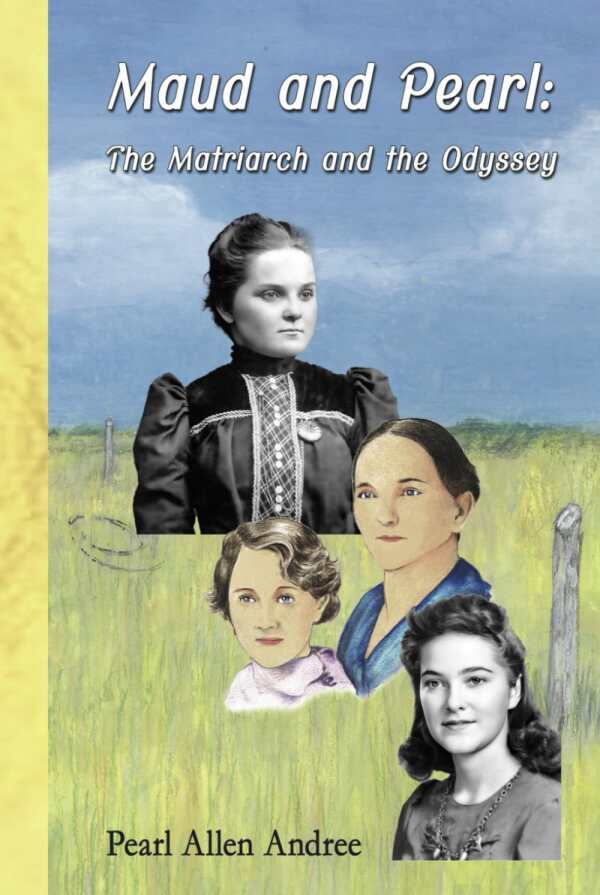
Maud and Pearl
The Matriarch and the Odyssey
An admiring family memoir, Maud and Pearl is about how multiple generations navigated a changing American landscape.
Pearl Allen Andree’s engrossing memoir Maud and Pearl balances family pride with personal and historical context.
Born in 1927, Andree was the youngest of nine siblings. Her mother, Maud, came to the frontier as a girl by covered wagon; she had a “deep joyous laugh” and became a moral and spiritual example to her children. Andree’s enterprising father was ambitious but often self-focused. They met at a spelling bee social, and their 1902 marriage was tempestuous and marked by period features like homestead farming, oil drilling, and Dust Bowl droughts.
Andree spent much of her childhood on the family farm or moving between Oklahoma and Arizona. Her family home was lit by “coal-oil lamps” and lacked indoor plumbing; her mother managed an extraordinary workload of child-bearing and child-rearing on an erratic income. Some of Andree’s brothers were “fruit tramps” during the Great Depression, hitchhiking or riding freight trains to find agricultural jobs. Later, Andree trained in drama, elocution, and narrative storytelling. In 1955, her first husband vanished while on a “Cold War-related” flying mission.
The book alternates between autobiographical chapters and brief, anecdotal recollections of family members that enhance their characterizations. There are some similarities between its cast members, blurring the lines between individuals; for example, multiple of Andree’s siblings exhibited strong Christian faith and industriousness and married when they were young. Still, distinguishing observations arise: Alma was stylish and innovative, and cut her own hair when she was three; Ornan was the family comedian; while in California, Pete used his horticultural savvy and discarded branches to graft and grow a pistachio orchard.
Andree’s self-descriptions are assured, with attention placed on her lifelong determination to pursue educational and career opportunities as well as marriage and family. Nostalgic remembrances of her teenage outings, radio shows, and the “yeasty scent” of baking bread contrast with her later feelings of despondency following the death of her first husband and a stillbirth, as well as her distress over her second husband’s fascination with 1970s swinger lifestyles.
Still, the book is patchwork in its construction, incorporating biographical sketches, vignettes, song lyrics, musings, and recipes into its mix. It includes instances of repetition and comes across as disjointed at times. The narration is also undermined by its whimsy: While matters of race are considered, they are treated from a privileged vantage, for instance, and topics including segregation and lynchings in Oklahoma are acknowledged but somewhat glossed over. Elsewhere, passion is expressed for Mexican culture, and the book notes that several Black ministers attended Andree’s brother’s funeral to honor his fellowship efforts.
A heartfelt memoir, Maud and Pearl is the multigenerational saga of a family on the American frontier.
Reviewed by
Meg Nola
Disclosure: This article is not an endorsement, but a review. The publisher of this book provided free copies of the book and paid a small fee to have their book reviewed by a professional reviewer. Foreword Reviews and Clarion Reviews make no guarantee that the publisher will receive a positive review. Foreword Magazine, Inc. is disclosing this in accordance with the Federal Trade Commission’s 16 CFR, Part 255.


