

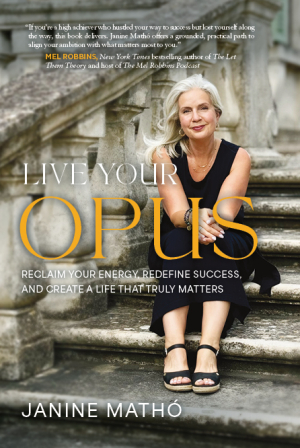
Live Your Opus
Reclaim Your Energy, Redefine Success, and Create a Life That Truly Matters
About redefining personal success and turning one’s visions into reality, Live Your Opus is an encouraging self-help book.
Inspired by the soul-searching that followed a sudden loss, Janine Mathó’s supportive self-help book Live Your Opus is about leading a meaningful, purposeful life.
Across its three parts, the book examines what it means to redefine success, dream, tap into one’s desires, and turn one’s visions into reality. Its proposed framework for renewed living is built on personal experiences, with its advice derived from Mathó having herself addressed the sudden “quiet” inside, cracks that became fractures, and a personal emotional recession. Indeed, vulnerable anecdotes appear throughout, as with stories of Mathó dealing with career burnout.
While some points and terms are returned to with unnecessary frequency throughout the book, its exercises and tools are individually edifying. These include tips for exploring change as a continuum and for pausing and breathing. Familiar coping strategies are emphasized throughout, and word pictures are used to ground some concepts in specific touchpoints. For instance, burnout is illustrated in terms of trying to power a city with a depleted grid, and the image of a person standing between their two selves on the way to personal growth is edifying.
To invigorate some of its familiar suggestions, the book points to studies and statistics said to spotlight the need for general society-wide change. A high percentage of workers are said to remain in draining jobs, for example. Common and sometimes ancient values like inner harmony are suggested as reliable counterbalances for such contemporary issues. Other illustrations, as with a figure eight with labeled segments that is used to convey fluidity, are used to flesh out complex points in a visual format. There’s also clear coverage of personality archetypes, like hesitators and navigators, to place the book’s recommendations in larger context.
The book makes big promises about the ability of its concepts and tools to lead to an overhauled life, and its case studies and accounts of lessons learned make its lofty gestures toward positive results appear accessible. Its overarching musical conceit appears throughout for continuity, though this is best developed in the book’s later sections. References to composing life, the value of pacing, and the rhythm of creating appear alongside assertions that one’s opus can never be considered fully finished. The book’s ultimate model for authentic achievements is encouraging, and its book-ending five tools for living out one’s “opus” are practical, building well on earlier points.
An optimistic self-help book, Live Your Opus models the pursuit of internal enrichment, self-acceptance, and persistence in the face of challenges.
Reviewed by
Andrea Hammer
Disclosure: This article is not an endorsement, but a review. The publisher of this book provided free copies of the book and paid a small fee to have their book reviewed by a professional reviewer. Foreword Reviews and Clarion Reviews make no guarantee that the publisher will receive a positive review. Foreword Magazine, Inc. is disclosing this in accordance with the Federal Trade Commission’s 16 CFR, Part 255.


