

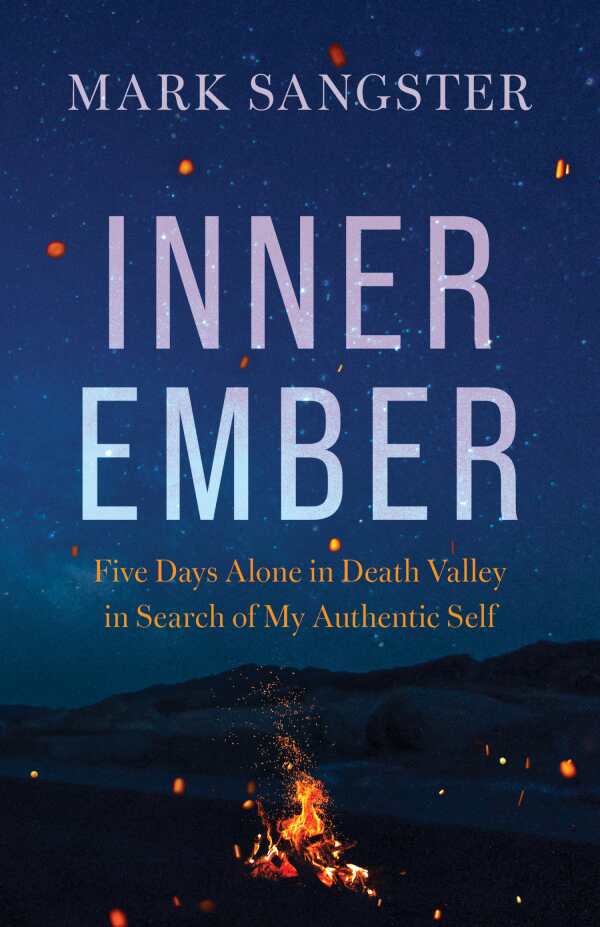
Inner Ember
Five Days Alone in Death Valley in Search of My Authentic Self
Following a life disappointment, a man looks back on an important quest experience for encouragement in the spiritual memoir Inner Ember.
Mark Sangster’s thought-provoking memoir Inner Ember concerns travels in Death Valley.
After losing his job, Sangster tried to recall a time when he felt full of joy and purpose—when his so-called inner ember glowed bright. He remembered spiritual experiences in Death Valley, inspired by Native American vision quests. In that isolated location, Sangster spent five days fasting alone. While he wasn’t willing to replicate the experience, he did feel compelled to write about it, hoping to recapture its feelings. Thus he looks back on his preparations, the trip itself, and the outcome.
The circumstances that led Sangster to embark on his quest are covered in depth, from his palpable dissatisfaction in his career and marriage to meeting Sparrow Hart, a white shaman who guided him and others on the quest. During his time alone in Death Valley, as he pursued a connection with a higher spiritual power, Source, he visualized multiple loved ones. The experiences were emotional, exposing open wounds, including around his relationships with his father and younger brother. He also developed a fever that amplified his guilt for letting his brother live in a home for adults with special needs.
Built on Sangster’s admiration of Native American cultures, the book includes frequent references to Indigenous beliefs. For instance, it covers a Navajo legend that says that a spider wove the web of the universe. But there are inconsistencies: Although the book states from the beginning that it will only refer to Sangster’s experiences as a vision quest on occasion, so as to avoid cultural appropriation, it does so a noticeable number of times.
Lyrical and metaphor driven, as with the observation that “there was another tremor forecasting the mounting pressure toward a volcanic explosion of domestic violence,” the prose often holds attention. Some of its references are clichéd, though, as with a gesture to “that old wound of childhood insecurity [that] tore open and spilled anger and fear into my mind.” And some hyperbole appears to distracting effect, as with “The interstate narrowed to one lane, as if rationing its asphalt to make the journey through desolation to the next rest stop.” Further, the story itself is rather inclusive, returning to Sangster’s present at a point when he had not yet found another job and his future was a question mark. Its declarations that uncertainty is okay and that no amount of worldly success will be enough to fulfill a person’s spiritual needs are somewhat encouraging.
With its metaphysical turns, the spiritual memoir Inner Ember recalls a personal decision to lose oneself in order to find oneself again.
Reviewed by
Carolina Ciucci
Disclosure: This article is not an endorsement, but a review. The publisher of this book provided free copies of the book and paid a small fee to have their book reviewed by a professional reviewer. Foreword Reviews and Clarion Reviews make no guarantee that the publisher will receive a positive review. Foreword Magazine, Inc. is disclosing this in accordance with the Federal Trade Commission’s 16 CFR, Part 255.


