

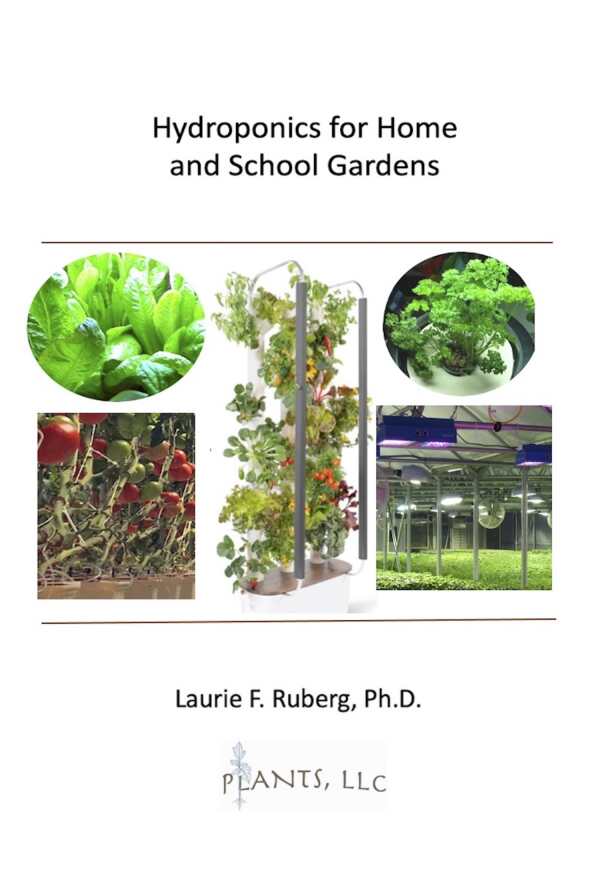
Hydroponics for Home and School Gardens
An edifying gardening guide, Hydroponics for Home and School Gardens sets forth persuasive arguments in favor of the more widespread use of hydroponics.
Laurie F. Ruberg’s meticulous gardening and sustainable living guide Hydroponics for Home and School Gardens encompasses applications ranging from small containers to indoor acreage and outer space.
The topic of hydroponics—the practice of growing plants in water solutions rather than soil, often indoors—is treated via pragmatic lessons. These encompass the basics of plant growth and a wide variety of contemporary hydroponic systems, including do-it-yourself bucket arrangements and all-in-one systems. Ample details on cost and implementation are included to assist in making decisions about what, where, and how to install a hydroponic system. The book also sets forth persuasive arguments in favor of the more widespread use of hydroponics to achieve food security for the planet’s increasing human population and in the face of decreasing arable land.
First debunking common myths about hydroponic agriculture, including the belief that plants require soil to grow, the book points to material including Styrofoam, porous rocks, and coir as useful. What plants can’t do without, according to scientific consensus, is light, water, nutrients, oxygen, and carbon dioxide, and these can all be part of a hydroponic system. Indeed, hydroponic agriculture is presented as a work-around for space limitations and other challenges to soil-based agriculture, including climate change, seasonal limitations, water scarcity, and extreme weather events.
The book’s clear graphics are an important part of its educational power. They appear in varied formats, including charts, diagrams, photographs, screenshots, and illustrations, to appeal to different learning styles. Precise labels and citations accompany most of them, although the font size in some of the screenshots is inaccessibly small. Still, the book is flush with insights into hydroponic applications, making wide use of data and stories about systems operating in household corners, on urban rooftops, in vast commercial warehouse spaces, and in a NASA project that grew plants hydroponically on a spaceship. Special attention is given to data on selection, hybridization, and the yields of common crops including lettuce, strawberries, and tomatoes. Such data-backed results provide solid support for its arguments for including hydroponics as part of a food security plan.
A smorgasbord of information, the book ably integrates complex science with common sense, juxtaposing data, analysis, and concrete examples that stand to be useful to new and experienced gardeners alike. Its integration of science with concrete examples is edifying, and its descriptive chapter titles and comprehensive index allow for easy navigation.
Hydroponics for Home and School Gardens is a thorough gardening guide to starting or improving a hydroponic agriculture system.
Reviewed by
Michele Sharpe
Disclosure: This article is not an endorsement, but a review. The publisher of this book provided free copies of the book and paid a small fee to have their book reviewed by a professional reviewer. Foreword Reviews and Clarion Reviews make no guarantee that the publisher will receive a positive review. Foreword Magazine, Inc. is disclosing this in accordance with the Federal Trade Commission’s 16 CFR, Part 255.


