

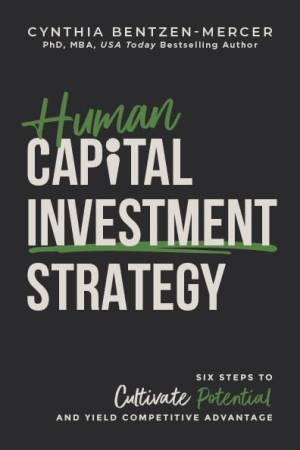
Human Capital Investment Strategy
Six Steps to Cultivate Potential and Yield Competitive Advantage
Framing an organization’s employees as strategic assets, the revealing leadership guide Human Capital Investment Strategy suggests investing in people to “unleash exponential value.”
Cynthia Bentzen-Mercer’s insightful business book Human Capital Investment Strategy is about developing and getting the most out of one’s staff.
About optimizing an organization’s human talent for maximum return, ensuring that one’s workers are high-performing assets, and gaining an edge over the competition, this leadership guide recommends applying investment principles like forecasting to workforce planning. Its advice includes reallocating workforce investments to be more efficient and building a company culture that high performers will want to be part of. Its system involves six foundational steps, including assessing one’s portfolio, stratifying risk, and expanding options.
Its approach systematic, the book atomizes its subjects to a granular level. For instance, one subchapter on human capital attributes is further divided into subchapters on individual agency, attributes, and what is teachable. In this way, the book approaches its subject matter with analytical rigor. Plentiful lists, bullet points, definitions, examples, and graphics make its information more digestible too.
In all, strategies for attracting, retaining, and developing employees are named, factoring in ongoing changes to the workforce. Indeed, the book asserts that labor pools are shrinking, despite this being a knowledge-based economy wherein human talent is more vital than ever. While mapping out best practices, it sets forth an overarching vision for cultivating human talent, presenting a people-first method for transforming company cultures. It takes into account the rise of artificial intelligence and other contemporary challenges, extracting lessons from case studies including Target’s failed expansion into Canada. There are also science-backed suggestions for using data to unlock a workforce’s potential, complementing suggestions that putting high-performing individuals in key roles can maximize productivity without increasing an organization’s payroll.
With its surveys, as of how academic studies of diversity evolved over time, the book contextualizes its data well, explaining how variables changed over time and how skills deemed more in demand are natural talents. But each chapter is formatted in the same way, ending with a point-by-point guide for implementing its recommendations. Its rigid itemizations are efficient but have diminishing returns. Further, some examples, such as the Wells Fargo scandal, are shortchanged; the book skims over related points and delivers bullet-pointed lessons sans nuance. Indeed, as the book continues, it develops the flavor of a digital presentation, catering to short attention spans; its checklists, such as its organizational readiness assessments, have the feeling of homework.
An organized leadership guide, Human Capital Investment Strategy is about maximizing talent in the workplace.
Reviewed by
Joseph S. Pete
Disclosure: This article is not an endorsement, but a review. The publisher of this book provided free copies of the book and paid a small fee to have their book reviewed by a professional reviewer. Foreword Reviews and Clarion Reviews make no guarantee that the publisher will receive a positive review. Foreword Magazine, Inc. is disclosing this in accordance with the Federal Trade Commission’s 16 CFR, Part 255.


