

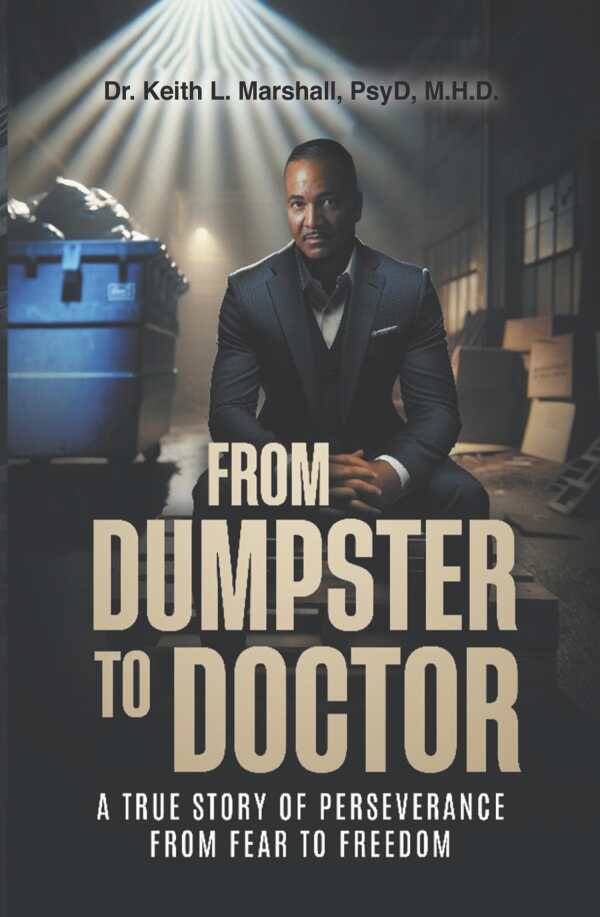
From Dumpster to Doctor
A True Story of Perseverance from Fear to Freedom
Extending empathy to others who have been through trauma and addiction, From Dumpster to Doctor is a testimonial memoir about recovery.
Keith L. Marshall’s poignant memoir From Dumpster to Doctor is about recovering from childhood trauma and a long-term drug addiction.
Recounting deep sources of shame as well as uplifting triumphs, this memoir about addiction begins with vignettes from Marshall’s unstable childhood in Philadelphia, which he spent in poverty. He was also victimized by his stepfather. Despite these challenges, he achieved academic and athletic success in high school.
Marshall went on to attend Temple University, where he was introduced to cocaine; he used the drug to dull his longstanding fear of rejection. His addiction persisted for twenty-three years. Faith, rigorous honesty, and family support helped him turn to a healthier life and earn a doctorate in psychology. Acknowledgements of how Marshall’s addiction impacted his loved ones and friends wend into regretful recollections of how he lied, stole, and cheated to get drugs—behaviors for which he apologized once he got sober, working to make amends with those hurt by his addiction.
Christian faith is prominent among the book’s guiding themes, though respect is also expressed for other belief systems, fostering wider accessibility. The tone is hopeful: Trauma and addiction are handled as elements of one’s life that belong in the past, with faith held up as a powerful tool for helping people “get up, clean up, and make up.” Scientific research on psychology and addiction balances out this exploration.
Throughout the book, compassion is evinced in depictions of others, even those whose behaviors were abusive. The book argues that people’s self-images can be distorted by traumatic events and past environments, making them susceptible to addiction, which is not entered into as a logical choice: “Most people do not wake up … and say: ‘Hey, I want to be a drug addict and alcoholic and mess up my life.’” However, the book’s arguments for compassion toward oneself and others become repetitive as it progresses, leading to narrative drag.
Further, despite Marshall’s psychological expertise, too much of the work is anecdotal. His experiences as an addict and post-recovery are leaned upon to validate the book’s frequent direct addresses to the audience, wherein the book reaches beyond its personal story to introduce outward support elements. It makes an argument for how recovery from addiction has community relevance, broadening its scope somewhat.
From Dumpster to Doctor is a hope-filled memoir about recovery from trauma and addiction.
Reviewed by
Michele Sharpe
Disclosure: This article is not an endorsement, but a review. The publisher of this book provided free copies of the book and paid a small fee to have their book reviewed by a professional reviewer. Foreword Reviews and Clarion Reviews make no guarantee that the publisher will receive a positive review. Foreword Magazine, Inc. is disclosing this in accordance with the Federal Trade Commission’s 16 CFR, Part 255.


