

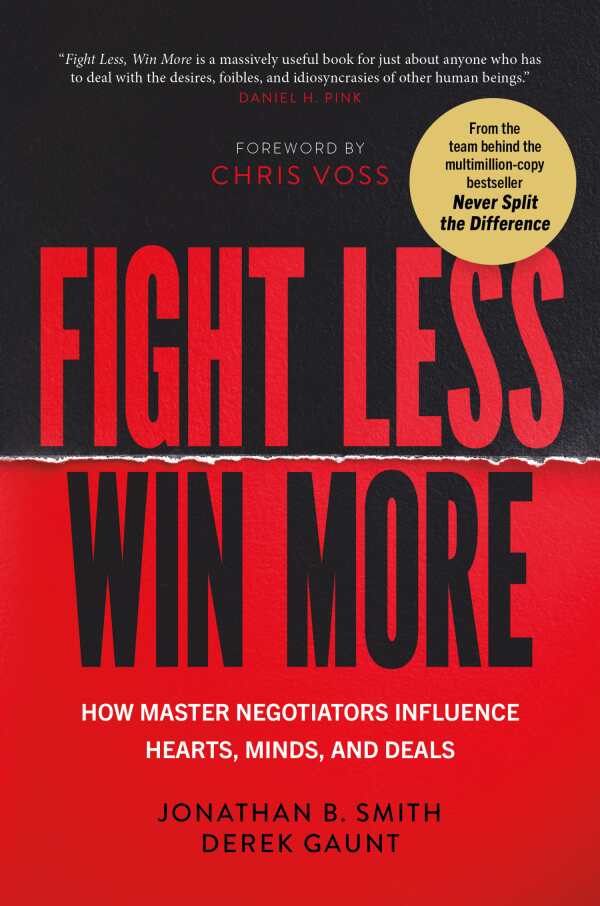
Fight Less, Win More
How Master Negotiators Influence Hearts, Minds, and Deals
The canny leadership guide Fight Less, Win More challenges conventional wisdom about approaching negotiations as a combat sport.
Jonathan B. Smith and Derek Gaunt’s shrewd leadership guide Fight Less, Win More is about getting the most out of discussions and relationships.
About negotiating through listening, trust, empathy, and emotional connections, the book pitches a counterintuitive approach to bargaining, calling for collaboration that yields mutual benefits. Its correlating lessons are broad enough to be used in all types of communications, even between family members.
It outlines the challenges that many negotiators face before presenting its ideas for tactical empathy and listening, dissecting discussions with analytical rigor in terms of tone, silence, encouragement, and other core components. It covers essentials like mirroring when the other person is speaking or summarizing so they feel understood before progressing to more advanced techniques like asking open-ended questions to elicit information.
Its advice can sound contrarian on the surface, as when it suggests slowing down to speed up, but the book supports its guidance with clear reasoning. It aims to shake people out of their conditioning by posing thought-provoking questions and broaching novel ideas, as of just asking if a deal is dead or if the other party wants to keep working together to eliminate an uncertainty. It notes that people sometimes say yes just to placate others and end up feeling vulnerable.
Its exhortations for empathy and understanding are strategic, as the book suggests ways of giving a conversational counterpart “the illusion of control.” It also forwards psychological tricks, such as nudging the other person to keep talking and getting them to open up by repeating the last few words of what they said or taking advantage of an “irresistible urge to correct.” Its direct addresses to the audience are disarming, as are its explanations of the possible scenarios one might encounter during a negotiation.
At times, the book is hyperspecific, as when it explores what conjunctions one should avoid when making observations about a counterpart’s emotions. Still, its thoroughness is most often a boon, whether it is issuing warnings about common pitfalls or spelling out alternative language that can be used (“noticed/saw/heard/think/guess”). It brings its hypothetical situations to life with extensive detail, as when fleshing out a story about frustration and anxiety after a neighbor’s child hit a car, making its techniques feel more compelling.
A savvy leadership guide, Fight Less, Win More puts the focus on people, connections, and communication.
Reviewed by
Joseph S. Pete
Disclosure: This article is not an endorsement, but a review. The publisher of this book provided free copies of the book and paid a small fee to have their book reviewed by a professional reviewer. Foreword Reviews and Clarion Reviews make no guarantee that the publisher will receive a positive review. Foreword Magazine, Inc. is disclosing this in accordance with the Federal Trade Commission’s 16 CFR, Part 255.


