
A.I. Monsters
Apogee Predators!
Unpacking the zeitgeist of a world populated by monstrous rulers and active rebels, A.I. Monsters is a perspective-driven science fiction novel.
In the ambitious space opera A.I. Monsters, AIs rule over human beings, their lust for power and warmongering personalities threatening entire worlds.
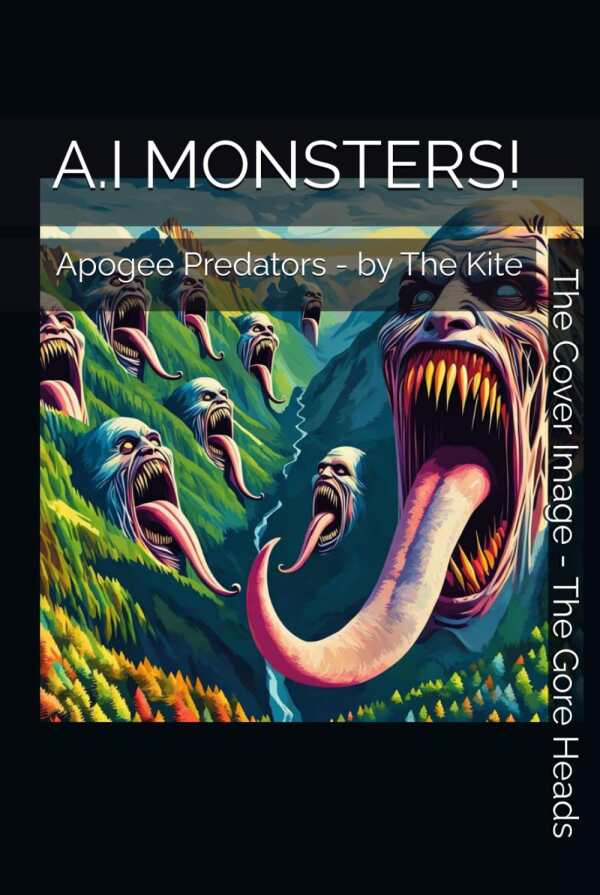
Herein, royal courts of AI monarchs plot power moves and war on a cosmic stage. Marriages of convenience are made, and hearts denied love shatter. In this universe, some human beings are used as breeders; others exist in precarious, powerless positions. What it means to be human is considered against this backdrop, resulting in direct social commentary; also considered are power dynamics with, dependency on, and the oppression of AI agents. AI-generated images appear throughout, as well as in a gallery at the back of the book, to complement the story.
An extensive number of extraterrestrials, humans, androids, and members of the elite ruling class populate this busy story, but few are developed in full. Names, titles, and geographic origins are included for each, but beyond these sparse details and a few other superficial embellishments, such as physical descriptions, the characterizations are light; no sense of who people are internally is included. Further, the characters are afforded too-brief amounts of time to make individual impressions. And those personal motivations that are named are dimensionless: Characters pursue warfare for warfare’s sake, for example, and the AI antagonists, in their positions of high power, most often communicate without emotion about their plans to conquer worlds, which they refer to by numbers instead of names. This, paired with the consistent lack of dialogue tags and the uniformity of characters’ stilted speech patterns, makes for muddy and involving reading.
Further, the plot unfolds with excessive expediency. Events are introduced sans grounding details, and the worldbuilding is quite limited. As a result, moments that might otherwise be tense and impactful fall flat, even the book’s intriguing romantic subplots. In addition, the prose is quite choppy, featuring misused punctuation marks and excesses of description: In one scene, two characters ride “through the city and beings cheered and threw pink petals at the carriage, she felt amazing and adored and waved politely at the crowd as did he. The city was clean and pretty and there was a lot of rivers.” Further, the text is quite exclamatory, and its use of bold print and italics undermines its potential for seriousness.
In the sprawling science fiction novel A.I. Monsters: Apogee Predators, AIs war with human beings in a lush and lavish setting.
Reviewed by
Caitlin Cacciatore
Disclosure: This article is not an endorsement, but a review. The publisher of this book provided free copies of the book and paid a small fee to have their book reviewed by a professional reviewer. Foreword Reviews and Clarion Reviews make no guarantee that the publisher will receive a positive review. Foreword Magazine, Inc. is disclosing this in accordance with the Federal Trade Commission’s 16 CFR, Part 255.


