
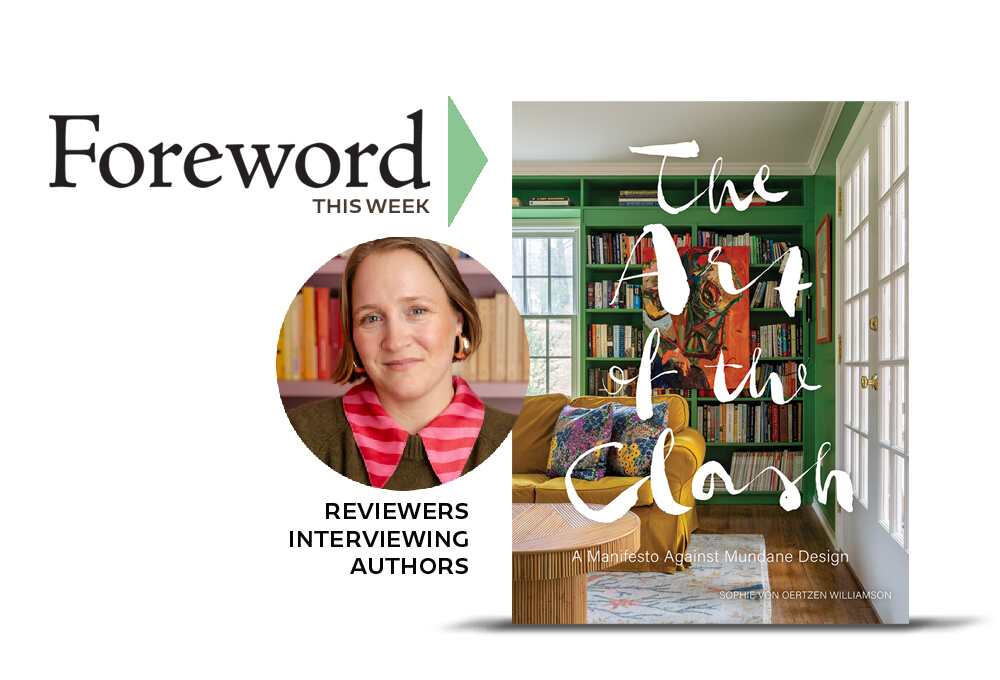
Reviewer Carolyn Wilson-Scott Interviews Sophie von Oertzen Williamson, Author of The Art of the Clash: A Manifesto Against Mundane Design
Cities show their age, of course, but when you walk the streets of Rome or Bruges or Prague, what you see is many ages, hundreds of years of contrasting building materials and architectural styles fused together—medieval door here, art nouveau sign there, and just maybe the remnant of a Roman wall incorporated into a church foundation next to a garishly painted tattoo parlor.
Yes, it’s chaotic. No, it’s not what’s taught in American urban planning schools. But in the minds of countless millions, the cityscapes of Europe are heartstoppingly beautiful.
Sophie von Oertzen Williamson is with us today to talk about how you can bring some of that artful chaos to your living room. The Art of the Clash, her Manifesto Against Mundane Design, earned an enthusiastic review from Carolyn Wilson-Scott, so we paired them off for a conversation about the power and beauty of contrast.
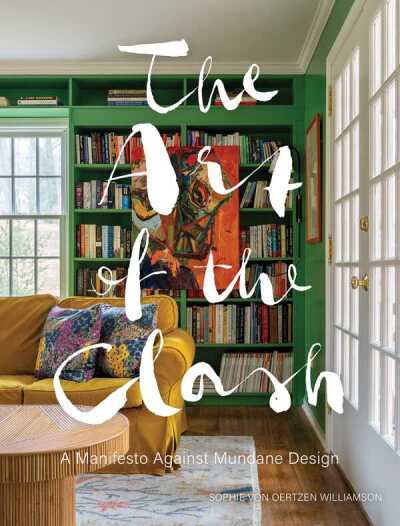
In the spirit of first-things-first, I’d love to start with the book’s images. They are stunning in the way they pull off what you so aptly term “the art of the clash”—unexpected combinations of color and richly layered furnishings that contrast in period or design style. It’s a look that takes either a lot of pre-planning or years of curating, one that you suggest people approach via an overall concept or uniting principle for the entire house. Do you have words of wisdom on how to realize this kind of vision, which can be hard enough even when working with a designer on a whole-house project—how would you guide someone approaching the process on their own and perhaps room-by-room or even piece-by-piece?
I think the most important advice I can give people is to stop throwing out things and start collecting. And by collecting I literally mean hoarding. Keep the books you once bought at the airport because you forgot to bring one on a trip, it will be a good filler on any book shelf and remind you of a nice trip (hopefully). Say yes to every item your parents want to throw out from your childhood home. Thrift like your life depended on it. And then: stop changing your furniture and buying things that are new because your old pieces don’t “fit” into your new house. I don’t understand that notion at all. Just use them and maybe in a different way than before.
We are currently in our eighth home since our wedding fifteen years ago. Not only would I have gone crazy if I had bought everything new with every move, I also wouldn’t have felt at home. Furthermore, my old “stuff” looks new and different in any new space. If you look closely in the book, you will find quite a few items that have moved with us from country to country. If you collect and keep things over the years, you can essentially “shop” your own home, and develop your taste with it. A lamp that you loved ten years ago and used as the main feature for a space might not do the trick in that way anymore today—but it might be great in your child’s room? That way, you’ll develop your style with each move and each change that life might throw at you.
While we’re on the topic of the book’s photography, let’s dish: Can you give us a behind-the-scenes peek at a home decor photo shoot? What goes into making a house picture-perfect, and do you have tips for how to achieve a put-together look in everyday life?
You’d be disappointed on how much my house doesn’t look picture perfect on a day to day basis. Because, never forget: interior design photography is selling you a dream. Furniture is moved for the angle, lighting is added, pillows are removed and so on! A lot of time goes into setting up a shot: we test the light, the angle, do we need to make the shot tighter, do we need to move the lamp over slightly or a lot so that the angle works?
Andrea Ceraso, my principal photographer, and I are a good team in getting the shot we want but one shot can take two hours or sometimes even more. Tight spaces and staircases are the most difficult ones to shoot. Take the photo on page 212 of the book: it looks down the very steep stairs in the Hamburg house. I was holding Andrea by her belt while she put her tripod on the steps and angled down to get the shot.
One advice that I adhere to when it comes to making my house look nicely chaotic, not overwhelmingly chaotic, is to use pretty storage. I have the terrible affliction of filling every empty surface with stuff, which drives my husband crazy. So I use pretty containers: silver bowls for all the phone chargers, painted ceramics for pens, wooden boxes for keys, etc. I never buy anything new for this, everything that we use for small storage is inherited, thrifted, antiqued, etc. It goes back to your first question: start collecting things and you’ll only be surrounded by your favorite items. It makes decorating so much easier.
In addition to the book’s presentation of your interior design, it also features your writing on the subject, in which you give readers insight into your personal backstory, as well as offering commentary on how each look was achieved. Can you speak to the role both of these creative modes of expression play in your life?
I like writing. A lot. But it doesn’t always come easily to me. Designing is much easier I find because it has less of a “white empty paper” problem. Designing, in particular, textile design but also interiors, can take inspiration from anywhere. The colors of our kitchen were inspired by a church window! Writing, on the other hand, gets less external input for me, which makes it hard sometimes. Writing the book, on the other hand, was fun but also very intense as I was on a tight deadline. I thrive on deadlines, however, and for this I could go back to my old university ways of working through the night. My poor husband held down the fort on Thanksgiving 2024 while I was writing for what felt like four days straight! It’s my best way of working though, something I can’t really do anymore with children and a husband so this was an exception that I enjoyed quite a bit.
In the book’s introduction, you talk about coming to a career in design later in life. Do you have advice to offer to others who might be facing a similar life-choice?
If I had it, I’d take it! Joking aside, I think there is no one path forward, especially when it comes to your choices of career. I know so many great designers who started in totally different fields and who are very successful now. For myself, being creative and living that side of myself has become inevitable. I don’t know how to live life differently anymore. I think this feeling of things falling into place after years of feeling that something important was missing from my life is one of my biggest drivers.
The book also touches on your childhood growing up outside the US, as well as your continuing European ties—your Austrian Swiss apartment is one of the book’s pictured spaces. How does this international milieu inform your design perspective?
I think it’s something that I never realised was exceptional, it just was. But being surrounded by a lot of beauty helped me define what I liked and didn’t like from a fairly young age. I remember vividly that I would feel uncomfortable in some of my friend’s houses because they weren’t cosy, maybe they had terrible lighting, that kind of thing. And how relieved I always felt when I came home and could let my eyes wander over the stucco on the twelve-foot-high ceiling of my bedroom.
Hamburg where I lived from five to sixteen is chock full of turn of the century architecture, with a lot of Art Nouveau influences. I will always be drawn to a space with high ceilings, parquet floor, and stucco. It’s almost too easy to design, I find. I love a good challenge.
But to return to your question: Of course, I’m hugely influenced by the places and spaces I grew up in. And because it is so diverse, I think it has always informed my need to create the clash. There is nothing more humming with tension and excitement than a Bavarian baroque space that is decorated with Bauhaus pieces. Or a Swiss chalet that uses the local craftsmen but with a modern twist. It’s the tension that I crave and that many European cities have because they grew over time, without any proper city planning (well, most of them, let’s definitely exclude Paris and Barcelona here). It’s why one of my favorite cities is Antwerp, the tension of the different periods is palpable and makes you creative by just walking the streets. My husband grew up there and we visit at least twice a year, so I know it well but there is always a new thing to discover.
With your book now out in the world, what’s next? How can fans of your work connect with you?
A book tour! Or something like that. And of course, focusing on my interior and textile design business. I share it all on my Instagram (with some good opinions that sometimes ruffle some feathers, which I don’t mind at all!) and sometimes also on my Substack. And any other details are also always available on my website!
Instagram: https://www.instagram.com/sophie.williamson.design/
Substack: https://substack.com/@sophiewilliamsondesign
Website: sophiewilliamsondesign.com
Carolyn Wilson-Scott


