
SHP Comics - Daring and Intelligent Comics on the EDGE!
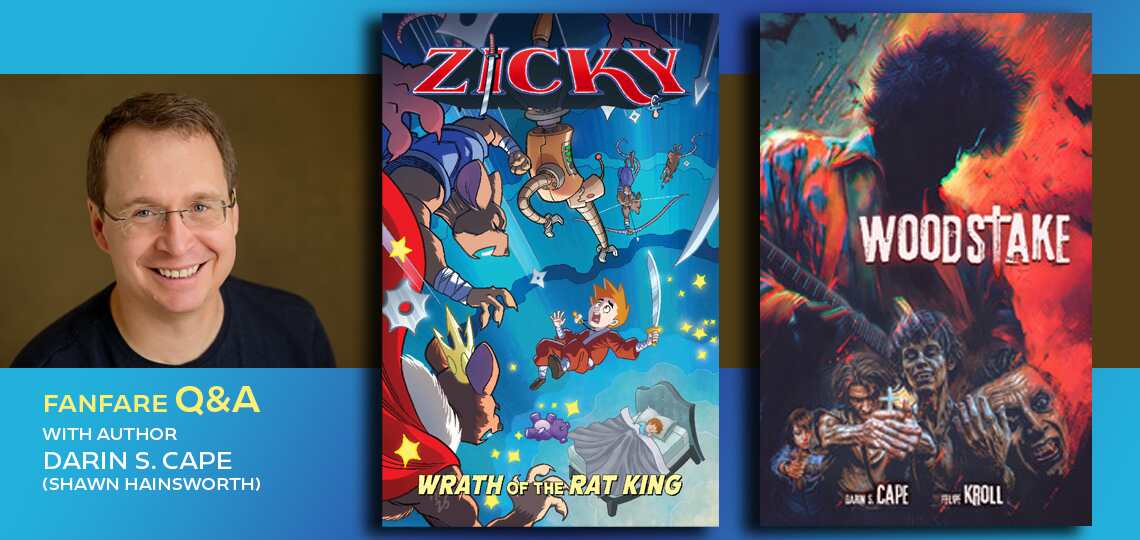
Reviewer Peter Dabbene Interviews Darin S. Cape, Author of Zicky: Wrath of the Rat King
At Foreword, we’re always excited to hear the backstory of a new publishing company, and today’s interview with graphic-novel publisher Shawn Hainsworth delivers an inspiring “if-not-me—who, if-not-now—when” tale of entrepreneurialism. Shawn fills in the details below, but suffice to say, as a screenwriter and documentary filmmaker, he launched SHP Comics with an enviable skillset.
Shawn’s debut graphic novel, Zicky: Wrath of the Rat King (spoiler: Shawn’s pen name is Darin S. Cape, author of Zicky), earned a glowing Foreword Clarion review by Peter Dabbene, and we wasted no time in putting the two together for a conversation.
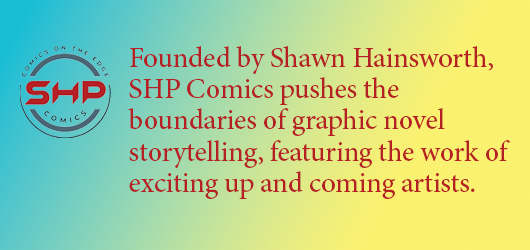
Zicky: Wrath of the Rat King is great fun for all ages. Is it true that the idea was rooted in stories you told your own children? Some descriptions of the book mention the tradition of isekai storytelling, a Japanese genre of fantasy fiction that features a character being transported from one world to another. Are you a fan of the genre, and if so, were there any that particularly influenced the creation of Zicky?
I’ve always loved the imagination of children. When my kids were little, I pretended to be a character named Zicky, a super-secret ninja who went on adventures while they slept. I honestly can’t remember where I got the name. Zicky just seemed to pop out of my brain fully formed, complete with a voice that I used to tell his stories in the first person. Miles and Zoe loved teasing Zicky as much as they loved hearing about, and contributing to, his adventures. Now they’re teenagers, I miss the days of our freewheeling games and storytelling, so I decided to bring Zicky to life. I did not grow up with manga, but I was always drawn to portal stories, such as Alice in Wonderland and The Lion, The Witch and The Wardrobe. I was also a big reader of epic fantasy. In addition to Tolkien, I was a fan of Stephen R. Donaldson’s The Chronicles of Thomas Covenant, a dark, portal fantasy. I always enjoyed seeing how different aspects of characters were emphasized and developed as they moved between the different worlds.
Zicky is a kind of tribute to a child’s imagination, with many aspects of the book grounded in the play of a typical child: for example, Zachary’s pacifier becomes a magic ring, while his small, beat-up Tickle Robot gets bigger and plays a key role in the adventure. Were you an imaginative kid? When did you make the jump from imagining stories to creating them in a physical form?
I was always interested in stories and storytelling. In high school, I spent a lot of my creative energy writing Dungeons and Dragons campaigns for my friends. I also wrote a computer-based text adventure game (“You are in a dark room. What do you do?”) and a few chapters of a fantasy novel. I began creating stories in a tangible form in college, where I studied documentary filmmaking. After graduating, I went on to make several documentary features, an experience that helped shape how I think about storytelling, because rather than imposing a story on the material, I had to find the story within the existing footage. I went on to work at various regional theatres as an assistant literary manager and assistant director, spending much of my time reading and evaluating script submissions.
I think all these experiences influenced me as a storyteller when I finally sat down to write and publish graphic novels. Tickle Robot is a game I used to play with my kids in which I would catch them up and tickle them on the couch until I ran out of energy. So much of the fun of this series, for me, is bringing to life the various characters from our “silly games.”
Zachary’s family offers realism, humor, and genuine love, plus their share of heroic moments. Were they, or any of the characters in the book, based on real people or actual experiences you’ve had?
The characters in the real world are my family. I am the clueless but well-meaning Dad, my wife is Mom, and my kids are Miles and Zoe. I even included our two dogs, Lily and Jango, as the Komainu, traditional lion-dog portal guardians placed at Shinto shrines in pairs to ward off evil spirits. I had a lot of fun trying to capture our family dynamics, including the chaotic and messy moments of daily life, which I hope other parents can relate to and enjoy sharing with their kids. I love being a dad and hope that feeling comes through in this story.
The book has a dynamic visual style, with storytelling aided by having two distinct artists, one (Zeno Decrux) who illustrates Zachary’s fantasy world, and the other (Hiorsh Gabotto) who depicts Zachary’s “real world.” Was using two artists the plan from the beginning? How did that idea develop, and was it easier or harder than having a single artist on a book?
I always intended to use two different artists and two different art styles for the real and fantasy worlds, combining manga and Western style art. In some ways, it was easier, because the two artists inspired each other along the way. The tricky part was working on the pages where the manga characters invade the real world. To develop these pages, one of the artists would draw a sketch, leaving space for the other artist to add their work. We would then pass the page back and forth until everyone was happy with the result. This took more time and coordination, but we were able to integrate Zeno’s kinetic style with Hiorsh’s looser, comic style in a way that I think really serves the story.
Zicky: Wrath of the Rat King is the first volume in the Zicky series. Do you have another story ready to go for volume 2? And if so, when can we expect to see it?
Zicky will be an ongoing series. I love the character and have lots of adventures planned. The next volume, Zicky: The Cursed Blade, will be published in the Spring of 2027. In this story, Zicky is falsely accused of stealing a legendary sword cursed with the soul of an evil samurai. The malevolent spirit begins to take hold of Zicky, unleashing chaos in both worlds. Forced to flee, he must unravel a century-old mystery and confront both his nemesis and a ghostly shadow warrior. This storyline leans more into classic samurai tales and is a bit darker than Zicky’s adventures with the Rat King. I want each adventure to feel distinct, exploring different fantasy worlds while remaining grounded in Zicky’s family dynamics and the growing pains of the main characters.
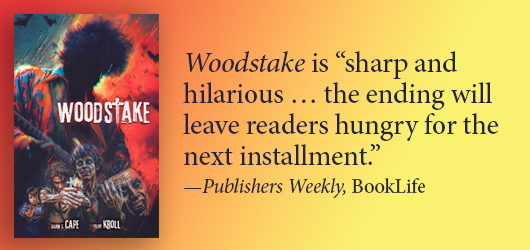
I had the pleasure of reading Woodstake, a clever and highly entertaining horror tale from SHP that you also wrote. Woodstake puts a vampire among the crowd at the 1969 Woodstock music festival; it’s a brilliant concept that creates opportunities for both horror and humor. Is that an idea that had been in your mind for a while? What inspired it?
I grew up in the shadow of the Woodstock generation and was very interested in the Vietnam War. One of the documentaries I made (Between Worlds) was about the resettlement of Vietnamese refugees, so I had done a lot of thinking about this period. The idea came to me as I was reading The Road to Woodstock, by Michael Lang, the main organizer of the festival, who makes a brief appearance in Woodstake. I think the idea started with the pun, wood stake, but I quickly started to imagine all the possibilities of a vampire at Woodstock. I am a lifelong fan of Bram Stoker’s Count Dracula because he is both a monster and a shrewd observer of society, someone with a deep understanding of human nature, which he exploits to his advantage. I realized this type of character would be a perfect foil for the idealism and naiveté of the hippie generation. Once I was able to connect the vampire to the festival thematically, I was off and running.
You have several roles at SHP—as a writer under the pen name Darin S. Cape (Zicky: Wrath of the Rat King) and editor under your real name, Shawn Hainsworth (Woodstake). You’re also the founder of the company. What led you to take on the risk and responsibility of starting a company that could publish your stories? What’s your vision for the company?
The idea for SHP Comics started during the pandemic. I think many people had a similar experience during this time, but I kept thinking, “if not now, when?” I wanted to both own and have full creative control over my stories, and the best way to do that was to publish them myself, so I just took the leap. It took almost five years to get to this point, the publication of our first graphic novels. My vision for the company is to publish books that I love. As the publishing world gets more consolidated and more risk averse, I think it is important for smaller publishers to follow their hearts. I acquired the rights to several books at the Frankfurt Book Fair last year and have started to expand the range of books we publish. Our mission statement is, “to publish daring and intelligent comics and graphic novels on the edge.” I hope to live up to those words.
Zicky
Wrath of the Rat King
Darin S. Cape
Zeno Decrux (Illustrator)
Jorge Gabatto (Illustrator)
Kids SHP Comics
Clarion Rating: 4 out of 5
A boy is sent on an exhilarating adventure when his dream life bleeds into his waking one in the imaginative graphic novel Zicky.
A boy’s fantasy world invades his real life in Darin S. Cape’s delightful graphic novel Zicky.
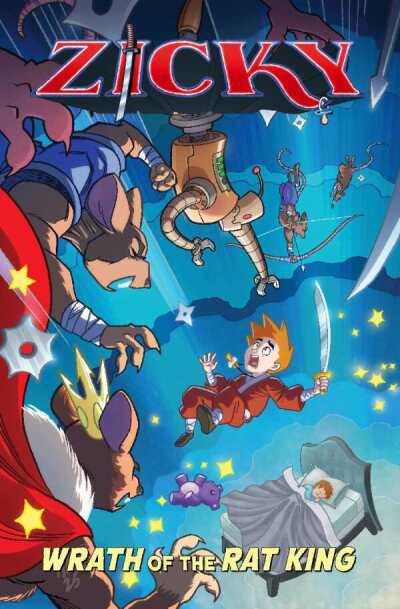
Five-year-old Zackary has a vivid dream life in which he becomes Zicky, an older, more athletic, wisecracking hero who fights against the rat king, Zooky, his evil alter ego. But then Zooky captures Zicky in Zackary’s dream.
When Zicky is captured, Zackary fails to return home by dawn, and his parents notice that he is missing. Meanwhile, Zooky enacts his plan to transport himself and his rat soldiers into Zackary’s reality and poses as Zackary. Zackary’s family is endangered by Zooky’s invasion plans. Zackary, his family, and their allies work to defeat Zooky and return their lives to normal.
Two different illustrators, using different art styles, contribute to this book, one attending to Zackary’s waking life and the other to Zicky and Zooky’s world. The fantasy world is vivified via bold and dynamic manga-style art, while the real world’s art is subtler and more realistic, with muted color tones. Details as of Zackary’s old pacifier, which serves as his magic ring, and his small, ragged Tickle Robot toy that grows much larger and more capable in his fantasy world pay homage to children’s imaginations. In both cases, the style complements the storytelling well, infusing excitement and enabling clear transitions between the worlds.
Unlike Zackary, Zicky is cocky but noble. Both exhibit cleverness throughout. Toward the end of the story, the line separating the two begins to blur, showing the leadership and budding maturity inherent in Zackary. Zackary’s parents, sister, and brother, meanwhile, are present to provide intelligent, sympathetic support.
With flashes of tongue-in-cheek humor, the book moves at a breezy pace, encouraging interactivity in spots. For example, one full-page illustration shows the family eating, even as the invading rats hide around the room; the caption suggests that the audience count all nineteen rats. At one point, the book also breaks the fourth wall.
Literary allusions strike a more sophisticated tone, as when Zicky and his allies encounter a group of lost souls and one asks, “Beatrice, dove sei?” Elsewhere, “The Ghost in the Machine” appears to return the fantasy characters to their world and erase the memories of Zackary’s family. And a clear moral is pronounced by the book’s conclusion, in which mistreated characters deliver justice upon their oppressors.
Zicky is a spirited graphic novel about the runaway imagination of a five-year-old.
Reviewed by Peter Dabbene
October 21, 2025
Peter Dabbene


