
"You can't win a fight you don't know you're in": An interview with actor, screenwriter, acting coach, and author Mike Kimmel
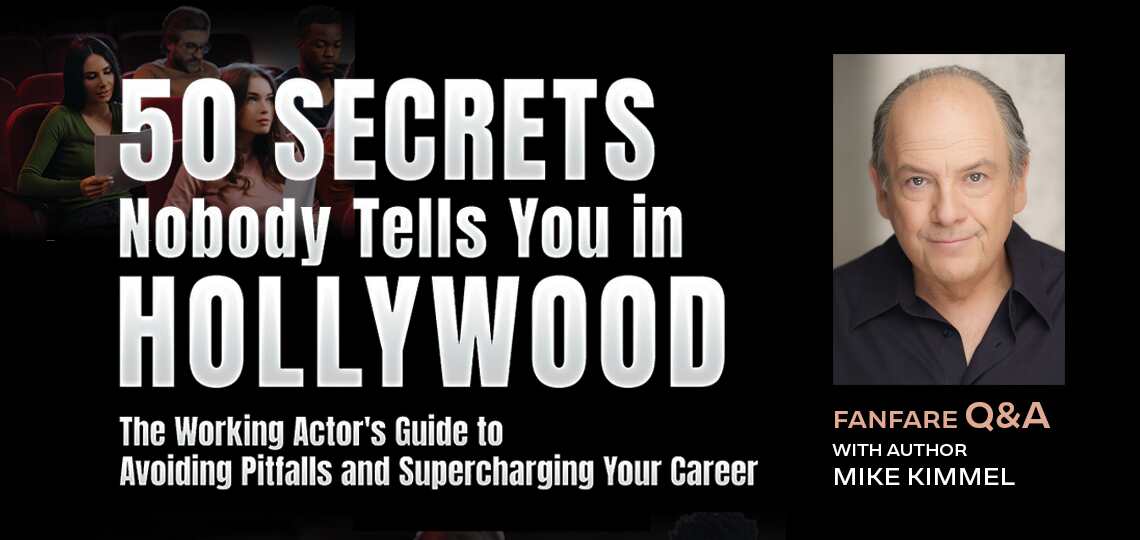
Reviewer Carolyn Wilson-Scott Interviews Mike Kimmel, Author of 50 Secrets Nobody Tells You in Hollywood: The Working Actor’s Guide to Avoiding Pitfalls and Supercharging Your Career
For many of us, the la-la-land mystique of Hollywood conceals the reality that it is a tough, fear-filled workplace for actors and screenwriters. While acclaim and financial security is always a possibility, the vast majority of performers in film, television, and theater experience steady rejection, uncertainty, and years of moonlighting at lower-paying jobs to pay the rent. Tinseltown is not for the faint of heart.
Actor, screenwriter, acting coach, and author, Mike Kimmel knows the Hollywood ropes better than nearly anyone. The author of twelve books on acting, he has devoted his life to helping aspiring actors succeed, even as he continues to audition. Over his lengthy career, he has worked with Francis Ford Coppola, Robert Townsend, and other top directors, while his list of television credits includes Game of Silence, Cold Case, and Buffy the Vampire Slayer. He was a regular sketch comedy player on The Tonight Show with Jay Leno for eleven years.
Mike’s recently released 50 Secrets Nobody Tells You in Hollywood caught our attention when it earned a glowing Foreword Clarion review from Carolyn Wilson-Scott and we quickly connected reviewer and author/actor/coach together for a conversation on the business of show business.

Although you were drawn to acting from a young age, you didn’t get to start your dramatic education until you were in your twenties. How was your introduction to the stage different at twenty than it would have been as a child?
I think starting late made me appreciate every opportunity a little more. I would send thank you notes and thoughtful gifts to industry people whenever I had a particularly good interaction. These were never expensive gifts––but they were thoughtful little gestures. For example, I had a great interview with a television producer who had grown up in a nice suburb of New York City. He told me his late mother had grown up in the Bronx––where I grew up––and had attended a particular church there regularly. A couple of days later, I looked up the church, printed off pictures, and mailed them off to him in a nice package. He was genuinely touched by this one small gesture and hired me several times after that. This didn’t cost a lot of money––just a little effort. It may not sound like much on paper, but these little gestures can really help you connect with people in a business setting. And a lot of actors forget that show business is a business.
This approach doesn’t work with everyone, though. If you can believe it, a casting director once yelled at me for sending him a thank you note! He said it annoyed him, cluttered up his desk, and was a waste of time, money, and paper. I disagree. I believe we need to exercise our gratitude muscles daily. Getting along with people and showing appreciation are essential parts of human interaction––but there will always be a few grumpy folks who are simply not going to “get” us. That’s fine. I can’t be everyone’s flavor of the month––but I can be a pretty good flavor for those who are interested in what I have to offer.
You began your acting life in New York before later moving to and working in Hollywood. What took you most by surprise as you made this change?
In New York, you always know where you stand with an agent or casting director. I’ve had several people in New York circles standing nose-to-nose with me and screaming in my face. I’ve had doors slammed in my face many times. As a native New Yorker, I can promise you that when another New Yorker doesn’t like you––you will know it. Subtlety is not our strongest trait.
In Hollywood, things are much, much different. People will tell you “No,” but seldom to your face. Hollywood runs on fear and uncertainty. Who will be the next big star? Who will sign the next big deal? Who will be the next series regular? It could be you. New stars are discovered––and created––every year. Many Hollywood insiders will be reluctant to tell you “No” today because they may want to piggyback off the success someone else helps you achieve tomorrow. For this reason, many newcomers express a vague feeling of being “strung along” and “never knowing where they stand.” As you can well imagine, this only fuels the overall sensation of fear and uncertainty running rampant throughout the city.
I also had the experience of being hired––and then “un-hired” right before filming began by someone I thought was a very close friend. That’s not unusual here either––even among our biggest stars. Lauren Bacall said it best: “I’ll miss Hollywood. Of the twenty friends I thought I had, I’ll miss the six I really had.”
Your book begins and ends each of its fifty chapters with quotations from notable people. What role do quotes play in your life?
Quotes play a tremendous role in my life. I started collecting motivational and thought-provoking quotes many years ago. I used to print out a few pages and carry them with me in a folder when going to auditions. I would read them over in the waiting room––while working on my audition script––to give me a quick little boost when I needed it. Friends started asking me about these quotes I carried around, so I started printing out copies for them too. In 2023, I published The Actor’s Book of Quotes, a collection of quotes specifically curated for actors. The categories include auditions, rejection, rehearsals, iconic roles, survival jobs, and a host of other topics of particular interest to actors.
In addition to providing inspiration and motivation, quotes give me validation. I have very strong opinions about most things––and about show biz in particular. I like to look for common ground with prominent people I respect––in show biz and other fields. When writing 50 Secrets Nobody Tells You in Hollywood, I tried to identify commonality of opinion with reputable people from a variety of backgrounds. If I can then show readers and students quotations from notable people who support my ideas, there will be a far greater likelihood they will more easily accept the suggestions in my book.
As artists, we must constantly fight to overcome procrastination, inertia, and overwhelm. Show business is an incredibly competitive field, and I want to do my best to reduce any resistance my readers and students may have to start benefitting from ideas and strategies that I know are going to help them. Quotes from reputable people that reinforce the ideas in my book are intended to help Hollywood hopefuls find their “Aha” moments. I want to help actors get off the couch and get into action.
People can be very skeptical in our industry. There are people who will read a book looking for opportunities to disagree with the author and challenge his point of view. That’s okay. I need to help those readers too. If they want to argue a point with me, that’s fine. If they don’t believe something in my book––especially something I’ve experienced myself or have observed firsthand––then maybe they’ll believe Sophia Loren, Barbara Stanwyck, Brad Pitt, Sebastian Stan, Alan Arkin, Elvis Presley, Frank Sinatra, and Martin Scorsese. All these industry stalwarts are quoted in 50 Secrets Nobody Tells You in Hollywood.
You’ve written monologue books aimed at providing material for children and teens, but in general, age-appropriate material is hard to find, especially as many auditions require a monologue to come from a full-length work. What is your advice for young actors struggling to find a good monologue?
Many famous playwrights will be furious if an actor changes their script for an audition. I won’t. Maybe that’s why I’m not a famous playwright.
I always tell students: “It’s my book, but it’s your audition.” Don’t be afraid to add or subtract. If you would like to change a descriptive detail in a monologue I’ve written––such as a character’s home city, occupation, age, gender, or favorite hobby––then please feel free to do so. I love to see my readers and students use my monologues and scenes as launchpads for strong auditions and career-building opportunities. I hope my readers will develop the confidence to think of everything I’ve written as jumping-off points for their own success. I provide the acorns. I hope readers use them to grow their own trees.
I worked with Academy Award winning writer-director-producer Francis Ford Coppola a few years back. He let me improvise so much on his film that I eventually stopped asking permission. He trusted me with the role, and I trusted him to rein me in if I added too much or took the storyline off course. We never crossed each other’s boundaries. Film, television, and theater are collaborative mediums. The best of the best will always be open to input that makes the project better.
Although our society is enamored with celebrity actors, and also responds with great enthusiasm to impressive performances, acting as a craft remains a mystery to the general public. How would you characterize the way that actors get from words on a page to creating an emotional response in their audience?
I can promise you that it’s a mystery to many actors, as well! Alec Guinness said it best: “Acting is happy agony.” There are many different styles and techniques. I’ve studied quite a few of them and find that there is a great deal of overlap. One of the things that makes acting a little daunting for newcomers is the variety of ways in which acting teachers explain certain abstract concepts. Actors must be fully present, grounded, connected––whatever you wish to call it. These are simply different ways of explaining the same thing: total focus and commitment to the role. The most effective way to accomplish this is to develop your “active listening skills.” Many actors don’t pay close enough attention to their scene partners’ dialogue. You can always tell when they’re waiting for their turn to speak. They look like hungry lions waiting to pounce.
I like to work on scripts that focus on developing the actor’s active listening skills. One of the ways to do this is to give an actor a scene with minimal dialogue––and give the scene partner many long passages of dialogue as a contrast. This is a wonderful exercise for actors to practice listening and reacting. Acting is reacting. It’s a give-and take, not a take-and-take.
In addition to working as an actor and writing acting books, you also coach actors. What does this process look like? How do you go about deciding where to start with a client?
I like to take a script a client is working on and help pick it apart to find hidden meaning and subtext. Most good scripts have clues that will lead the actor to some very interesting discoveries. Even the most accomplished actors need help in this area from time to time. I’ve coached actors whose resumes were much longer than my own.
It’s always a little more challenging when we’re reading a scene from a new television show that hasn’t yet been on air. There are no previous episodes to watch. In this case, though, it’s still possible to get a sense of the show from doing a deep dive into the past history of the creative team at the helm. Directors and producers generally stay close to the genres that have brought them their most recent successes.
Is there a current trend in the industry that you think is unfortunate? Something from the past we’ve gotten away from that you’d be all for bringing back?
Yes, the 2020 pandemic changed the way auditions are conducted in our industry. Most auditions are now conducted in live online meetings or by pre-taped audition submissions. It’s now rare to have a live face-to-face audition with a casting director. This has made our industry even more competitive. Actors who formerly had to travel to live auditions can now audition for roles all over the country from the privacy of their own homes.
Consequently, every available role now has ten times as many actors submitting for it than we saw years ago. A lot of industries were hit hard during the pandemic, but film and television still hasn’t bounced back like they should. I think we’re in the process of changing everything, though. I believe live auditions will come back to a far greater degree than we’re seeing right now. It may take a while to get there, but I think actors will soon begin auditioning live more regularly. I think eventually it will be fifty-fifty. There are certain intangible elements in the casting process that are difficult to convey electronically.
The book provides an extensive list of recommended reading. Do you have any favorites from this list you care to highlight?
Yes, an early teacher of mine was the late Michael Shurtleff, who wrote the book Audition. This book has long been considered a classic in the field. Mr. Shurtleff was an absolute genius when it came to breaking down acting scripts into their most important beats or components, finding hidden subtext, uncovering important clues in the dialogue, and encouraging actors to look for the unusual choice or motivation in their audition preparation. Mr. Shurtleff once confided to me that he wanted to update his book with a new chapter that was a little bit different. Though he didn’t have the chance to do this before he passed, I still reference many of his ideas in my own work with private students––and in my own books, as well.
Mr. Shurtleff was sometimes criticized for focusing on audition technique rather than character building or script analysis––even though his book is clearly titled Audition. Most geniuses are unfairly criticized during their lifetimes. However, the years have proven that he was right. Michael Shurtleff’s book holds up just as well today as it did when it was first published in 1978. His approach to actor training was spot-on, as well. I believe everything we do on stage and screen is audition technique.
As I mentioned earlier, I had the honor and privilege of working with Academy Award-winner Francis Ford Coppola––and dedicated 50 Secrets Nobody Tells You in Hollywood to him, as well. Mr. Coppola wrote a brilliant book, Live Cinema, detailing the groundbreaking film-theater hybrid process he created. His book includes a rare glimpse behind the scenes into his creative process while working on Distant Vision––the project in which he cast me in one of the lead roles. Working with the director of The Godfather and Apocalypse Now was a major career highlight for me. Like Michael Shurtleff, Francis Ford Coppola is a true creative genius. I feel grateful and humbled to have learned and grown through collaborations with people at this level. I try my best to bring a little bit of what they’ve taught me into my own teaching and coaching––and into the writing of my own series of books for actors.
You are a member of the National Academy of Television Arts and Sciences, which produces the Emmys. Can you provide those of us watching the awards from our couches an idea of what’s going on behind the scenes?
It’s always a little stressful in the green room. It actually starts getting stressful about three months before we ever get to the green room––when the nominees are announced. Believe it or not, many of our favorite on-camera stars are actually a little nervous and socially awkward in their unscripted moments. Most are terrific in front of large audiences, but a little uncomfortable one-on-one and in small, intimate groups. Through the years, I’ve coached quite a few celebs in the art of the “meet and greet.” There are several well-known coaches, in fact, who specialize in prepping celebrity actors for media interviews. There’s a tremendous amount of money and potential new opportunity at risk as actors get closer and closer to the top in our industry.
Off-camera, many celebs are extremely competitive with one another, as well. “Who has the better-connected agent? Whose show translates to more advertising dollars? Whose name on the credits brings in a greater market share? Whose shows perform best overseas? Who’s younger, hipper, richer, and better-looking?” These are all questions our favorite stars ask themselves when interacting with one another backstage. Add to this mix the unfortunate tendency to chase each other’s husbands and wives, and you can have a pretty stressful backstage experience at any awards show.
Many people remember “The Slap Heard Around the World” at the Oscars a while back. My sister asked me at the time if I was surprised when this happened on-camera. Nope. “I’m surprised anybody is surprised,” I told her. “I’m actually surprised it doesn’t happen every year.”

You’ve already written twelve books on the dramatic arts. Is there another in the works?
Yes, I believe we have to keep going in life. I never want to stop writing acting books and booking acting roles. I often tell friends and colleagues: “You don’t have the right to keep your gifts and talents from the world.” I have to be willing to step up and take my own advice too.
I have a system that seems to work well––although I’d like to make it work faster. I’m always writing a minimum of three new books at a time. Whenever I’m stuck on one, I move on to the next. At least one of them is always a book of original scenes or monologues––either for children, teens, or adults.
Sometimes it’s hard to predict which book will be the next to be completed. Right now I have four new titles that are each about ninety percent completed. I believe the next one out will be a book of original two-character dialogue scenes for adult actors. I’ve already asked a good friend to write the foreword for that book. My friend is also an experienced actor who teaches and coaches. We’ve read the scenes together and my friend likes them a lot. She has already started using them in the classes she teaches. I always like to have another pair of eyes that I can trust look the material over before the book goes to press. I believe these are two-character scenes that are going to be very helpful for actors in training and for performance. There’s an old African proverb: “If you want to go fast, go alone. If you want to go far, go together.”
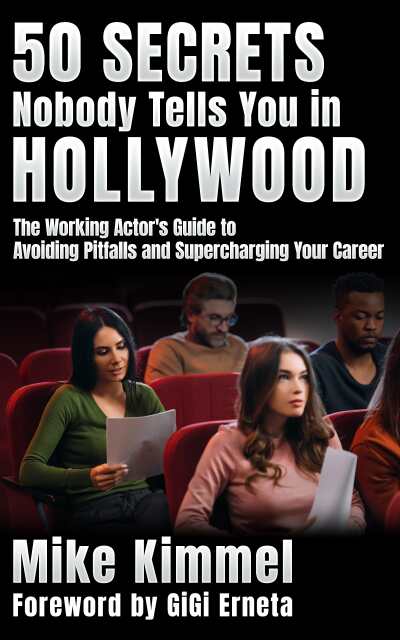
50 Secrets Nobody Tells You in Hollywood
The Working Actor’s Guide to Avoiding Pitfalls and Supercharging Your Career
Mike Kimmel
GiGi Erneta (Contributor)
Ben Rose Creative Arts (Dec 1, 2025)
Clarion Rating: 4 out of 5
In the experience-based career guide 50 Secrets Nobody Tells You in Hollywood, stories about professional actors’ successes and flubs make the industry feel approachable.
Acting coach and professional actor Mike Kimmel’s knowledgeable career guide 50 Secrets Nobody Tells You in Hollywood is for people looking to work in show business.
Encouraging but realistic about the difficulty of breaking into the Hollywood scene, this practical guidebook includes fifty chapters with distinct and actionable advice. There are thoughts on expanding the chances of advancing an acting career by being willing to travel for work; there are tips for avoiding becoming a “hanger-on” of a bigger star in an attempt to get ahead too. Emerging actors are counseled to be savvy about those who might look to take advantage and to always be on their own best behavior. Elsewhere, Kimmel advises against commingling one’s personal and professional contacts and warns against being chatty at auditions, when it’s easy to misspeak.
The prose is clear and succinct, and the tone is straightforward, as where the book reminds aspiring actors not to take it personally when passed over for a role. “Nobody cares how the actor feels,” Kimmel says. “Get back to work. Knock it out of the park again—and even stronger—on your next audition. Do even better next time.” The recommendations are supported by personal and industry anecdotes throughout. For example, Kimmel recalls how a girlfriend embarrassed him in front of his agent, teaching him not to mix business with pleasure.
Other actors in Kimmel’s orbit are also held up as examples, with stories about their successes and flubs helping make the acting world feel approachable and serving as reminders that it’s not necessary to achieve stardom to make a living in Hollywood. Household names are represented among the book’s examples too, as where the book notes that Sharon Stone started out by taking a small role in a Woody Allen movie, just what she needed to feel she was going somewhere. In addition, each chapter begins and ends with a quote from someone famous for inspiration.
Still, some of the book’s tips are quite familiar, such as “There are no small parts, only small actors.” Idiosyncratic advice also appears: The book is adamant, for instance, that actors should avoid swearing in public. Further, some of the declarative tips strike a rigid note, as with the assertion that new actors should never show skin in a role, without room made for nuance or counterarguments.
50 Secrets Nobody Tells You in Hollywood is a valuable career guide filled with experience-based recommendations for improving one’s odds of succeeding in Hollywood.
Reviewed by Carolyn Wilson-Scott
August 25, 2025
Carolyn Wilson-Scott


