

YA Author Writes Critically-Acclaimed Novel for Adults
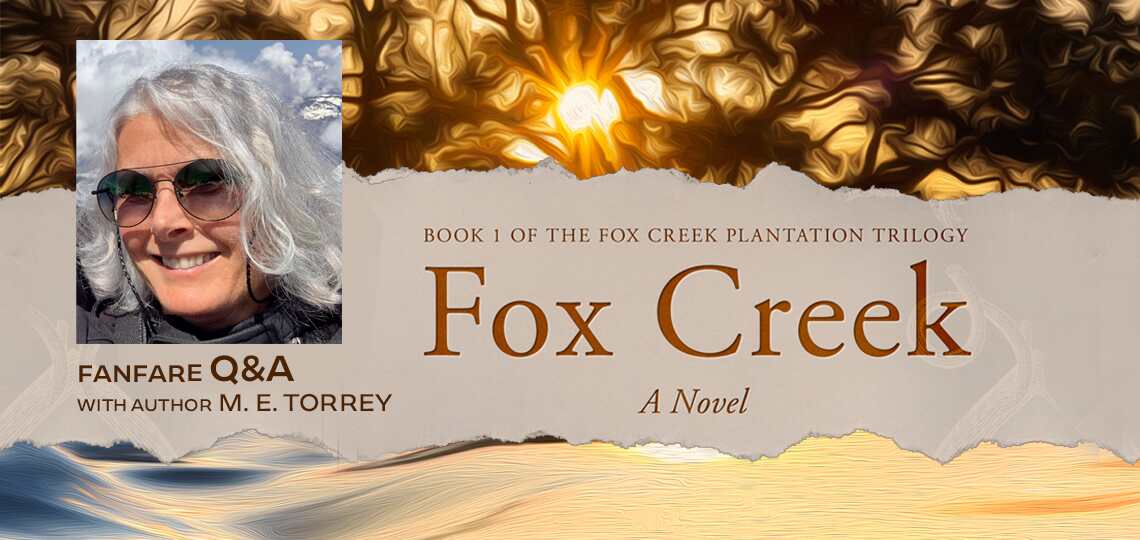
Reviewer Caroline Goldberg Igra Interviews M. E. Torrey, Author of Fox Creek: Book 1 of the Fox Creek Plantation Trilogy
It is not a stretch to say that the United States continues to suffer from a lingering sense of PTSD from centuries of slavery and the Civil War. As a society, our sensitivity to racial and political triggers stemming from that period of history serves to inspire storytellers to explore the human dynamic that existed on slave-holding plantations. Very few novelists have done it as compellingly as M. E. Torrey in Fox Creek.
We discovered M. E. when Fox Creek earned a glowing Foreword Clarion review from Caroline Goldberg Igra. The opportunity to connect reviewer and author to hear more about the series proved too irresistible to pass up.
Your exploration of antebellum life and social strata within Southern plantations suggests a deep interest in the period. Have you always been intrigued by this period of American history? What kind of research did you do for this project?
I think I always had an interest in the antebellum period from the time I started reading novels, about age ten or eleven. I remember picking up novels about plantation life and then being disappointed because they focused entirely on the white family who lived in the Big House. Slaves were far in the background, quiet shadows (or worse, caricatures) if they appeared at all. It wasn’t until around 1996 that I was able to take a trip to Louisiana to see plantations for myself.
Because I’m a born and bred Northerner, I had to research like crazy. I had to know the landscapes, the people, the language, the rhythms, until they seared my soul. This took numerous trips to Louisiana, including a week spent ensconced in the Louisiana State University archives. Overall, I did three years of research—reading diaries, autobiographies, letters, and journals of plantation owners, as well as former slaves.
Monette and Kate are very close as children, but their relationship changes as Kate grows up and realizes that they will forever be master and slave. Were you inspired by other literary explorations of societal restrictions on interaction between social classes?
I’m not sure whether Kate really doesn’t realize this in her heart of hearts. While she’s white and Monette is mixed-race, Kate still pulls Monette into her world as an equal whenever it suits her, clueless to the ramifications Monette will suffer when she abandons her duties and follows Kate. Kate doesn’t see their relationship changing, instead it is Monette who sees this widening chasm between them. Kate is called into the world of the white elite, whereas Monette sees her own world closing in like a hand around her throat. She is powerless, at the absolute bottom of the social pyramid and prey to the vagaries of human cruelty, even prey to Kate’s whims, which ultimately, have devastating effect.
I have always been drawn to books that explore social injustice. Examples of books that have helped to shape me are To Kill a Mockingbird, The Handmaid’s Tale, The Color Purple, Of Mice and Men, Wild Swans, and Angela’s Ashes. Of course, there are tons more that I’ve read, and a gazillion more on my “to read” list! So little time!
Much of the story focuses on Monette, Kate, and Breck, characters just reaching puberty and just beyond. In this way, it feels like YA. Did you consider labeling it YA instead of Historical?
I spent twenty years of my career writing for YA and middle-grade audiences for publishers such as Random House and Penguin. When the inspirational lightning bolt first struck and I knew I would write a book about the antebellum South, I knew it had to be a novel for adults. The themes were too complex and riddled with violence and trauma. There is also a lot of what I would call “silence” in the book: silence where what is not stated is nevertheless understood. What is not said becomes very powerful. Young teens, and children in particular, think in very concrete terms. Fox Creek verges on being too abstract for a YA audience.
Also, Fox Creek is the first book in the Fox Creek Plantation Trilogy, so while the characters begin as children, by the end of book three they will be well into their thirties. I began these characters as children because I was intrigued by societal norms, family structures, and childhood trauma (or the lack thereof), and how these shape an individual.
How might you have written Fox Creek differently—which themes would you have developed more, which less, what stylistic changes might you have made in the writing—if you had opted to make it fit into the YA category?
If I had written Fox Creek for a YA audience I would have had to significantly tone down the violence, trauma, sexual assault, pre-Civil War politics, and more. I also would not have used adult characters as view-point narrators, such as William, Sarah, Mammy Hester, and Mehitable, which would have been, in my opinion, a huge loss to the story. These adult characters ground the book in the history of the land, their understanding of society and duty, the political landscape, and so much more. (For me, it would be like cutting off my arm to vanquish their voices!)
To be honest, all I feel when I answer this question is loss, which means that Fox Creek is not, nor was it ever, meant to be written for a YA audience. However, if I had chosen to write it for YA, in all likelihood, I would have written the entire novel through Monette’s point-of-view. To give you an example, I wrote a thematically similar book for YA titled Voyage of Midnight, published by Knopf Books for Young Readers (2011), which Kirkus Reviews called, “intense and harrowing.” In it, a young orphan, Philip, finds a long-lost uncle who takes him on a voyage aboard a slaving ship. The story is told exclusively through Philip’s eyes as we follow him on his journey from naïveté to horror to abolitionist.
Fox Creek Plantation is described in vivid, rich detail, bringing it to life for the reader. It felt like a place you had visited and researched. Was it based on an actual plantation, or is it an amalgam of several?
The “Big House” in Fox Creek was based on Highland Plantation in West Feliciana, Louisiana, which had been home to the Barrow family. Bennett Barrow, master of Highland, wrote a plantation journal which became very useful to me regarding his character and the intricacies of everyday life and plantation management.
The plantation complex itself was an amalgam: a barn from here, a stable from there, (I have photos of all the structures) orchards, cemetery, playhouse, slave cabins, cooperage, blacksmith shop … I created a map of the plantation complex, included all the buildings that I wanted, and then dropped the entire plantation (3000+ acres) into a likely spot in West Feliciana not too far from a fictional town called, St. Marysville. I just love making things up.
The story highlights the very different experience of the women on the plantation from that of the men—Sarah from William, Kate from Breck. The expectations from the different genders weigh heavily. Have you explored gender themes and disparities in other pieces of writing?
Actually, Fox Creek is the first novel in which I explore gender themes. (My previous books for children were hard-hitting adventures for boys, as I had three sons and that was where my mind was at the time. My books for younger readers present boys and girls as equal partners as they run a business and science lab together.) Yet, while I haven’t explored gender themes previous to Fox Creek, gender themes are nevertheless important to me. Over forty years ago, at the tender age of twenty three, I found myself divorced with three young sons. I left my marriage because I was made to feel “less than”. Yet I could feel, deep down, the potential of my life. It was then that I began a journey of self-discovery. Part of that discovery was questioning what it means to be female in a society built by and for men. Specifically, white men. I began watching, listening, and noticing the disparities between genders.
In Fox Creek, Sarah, as plantation mistress, must follow the dictates of her society. She must be genteel, well-spoken, a woman of letters, concerned with the matters of the everyday, not “manly” matters such as politics or sport. Fortunately for Sarah, she’s well-suited for her gender role. She naturally eschews politics as it makes her uncomfortable. She’s a terrible horsewoman. She happily buries herself in her gardens, concerns herself with domestic duties, and writes in her manuscript about etiquette for young ladies. For her, in her time and station, she is both jailer and jailed. She holds the key to her freedom but has no desire to put the key in the lock.
It is another matter with Kate, however. As Sarah’s daughter, Kate receives plenty of instruction regarding the expected behavior of young ladies. But Kate’s personality is more like her father’s: headstrong, demanding, impulsive, passionate… . To ask someone like Kate to mind her manners (while her brother Breck can do as he pleases), is like asking an eagle to trim its wings to the size of a sparrow’s. If Kate were alive today, she’d be a CEO. She’d be the boss. But at Fox Creek Plantation, her personality, desires, and passions—which could be so powerful today—are smothered in lace, modesty, and obedience. I feel her pain.
The novel features many stories of typical, positive childhood experiences, but does not hold back when making clear the horrific treatment of masters over slaves, including violent scenes. The focus on the horrific injustices of antebellum society suggest a clear agenda. Do you have a special interest in social injustice as it pertains to history or also, contemporary times?
As I stated previously, I have always been drawn to issues of social justice. Books like To Kill a Mockingbird, which I read in the sixth grade, spoke deeply to me. I was a child of the 1960s. I remember the assassinations of JFK, MLK Jr, and RFK. I remember the massacre at Kent State—the killing of unarmed protesters by the National Guard. These images deeply troubled me. My father helped me and my siblings by explaining Jim Crow laws, prejudice, government overreach, and human rights. So, I grew from that milieu into a person who does not look away from injustice, rather, I look straight at it and ask, why does it have to be so? What can I do to help heal our world?
Writing Fox Creek is one act I can do to help heal our world. Books 2 and 3 will further that agenda—the agenda of healing our collective wounds. In looking with clear eyes at our past, we can connect the dots with today’s racial injustices. We can start to understand systemic racism and perhaps how we have personally benefitted, or conversely, been marginalized. It takes courage to look. I choose to have courage.
Another act I do is I co-founded a charity, Orphans Africa, in 2007. We all work as volunteers, building boarding schools for orphans in Tanzania. There are scads of orphans due to AIDS, malaria, TB, and being just too poor to stay alive. We take in children between the ages of two and twenty-two, providing them with a place to live and quality education. In the years that we’ve been operating, we’ve educated thousands of children, many of whom have gone on to become doctors, teachers, entrepreneurs, nurses, lawyers, mechanics, tailors, and more. We’re very proud of what we do.
I believe that, as a citizen of the world, it is incumbent upon me to do my part to help heal the world. To act with kindness. To listen to what others have to say. It is my hope that Fox Creek becomes part of the larger discussion of humanity’s story.
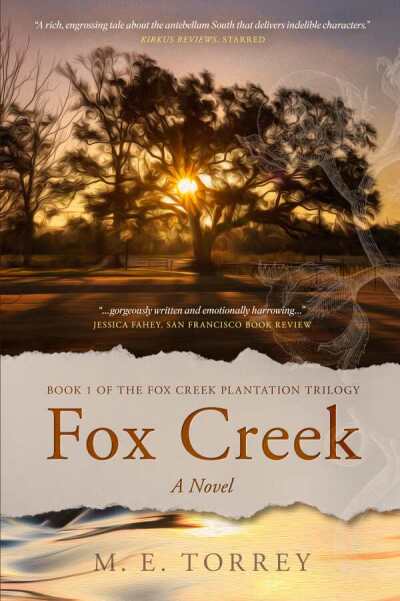
Fox Creek
A Novel
M. E. Torrey
Sly Fox Publishing (Sep 1, 2025)
Clarion Rating: 4 out of 5
An expansive novel with a varied cast, Fox Creek is about plantation life in the South.
In M. E. Torrey’s riveting historical novel Fox Creek, Black and white people on a plantation experience and enact racial prejudice and injustice during the tempestuous antebellum period.
Monette, the daughter of a Black mother and a white father, is a child when she’s taken away from one plantation and sold to the Fox Creek plantation near New Orleans. She is befriended by Kate, the plantation owner’s daughter. As the girls mature, each is forced to assume her “proper” role as enslaver or enslaved; their relationship is challenged.
Kate’s grandmother, Mehitable, is determined to make sure Monette “knows her place,” accusing her of “eating and drinking” like she owns the place and hitting her with her cane. Meanwhile, Kate’s brother, Breck, teaches Monette and another enslaved person, Footy, to read even though it is illegal. All the while, Monette’s dreams are haunted by her past. Further, an unlikely romance between Monette and Breck threatens any chance for peace on the plantation; ultimately, this development adds little to the central storyline.
The broad cast also includes the plantation owner, William, who struggles with the responsibility of maintaining the plantation; his wife Sara, who has a complicated pregnancy and resents her overbearing mother-in-law; and Cyrus, a young enslaved man who arrived at Fox Creek with Monette and who looks out for her throughout the story. The narrative shifts between their perspectives to present many aspects of life on the plantation.
Explorations of relationships between men and women, between Black and white people, and between parents and children come via conversations and intimate situations too, with people fleshed out best in connection to one another. For example, Kate and Monette play together early on in the novel. Later, when Kate becomes romantically interested in someone, she leaves behind her life as Monette’s friend. Meanwhile, William is frustrated by Breck’s “weakness” in regard to the enslaved, and Monette is marginalized among other enslaved people because of her “yellow” skin tone and the privileges it carries.
While New Orleans and areas beyond the plantation are described in fluid but adjective-heavy prose, resulting in some period color, the bulk of the narrative is focused on the Fox Creek plantation as a microcosm of antebellum life in Louisiana. Relationships change as the story continues, resulting in surprises as the book moves toward its intriguing conclusion.
A rich historical novel, Fox Creek is about the challenges, considerations, and concerns of enslaved people and plantation owners in the antebellum South.
Reviewed by Caroline Goldberg Igra
May 6, 2025
Caroline Goldberg Igra


