
Shining a light on toxic bosses: An interview with the author of "I Wish I’d Quit Sooner"
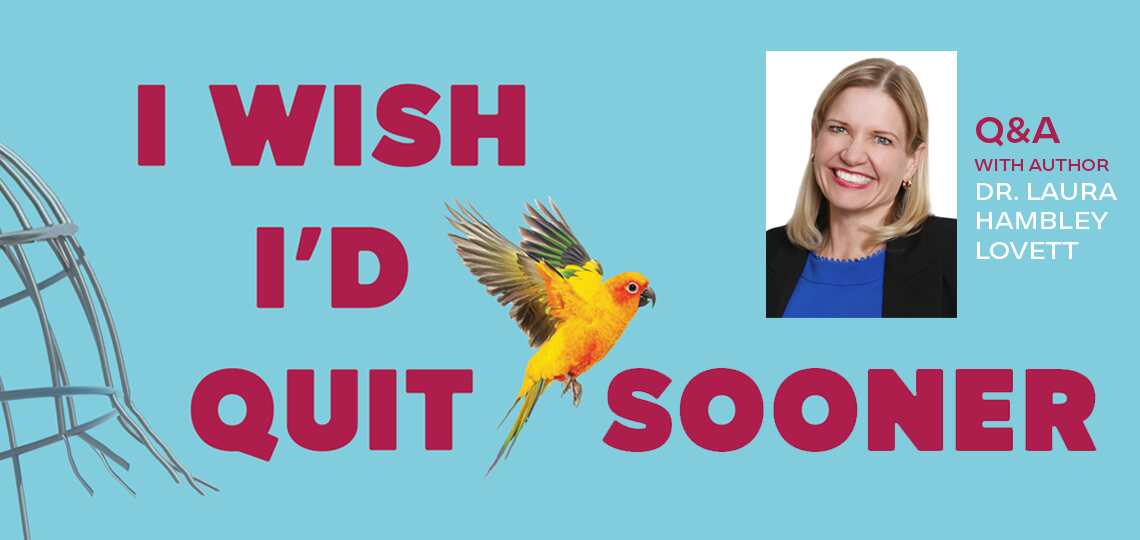
An Interview with Dr. Laura Hambley Lovett, Author of I Wish I’d Quit Sooner: Practical Strategies for Navigating and Escaping a Toxic Boss
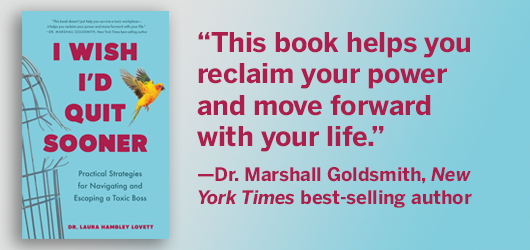
Dr. Laura Lovett is with us today to talk about the most egregious type of business leader: the toxic boss—one whose narcissism, lack of empathy, and downright cruelty can do lasting psychological damage to their employees. In her recently released I Wish I’d Quit Sooner, Dr. Laura charts a path to better times for those traumatized workers. She leans on twenty-five years of experience in organizational psychology to help readers identify the eight different personas of toxic leadership and offers six potential options to get out of these traumatic situations.
Fresh off a careful read of the powerful book, Foreword’s Executive Editor, Matt Sutherland, connected with Dr. Laura for an engaging conversation.
At the end of the day: work is work. Does anyone really love everything about their job? With that pessimistic thought, can you give us a healthy sense of realistic expectations about work?
Like anything in life, jobs have good and bad days. It is possible to love a lot of aspects of your work, but very rare to love everything! I’ve spent my career helping people find careers that are fulfilling and use their talents—a goal that is within everyone’s reach.
What led you to write this book? How has your psychology background helped you understand both sides of the bad boss-victimized employee relationship?
I’ve worked with employees and leaders for over twenty-five years in my field of organizational psychology, and I’ve seen and heard far too many toxic boss situations. In the past few years, I noticed an increase in these cases with my clients and across our team of psychologists and felt that I needed to research what toxic leadership was all about. As an adjunct professor I supervise university students and we embarked on interviews and surveys with “toxic boss survivors” across North America. These are not just bad bosses, but truly toxic ones whose ongoing behaviors harm people’s well-being, engagement, and productivity. My psychology and research background allowed me to dive deep, bring in real-world evidence and stories, and layer in my twenty-five years of experience as a workplace psychologist.
Early in the book, you seek to allay some lingering doubts in the minds of readers by offering these words of wisdom: a) it is not your fault you ended up with a toxic boss, and b) you will take away important lessons and growth from this terrible experience. Why do you feel it’s important for victims to find a silver lining? Are there a certain number of stages—like the five stages of grief: denial, anger, bargaining, depression, and acceptance—needed to move through before actually doing something about a toxic boss?
Like any form of trauma (and toxic bosses do lead to trauma), there are both psychological and physical impacts which need to be processed. The stages of grief can apply, but I view it more as the many impacts of a toxic boss (physical, emotional, psychological) and especially rebuilding confidence, which I help the reader to understand. Finding a silver lining in terms of the learnings and how you have grown through the experience is difficult at first, but over time is an important part of healing for toxic boss survivors.
Help us understand what motivates a toxic boss. Are they aware of the damage they do and that their behavior adversely affects the success of their company?
No, a toxic boss is not insightful about nor open to feedback on their behaviors. They don’t see themselves as toxic and instead find fault with those they are harming. In my research, I had an aha moment about the differences between a difficult and a toxic boss. Difficult bosses can change and grow as leaders, but a truly toxic boss is not typically able to change and should not be in a people leadership role.
What are some of the specific health concerns for employees who work for a toxic boss?
I look at health as physical and emotional/psychological. In the book, I explore many impacts on both based on real toxic boss survivors and research. Impacts include cardiovascular health (e.g., high BP), gut issues (e.g., ulcers), anxiety, depression, burnout, sleep issues, and so on. People get impacted in different ways, but the book shines a light on the range of impacts a person may be facing.
In the book, you periodically offer Dr. Laura’s Coaching Breaks. How should readers use these pauses in the book?
As I’ve coached many clients post-toxic boss, I’ve come to learn the types of questions and insights that can help them. The coaching breaks help people to better understand themselves and observe their situations a little more deeply. With the audiobook, I include a forty-nine-page workbook that has all the checklists and activities so those who listen to the book can equally benefit.
It’s fascinating to read your list and descriptions of The 8 Toxic Boss Personas: 1. The Self-Serving Egomaniac, 2. The Control Freak, 3. The Dishonest Manipulator, 4. The Great Divider, 5. The Unethical Corruptor, 6. The Abusive A-Hole, 7. Disordered Personalities: The Narcissist and Sociopath, 8. The Gaslighter. No doubt, every reader will hone in on a couple of these personas when thinking of their toxic boss. So, in your estimation, what percentage of bosses are toxic? Or, more importantly, what percentage of employees may have a toxic boss? Why is it helpful to label a boss’s behavior and what should readers do with the knowledge?
I enjoyed the creative process of naming these, as well as analyzing the hundreds of examples that led to them. By naming what behaviors one is experiencing, they are more empowered to move forward and get back into the driver’s seat of their career. Most toxic bosses have several of these personas. Readers feel better understood and supported by knowing they are not alone in these experiences.
Assessing the percentage of toxic bosses out there is tricky as they do not identify as such nor do organizations track this. Based on my research with survivors and my practical experience I’d say 5–10 percent are toxic (which is way too many!) Likewise, truly great leaders are only about 5 percent. Many leaders are difficult, average, or good—workplaces clearly need to hire, promote, and develop more effective leaders and eradicate toxic ones!
There’s a famous expression about the best way to gain wisdom from someone you revere: Don’t study the life of the master, study the life of the master’s master. Which begs the question, is the reverse true? Do we need to look at the former bosses of toxic bosses in order to understand why they thought it was okay to manage their company in such a destructive way?
Great question—yes, the boss’s current and former bosses play an important role. They role model leadership behavior, for better or worse. One way that toxic bosses develop their destructive behaviors is through learning from others. Yet their behavior also stems from unhealed trauma in their own past. They navigate their “leadership” with a massive ego and a lack of empathy. I call them bosses, not leaders, as a true leader brings out the best in their people. When I talk about how organizations must deal with this issue, it starts with the toxic boss’s boss being curious, caring, and courageous when it comes to dealing with toxicity in their span of leadership.
You cite an international survey of the career regrets of one-thousand employees: nearly 60 percent regretted that they stayed in a job too long. And then you state unequivocally: bad bosses rarely change, so get out as soon as you reasonably can. Why do so many of us—foolishly and doggedly—hold out hope that our boss will change?
We hold on often because of fear—fear that we won’t be able to find another job, or make as much money. Many are tied in financially and can’t easily leave. Some will work harder to try and impress their toxic boss, yet the behaviors get worse over time. Many of my research participants, when asked what advice they’d give to readers, said that they “wish they’d quit sooner”—hence, the title of my book.
In chapter 3, you identify six potential steps available to anyone working under a toxic boss, including number six: just quitting. Having six options may surprise a lot of readers who might be so beleaguered and discouraged that they don’t realize there are many paths forward. But taking the first step is what’s important. What’s your message to someone who’s finally ready to do something?
Knowing there are six options empowers people and gives them hope. The first step is awareness of what you’re experiencing and that you have choices. Creating a winning exit plan is such a critical step that I have a whole chapter on that. Setting a GR—good riddance—date is psychologically powerful to help people navigate their way forward. There is a light at the end of the toxic boss tunnel!
And then, there’s always the possibility that your boss will take those six options out of your hands and fire you. Which, as you say in the book, might be a godsend—albeit, shocking at the time. Why isn’t being fired the end of the world?
I’ve worked with hundreds of people who have been fired, and in the majority of cases they look back on it grateful it happened, as they were unhappy and are now in a better place. Processing the shock and betrayal is tough, but it’s even tougher reporting to a toxic boss longer-term.
You stress self-care in the period directly after leaving a brutal work experience, when many people might feel desperate to find a new job. What does self care look like?
Self-care is critical as a toxic boss depletes our energy. Building resilience is key to being able to show up with energy and confidence in the job search. I’ve seen so many people with their confidence destroyed from a toxic boss, and have helped them rebuild it, which takes time. My book gets at ways a person can do this, including crafting a personal wellness plan.
Any other final thoughts that we didn’t get a chance to cover?
That my book is not only meant for those who have experienced a toxic boss, but also for human resources (HR) leaders, business owners/leaders, coaches, and therapists helping others navigate these challenging situations. The more people can gain awareness of this issue, and have conversations about its impacts, the better we can tackle it as a society. Let’s #stoptoxicbosses
Are you working on another writing project? What does the future—at least, the one you control—hold for Dr. Laura?
Not yet, but I will. I love writing both fiction (i.e., my psychological thrillers currently being pitched for movies: Losing Cadence and Finding Sophie), and non-fiction. I have ideas brewing and need to make space for my next project, but for 2026, I will focus on getting I Wish I’d Quit Sooner to reach and help as many people around the world as possible.
Matt Sutherland


